
The 80-meter tower and a few modest sheds situated on the cliffs of Tasmania’s remote north-western coastline may appear ordinary at first glance. However, this site has played a crucial role in providing evidence that humanity is significantly impacting the planet’s climate. The Kennaook/Cape Grim Air Quality Testing Station, managed by a dedicated group of scientists, has also demonstrated that collective global efforts can lead to meaningful change. As it celebrates its 50th anniversary, this facility, which has been monitoring air quality for half a century, is arguably more vital than ever.
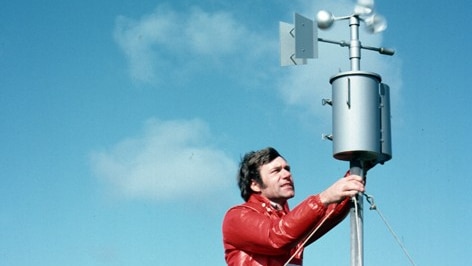
Graeme Pearman, a former CSIRO scientist, was among the early team members who helped establish what has become one of the world’s most significant stations for observing human-induced atmospheric changes. The initial setup was far from glamorous, with equipment housed in an old NASA caravan previously utilized during the Apollo missions.
Dr. Pearman’s journey to this clifftop location began in the early 1970s when he was tasked with measuring carbon dioxide (CO2) levels above a wheat field in a different project. He found that the CO2 concentrations he recorded were strikingly similar to those documented by Charles David Keeling, who was measuring CO2 levels in Hawaii. This raised questions for Dr. Pearman, given the differing environments of the two hemispheres.
“We were puzzled as to why two such disparate hemispheres—one predominantly oceanic and the other largely land-based, one densely populated and the other much less so—would exhibit comparable concentration levels,” he noted. However, over the course of the next year, through aerial observation initiatives, he confirmed that his findings were accurate, aligning with Dr. Keeling’s concerns that CO2 levels were escalating globally, primarily due to fossil fuel consumption.
“I found it hard to believe that human activity could so profoundly disrupt nature,” he remarked.
In the following three years, plans were set in motion to create a permanent Australian background observing station, which would be jointly operated by the Bureau of Meteorology and CSIRO, now recognized as Kennaook/Cape Grim.
The station continuously draws air from the surrounding coastline through inlets, including one positioned 80 meters up a tower, conducting real-time analyses. The air it captures is representative of a much larger context, which is why this site is counted among only three “premier” global monitoring stations.
With strong westerly winds from the Southern Ocean, aptly termed the “roaring forties,” the station is ideally situated to receive air that has traveled vast distances without encountering land, making it some of the cleanest air on the planet.
For researchers, the data collected here is invaluable. CSIRO scientist Melita Keywood, who oversees the aerosols and reactive gases program at Cape Grim, explained that the measurements obtained at this location reflect the true global atmospheric background, free from local contamination. “When we detect a shift in the clean air we analyze at Cape Grim, it indicates a significant global change has occurred. This is what makes Cape Grim particularly important,” Dr. Keywood stated, emphasizing the implications of their findings on public health and ecosystem wellbeing.
Every season, air samples are carefully collected and stored in an air archive located in Melbourne, the oldest of its kind in the world, allowing researchers to revisit historical air quality data for gases that have not been previously analyzed. Recently, the collection has been expanded with donated scuba tanks, enabling a deeper historical perspective.
Over the past 50 years, one of the most significant trends observed at the site has been the rising levels of the greenhouse gas CO2. Following the earlier measurements by Dr. Keeling in Hawaii, CO2 levels, which were around 330 parts per million in 1976, have now surpassed 420. This surge is alarming on its own. Yet, when compared to ice core data extending back hundreds of thousands of years, the magnitude of this change is staggering.
Dr. Pearman pointed out, “This dramatic alteration in atmospheric composition has occurred within a span of less than a century, a change unprecedented in the last million years.”
In addition to greenhouse gases, Cape Grim has also tracked the levels of chlorofluorocarbons (CFCs), substances linked to the depletion of the ozone layer over Antarctica. Following the station’s establishment, CFC levels surged in the late 1970s and 1980s due to widespread usage in various products. However, after the 1990s Montreal Protocol was enacted to phase out these ozone-depleting chemicals, CFC levels began to decline.
While British scientists identified the ozone “hole” over Antarctica in 1985, Cape Grim’s extensive records played a crucial role in confirming the causes of this phenomenon and monitoring the recovery process. CSIRO scientist Paul Krummel, who oversees the greenhouse gas and ozone-depleting substances program, noted that the station’s data even aided in detecting illegal CFC emissions from China during the 2010s. “We noticed that CFC-11 was not decreasing at the expected rate, which prompted us to trace it back to illegal production in eastern China,” Dr. Krummel explained.
This realization led to international scrutiny and efforts to curb illegal manufacturing. The recovery of the ozone layer is now regarded as one of the most effective global environmental initiatives, illustrating the power of coordinated action.