
The Navajo Nation, known as Diné, meaning “the people,” stands as the largest Native American reservation in the United States, covering an area of 27,000 square miles across New Mexico, Arizona, and Utah. The Navajo community demonstrates remarkable resilience in the face of a shifting cultural environment and numerous threats to their traditions.
In spite of significant obstacles such as poor housing conditions, unreliable infrastructure, and limited access to technology, both elders and young people are dedicated to safeguarding their vibrant cultural heritage and identity.
A Native American dancer, adorned in traditional attire, heads towards a performance venue in Winslow, Arizona. Throughout November, various public events and performances are held to honor Native American culture.
The impact of colonialism has deeply affected Navajo culture, particularly through the forced assimilation of children in boarding schools, which led to severe cultural suppression.
Virginia Brown, a 69-year-old elder, shares her painful memories: “I was sent to a boarding school at the age of six. Our long hair was cut off, and if we spoke in Navajo, we were punished with soap.” This resulted in a significant gap in the transmission of traditional knowledge and language, which the Navajo are striving to reclaim.
Virginia Brown prepares traditional fry bread in her kitchen.
Even though Navajo is one of the most commonly spoken Native American languages, the number of fluent speakers has seen a decline. UNESCO now categorizes it as a “vulnerable” language, following a 3.4% reduction in speakers in recent years.
In response, educational institutions, including Holbrook High School nearby, have initiated programs to teach the language and cultural practices to help preserve their heritage.
Many in the younger generation perceive a decline in their cultural practices. At a local skate park in Tuba City, young children skate while gathering around their smartphones.
“I think our culture is diminishing,” says 14-year-old Victoria. “Kids my age are getting lost in social media and show little interest in our culture. It frustrates me a lot.” Some attribute this shift to the overwhelming influence of mainstream media, which often overshadows traditional values as many young individuals gravitate towards dominant cultural narratives instead of ancestral customs.
However, numerous individuals actively engage in preserving their heritage by practicing traditional crafts passed down from their elders.
Drake Mace, a shepherd and weaver, looks after his sheep at his home in Whitehorse, New Mexico, in November 2025.
Drake Mace creates rugs using a vertical loom at his residence.
“When I am with my sheep, I feel closest to my grandmother,” states 40-year-old Drake Mace. He tends to Navajo-Churro sheep and utilizes their wool to craft intricate rugs employing the traditional weaving techniques learned from his grandmother.
Approximately 30% of households within the Navajo Nation do not have access to running water, which necessitates that residents spend considerable time transporting water from public sources. Consequently, some families are relocating to urban areas, leaving behind ancestral lands that have been part of their family for generations.
Others, like 48-year-old Tara Seaton, successfully balance life on the reservation while working from home. She integrates her traditional lifestyle with modern technology, being employed by Texas State University and paying $140 monthly for Starlink internet.
Feral horses roam the Navajo Nation, which hold significant cultural importance for Native Americans but also pose challenges to the land, water sources, traditional foods, and wildlife.
Describing her lifestyle, Tara Seaton explains, “I identify as a traditional Navajo. I ride my horses and strive to remain true to my culture. I wouldn’t have what I have without my cultural roots. Working from home gives me the best of both worlds while allowing me to stay here.”
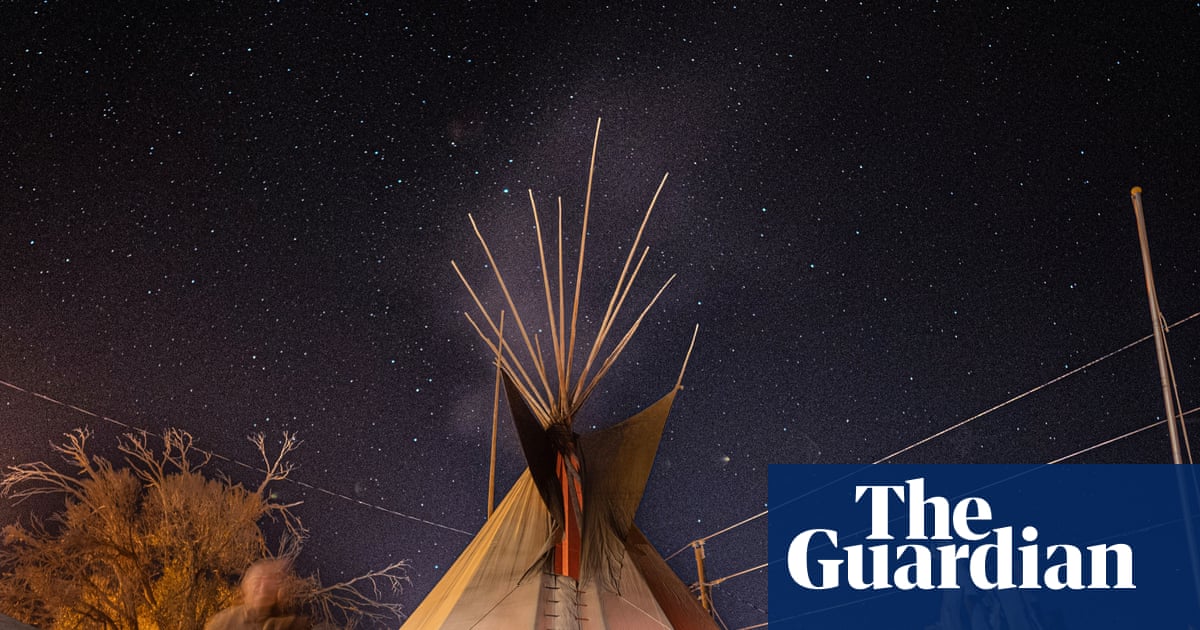
In Navajo culture, sacred ceremonies are essential for restoring harmony, known as Hózhó. These ceremonies are often conducted in a hogan or a tipi.
A tipi is prepared for a peyote ceremony in a residence in Window Rock, Arizona.
A man attends to the fire during a peyote ceremony held in a tipi located in Window Rock, the capital of the Navajo Nation.
Jonus Yazzie, 70, has arranged his tipi in Window Rock for a peyote meeting, an all-night spiritual and healing ceremony involving the hallucinogenic peyote cactus as a sacred sacrament for connecting with the Great Spirit.
Jonus was invited by one of his nephews to facilitate this meeting to assist him during a tough period in his life.
Another nephew, Tom, 53, gestures toward the gently burning oak wood fire at the center of the gathering.
Emmet collects water from a community well. Approximately 30-40% of the residents in the Navajo Nation lack running water, compelling them to collect water from public taps, community wells, or nearby towns.
“This is part of our way of life and what we learned,” Tom states. When asked about the perceived decline of their culture, he responds, “In the past, people lived differently. Our traditional values have evolved. We are continually adapting and changing, but we are still here.”
Native American dance groups like the Diné Tah Navajo dance troupe work diligently to preserve cultural practices, presenting dynamic performances to schools and at public events.
Shawn Rice, the leader of the troupe, underscores the therapeutic aspect of their dancing, which helps reconnect younger generations with their heritage.
Members of the Diné Tah dance troupe perform in front of students at Newcomb High School in the Navajo Nation.