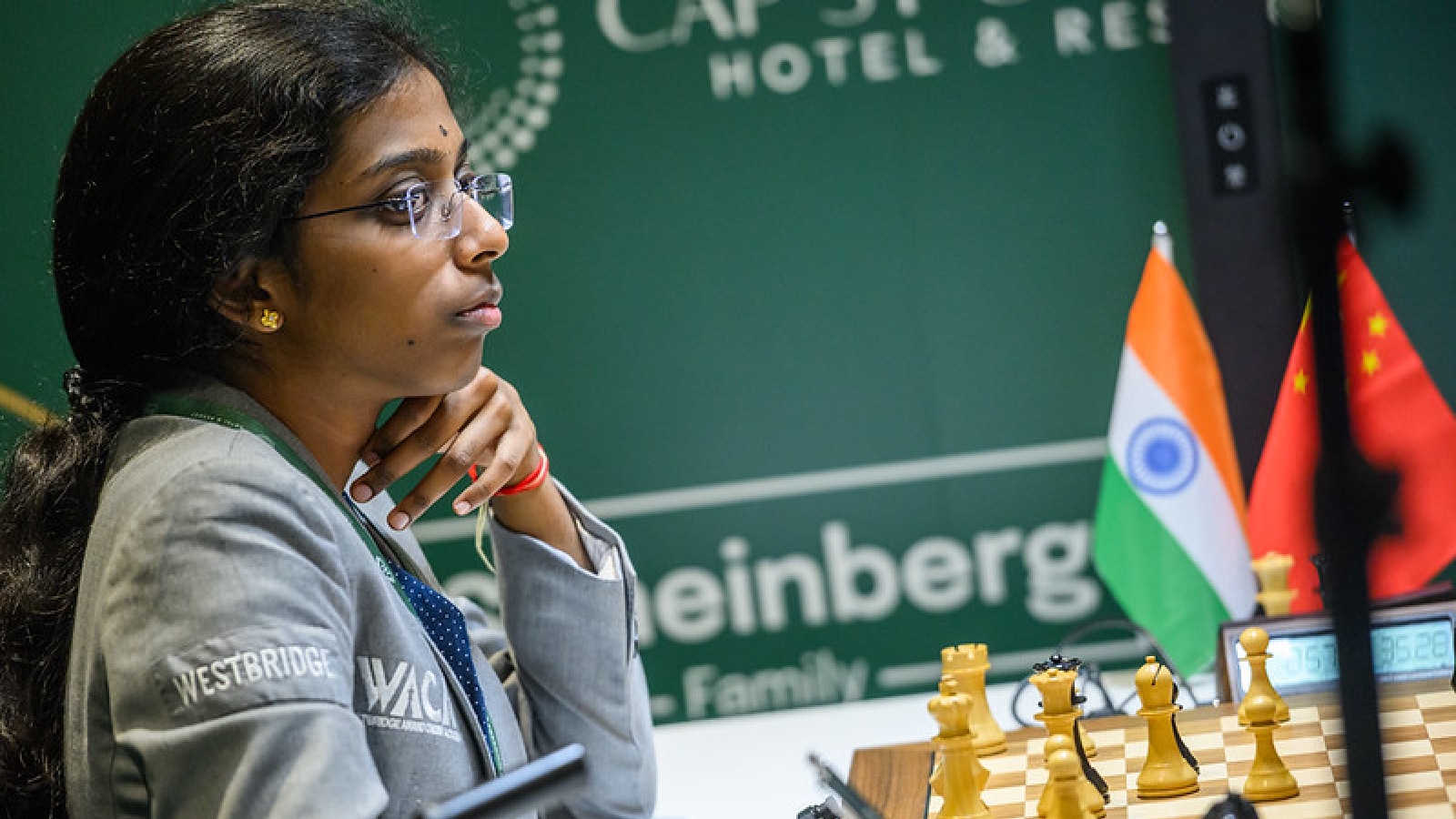

Indian Grandmaster R Vaishali has faced criticism regarding her ability to manage time constraints during matches, especially when the clock is ticking down. Observers note that her gameplay tends to diminish under such pressure, leading to suboptimal decisions. This reputation has persisted, and during her seventh-round match against China’s Tan Zhongyi at the Women’s Candidates Tournament 2026 in Cyprus on Sunday, it seemed to be playing out once again.
With only three seconds left on her clock, Vaishali proposed a queen exchange on move 26. This was a precarious moment, as three seconds offers insufficient time for meaningful calculations—just enough to grasp for a potential escape.
In contrast, Tan had an ample thirty-seven minutes and forty-two seconds to contemplate her next move. The position favored her significantly at +3, a solid winning advantage that typically translates into victory. This situation was not characterized by sharp tactics but rather a gradual positional decline for Vaishali, who was at the mercy of Tan’s strategic control.
After a pause, Tan took nearly twenty minutes to respond, ultimately making a less-than-optimal move. While it wasn’t a blunder, it was just inaccurate enough to allow Vaishali a reprieve. Miraculously, she found herself back in the game.
As the match progressed, Vaishali’s demeanor shifted noticeably. Her hand hovered over her mouth, and her eyes darted around the board and the room, accompanied by deep breaths. She adjusted her glasses in a seemingly instinctive manner, struggling to maintain her composure.
Meanwhile, Tan’s expression shifted dramatically. A look of disappointment washed over her as she placed her hand on her head, recognizing her error in real-time. This lapse was not due to time pressure or the complexity of the position but stemmed from her own oversight, which ultimately favored Vaishali.
Tan’s rook move to a1 opened the door for Vaishali, who seized the moment by sacrificing her rook to capture Tan’s dark-squared bishop, thus gaining an extra bishop in a winning endgame. Vaishali capitalized on her fortune and secured her second consecutive victory, extending the match to 51 moves before Tan conceded defeat.
This match encapsulates the dynamics of the tournament, as Vaishali, who had been struggling just two rounds prior, has now closed the gap to half a point behind the leading player, Ukraine’s Anna Muzychuk. Muzychuk, a last-minute replacement for India’s Koneru Humpy, drew her match against Kazakhstan’s Bibisara Assaubayeva, while Zhu Jiner faced Aleksandra Goryachkina in another decisive game.
In the Open event, R Praggnanandhaa was under pressure to catch up with Uzbek prodigy Javokhir Sindarov. Facing the highly experienced American Fabiano Caruana in the seventh round, Praggnanandhaa, playing white in the Slav Defense, made a bold knight sacrifice to seize the initiative.
When Caruana captured the knight on e5, he likely expected a straightforward piece exchange. However, Praggnanandhaa castled kingside, allowing Caruana to retain the material advantage. Instead, the Indian player aimed for a queen trade, planning to regain his piece shortly thereafter, a strategy he executed with precision.
However, this ambitious plan resulted in Praggnanandhaa falling nearly an hour behind on the clock. Against a player of Caruana’s caliber, who was also trying to reduce the gap with Sindarov, the position did not present any significant threats. Despite taking risks, Praggnanandhaa could not break through, and the game concluded in a threefold repetition after 38 moves.
Anish Giri displayed an impressive defensive performance against the tournament leader, Sindarov. At the 40-move mark, Giri was down over an hour on the clock yet managed to hold his ground against the formidable Uzbek player.
In the Queen’s Gambit Declined, Giri maintained control throughout the lengthy struggle, which lasted 85 moves and ended in a draw after both players exchanged all their pieces, resulting in a lack of material for checkmate.
Sindarov’s impressive streak of four consecutive victories against notable opponents, including Praggnanandhaa and Caruana, was finally halted with this draw. Meanwhile, China’s Wei Yi rebounded from earlier setbacks to secure his first win of the tournament, defeating Russia’s Andrey Esipenko, who suffered his third loss.
As the tournament reaches its midpoint, Sindarov leads with 6.0/7, holding a comfortable 1.5-point advantage over Caruana and a two-point lead over both Praggnanandhaa and Giri.