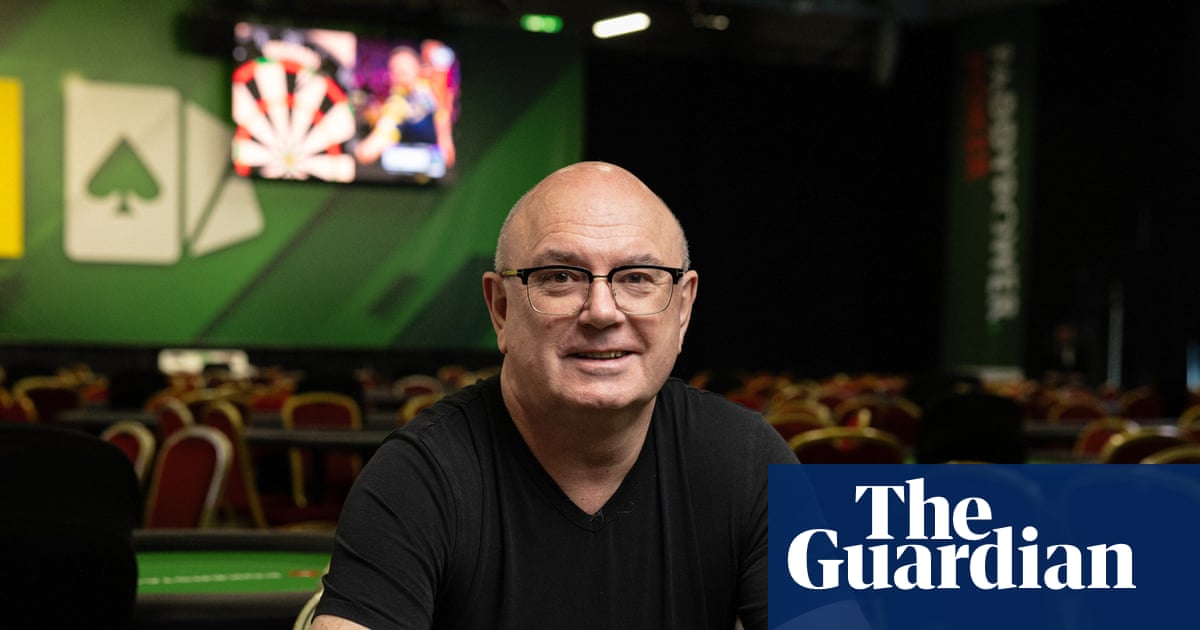

Gary Fisher has long had a passion for poker, but it wasn’t until he reached the age of 60 that his partner encouraged him to pursue it more seriously. “She pointed out, ‘You have a talent for it, but you don’t invest time in studying. You simply show up to play,’” Fisher recalls. While this advice surprised him, he took it to heart, dedicating time to learn the game through research, online courses, and coaching, ultimately transitioning into professional play.
This year alone, Fisher, a London resident, has participated in tournaments across several cities, including Cyprus, Marrakech, Amsterdam, Tallinn, and Paris. He pays his entry fees and has earned a remarkable $200,000 (£150,000) in winnings. “I’ve had an excellent start,” he shares during a video call from his hotel in Dublin, where he is competing in the Irish Open, with plans to head to Melbourne next.
Reflecting on his career path, Fisher muses, “You don’t often experience such highs in a regular job … It’s surprising my career advisor in school didn’t suggest that I could become a professional poker player in my sixties.” (Instead, he was encouraged to pursue mechanical engineering.)
While on the tournament circuit, Fisher prioritizes his health by maintaining a balanced diet, avoiding alcohol, ensuring quality sleep, working out, and consuming hydration salts during extended matches. The intensity of play can be demanding, sometimes requiring up to 12 hours a day over several weeks. “Every single hour presents tough decisions, and there’s no opportunity to relax,” he notes.
His attire consists of a plain black T-shirt, and he opts not to wear sunglasses or hats, stating, “I prefer to be transparent with my expressions. I want to convey exactly what I intend.” He also conducts thorough research on his opponents at the table, allowing him to approach each hand with strategic assumptions about how to play against everyone. To date, his total poker earnings have reached $1.1 million, ranking him 755th globally and placing him among the top 40 players in the UK. “I meticulously track every tournament to understand my average hourly earnings and return on investment,” he explains.
However, for Fisher, the pursuit is not solely financial. “I believe elite golfers aspire to be the best in the world. The dollar amounts reflect their ranking, but the true motivation lies beyond just the money – it’s about being acknowledged as a top player. The same applies to me in poker … I appreciate when people approach me and say, ‘You performed well in Tallinn. Congratulations.’ (He secured third place.) “I aim to be recognized among the elite.”
Growing up in Kingston upon Thames, southwest London, Fisher fondly remembers playing board games with his mother, though he struggled with card games. “I wouldn’t classify poker merely as a card game,” he asserts. “It encompasses mathematical reasoning, psychological insight, logical evaluation, and pattern recognition.”
Fisher’s affinity for mathematics led him to study physics at university, and his first professional role was as a software engineer. He valued physics for its ability to distill complex concepts, such as the universe, into elegant mathematical frameworks that could be easily communicated. “In many ways, I still engage in that process: simplifying the intricate dynamics of nine players engaged in game theory – a complex mathematical concept – into manageable strategies that I can apply. That’s the aspect of poker that truly fascinates me,” he states.
After earning an MBA at the age of 31, Fisher worked in business strategy at IBM, transitioned to management consulting, and later established his own technology firm in his early fifties.
Now, he is not seeking consultancy opportunities, as he views himself as being at the beginning of his poker journey. “There’s so much more I want to accomplish. A major title is on my radar, and honestly, I aspire for a million-dollar win,” he reveals.
His new professional path has instilled in him the virtues of “patience and discipline,” qualities he admits he previously lacked. “I’ve often been impatient in life, eager to accelerate progress, which has led to lapses in discipline.” He acknowledges that this trait has contributed to “some missteps in work and relationships.”
Now, during challenging moments at the poker table when his chips are dwindling, he consciously avoids hasty choices, reminding himself, “I can be patient. I have the ability to rebuild.” As he puts it, “There’s a wealth of lessons to draw from poker.”
Have you experienced a significant change in your life after turning 60?