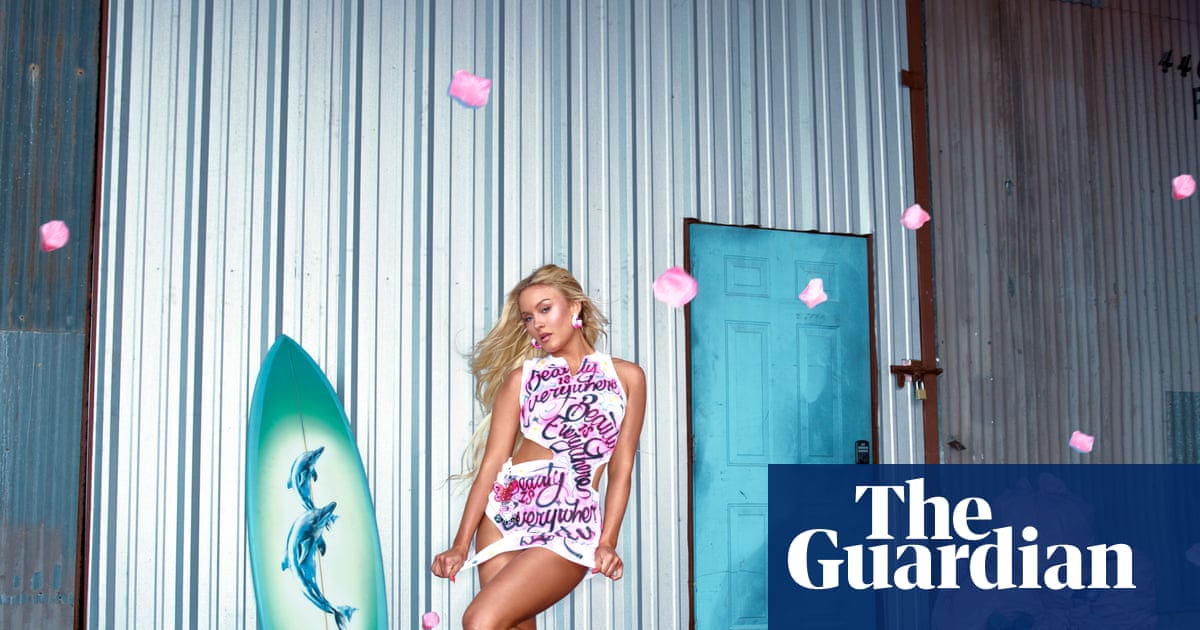

On a pleasant spring afternoon, the historic Paramount Theatre in Brooklyn is buzzing with activity as it turns into a hub dedicated to Zara Larsson. Stage technicians rush around, while managers furiously type on their smartphones, and various individuals await their chance to interact with the Swedish singer.
In a cozy, carpeted area downstairs, Zara Larsson is playfully on all fours, cheerfully saying “puss puss” into a camera. Amidst the surrounding chaos, she appears focused, sporting bright blue stockings, orange shorts, and a fitted blazer reminiscent of a graduation-themed Malibu Barbie. A crew member activates a leaf blower, causing her blonde hair to flutter dramatically. After a few poses, she glides over in feather-trimmed high heels and hands me a can of water. “Cheers!” she exclaims as we clink our drinks together.
Larsson’s career trajectory is accelerating rapidly, leaving little room for celebration beyond sipping designer mineral water. During our meeting, her collaboration with PinkPantheress has soared to the top of Billboard’s global charts, propelled by the viral performance of Olympic figure skater Alysa Liu. At that moment, Larsson boasts three tracks in the US Hot 100 and ranks as the fourth most popular female artist on Spotify globally, trailing only Taylor Swift, Olivia Dean, and Raye.
Although she first gained attention at 16 with the heartfelt ballad “Uncover,” it was the release of her album “Midnight Sun” last September that marked a significant turning point in her career. This vibrant album blends energetic electro-pop with drum and bass, transforming her into a whimsical figure of fun filled with imagery of dolphins, rainbows, and bright colors. In a time when pop music often feels like a competitive endeavor characterized by chart manipulation and media scrutiny, Larsson shines as a beacon of joy, committed to providing an uplifting escape for her audience.
“I’m having the time of my life,” she says, smiling as she removes her heels. Approaching the conclusion of a six-week US tour, her shows have been trending online nightly, thanks in part to her habit of inviting fans to join her on stage for a dance to her hit “Lush Life,” which has seen a resurgence on the charts. “The energy at these shows is incredible. But I hope this will be the last time I perform in venues of this size,” she shares, eyeing larger arenas for future performances.
One of the reasons “Midnight Sun” resonates with her fans, who proudly call themselves “Larssonists,” is its authentic youthful exuberance. The album is packed with fun, femininity, and clever lyrics that evoke carefree summer vibes and intimate moments, all showcased through Larsson’s remarkable three-octave vocal range. “The shift in ‘Midnight Sun’ was my mindset,” she reflects. “I genuinely evolved as a songwriter. Some people associate personal songwriting with sadness and guitars,” she adds with a playful grimace. “But that’s not who I am.”
Musically, “Midnight Sun” explores a variety of genres, including eurodance-pop and Baltimore club sounds, and even features some delightfully cheesy accordion. The title track was nominated for the Grammy for Best Dance Pop Recording this year. Larsson’s lyrics often feel conversational, like voice notes shared with a crush: “Look FaceTime / ‘Cause my outfit’s so nice / And you say you love it ’cause it’s all see-through / Ooh!” In other moments, she candidly addresses her vulnerabilities, as seen in “Saturn’s Return,” where she reflects on her early aspirations. “By 20, I thought I’d be filling stadiums,” she sings. “That didn’t happen, so I changed the deadline / It might take another 20 years, and that’s okay.”
In the mid-2010s, Larsson was a familiar presence in the pop scene, known for numerous popular collaborations with artists like Clean Bandit and David Guetta. While these tracks were great for workout playlists, they didn’t reveal much about her as an artist. Even her more recent albums, including “Poster Girl” and “Venus,” felt somewhat generic and overly influenced by market trends. In a candid moment from her documentary “Zara Larsson: Up Close,” she commented on her prior struggles with cultural relevance. “Many people know the songs,” she said, “but they don’t realize I’m the one singing them. What’s up with that? I have hits, but I lack cultural significance.”
Reflecting on her journey, Larsson admits, “I think maybe I wasn’t truly an artist. I didn’t let myself create what I truly wanted, as I was too concerned about radio play.” However, she now recognizes that radio’s influence is diminishing in the streaming age. “Who cares about radio?” she asserts. “It mainly supports what is already popular.” For Larsson, it is far more meaningful to see fans at her concerts wearing handmade T-shirts and floral tributes that celebrate her “Midnight Sun” aesthetic. This vibrant and extravagant style aligns her more closely with fellow artists like Chappell Roan and Sabrina Carpenter while remaining accessible—most of her stage look can be found at stores like Claire’s.
Originally from Stockholm, Larsson’s desire for fame began at an early age, leading her to perform in shopping malls and parking lots. She was both impressively talented and pragmatically focused. At just 11 years old, frustrated by the lack of a record deal after winning the Swedish talent competition “Talang,” she traveled to Los Angeles to meet with representatives from Disney and Nickelodeon. “It was the only place I could envision my future,” she recalls about Hollywood. “Nobody took me seriously, but I was very serious.”