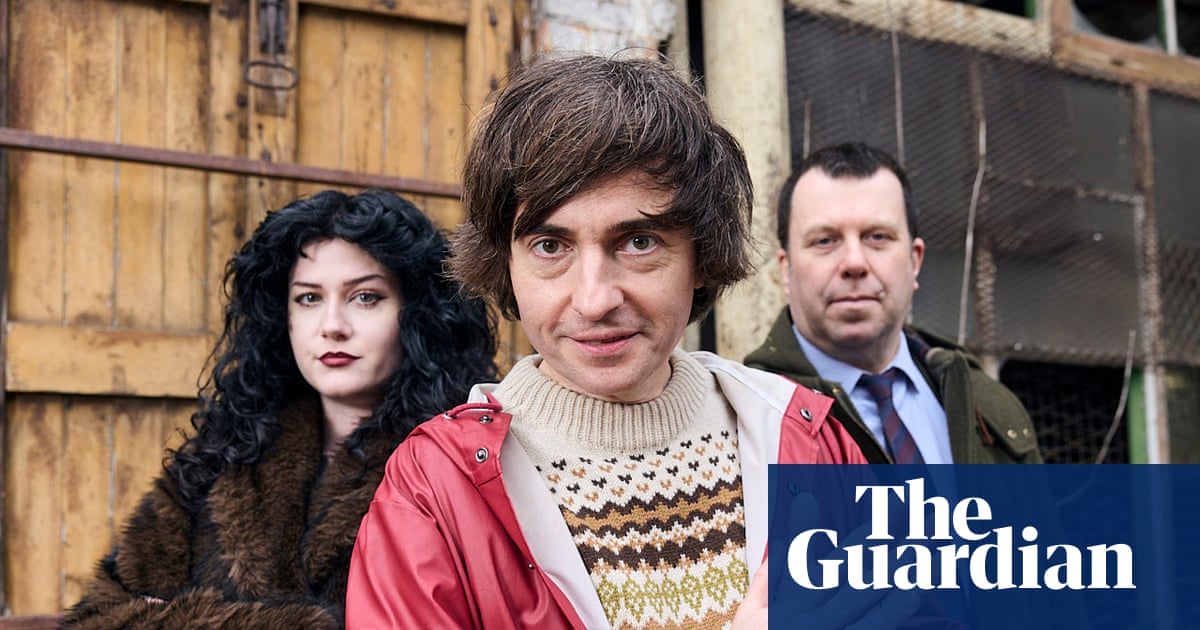

“Oh. Em. Bloody. Gee.” Danny Robins, often referred to as the “high priest of the paranormal,” has shed his signature red anorak and is energetically roaming the stage of the London Palladium, sharing a series of ghostly anecdotes. From an encounter with a spectral infant to a haunted Teams meeting and even a tale involving a “hairy flasher,” he meticulously examines each story alongside parapsychologists Evelyn Hollow (Team Believer) and Ciarán O’Keeffe (Team Skeptic, known for exposing Derek Acorah, a medium from Most Haunted, as a fraud in what Robins describes as “the Biggie and Tupac of the paranormal”). The captivated audience—comprising millennials, boomers, and Gen Z—enthusiastically contribute their own eerie experiences, including one woman who nervously recounts a story about a skeleton intent on attacking her sister. This is the captivating realm of Uncanny.
Since its inception as a paranormal investigation podcast on Radio 4, which featured the chilling opening lines, “I know what I saw,” Uncanny has undergone significant evolution over the past five years. The inaugural episode, titled The Evil in Room 611, featured scientist Ken reminiscing about unsettling incidents from his university days, describing a menacing shadowy figure and rattling doors, prompting Robins to exclaim, “Bloody hell, Ken.” Following this, two specialists offered their insights: parapsychologist Caroline Watt suggested hypnagogic hallucinations, while ordained minister Peter Laws attributed the occurrences to poltergeist activity.
This straightforward format quickly gained traction, resulting in over 8 million downloads within just two years. Uncanny has since expanded into a multifaceted franchise, including live performances, a television series, a US adaptation, celebrity specials, literary works, and even UncannyCon. The podcast is among the most listened-to offerings on BBC Sounds and topped the charts at the close of the previous year.
Now, a new Uncanny YouTube channel is set to debut, concentrating on classic cold cases, such as the black monk of Pontefract and the Barney and Betty Hill UFO incident. This initiative could propel the cult British podcast to new heights—yet the question remains: can it captivate an international audience?
Just a week after the sold-out Palladium event, Robins, Hollow, and O’Keeffe find themselves in the windowless dressing room of the Churchill Theatre in Bromley, discussing their journey. “When we began our first tour, we performed in venues like this one, and often only 250 people would occupy a 2,000-seat theater,” Robins reflects. “Now, the seats are filled.” This marks their 44th performance of the Fear of the Dark tour, with just a few shows remaining. O’Keeffe describes the Palladium experience as “completely surreal,” while Hollow recalls a memorable moment in Guildford, where a bassist from the band The Jam waited for their autograph.
Robins is no stranger to celebrity admirers, mentioning that Simon from The Cure was seen with an Uncanny tote bag while on tour. Numerous well-known figures, including Reece Shearsmith, James Acaster, Diane Morgan, Daisy May Cooper, and Bridget Christie, have participated in specials due to their enthusiasm for the show. “How often does someone in the paranormal field get to collaborate with hosts of 8 Out of 10 Cats or the bassist of one of the greatest goth bands ever?” Hollow muses.
Beyond the famous faces, Uncanny has attracted a vast and dedicated following, now numbering in the millions. “We often have children as young as six approach us at our shows,” Robins notes. Families frequently express that Uncanny has become a shared interest that has brought them closer together. “In a world where division is rampant, it’s heartening to see how the Uncanny community, despite differing views, finds enjoyment in the experience and embraces respectful disagreement,” he adds.
What fuels this widespread fascination? “A compelling Uncanny case is one that leaves my colleague here scratching his head,” Robins jokes. O’Keeffe concurs, pointing to the episode featuring Harry Called as a prime example. In this episode, Will, a staunch skeptic of the paranormal, grapples with frightening occurrences after engaging with a Ouija board, including eerie phone calls. “It’s challenging for me to assign a singular explanation to these events,” O’Keeffe admits. “But it’s also the ordinary occurrences—like a ringing phone or a message left behind—that resonate with everyone.”
Historically, paranormal entertainment in the UK has often been viewed with skepticism. Before Uncanny, Robins had penned the play 2:22 A Ghost Story, recalling a conversation with a critic who seemed dismissive of the concept: “A play about ghosts?” he questioned, conveying a general air of derision. Robins had also launched a short-lived podcast titled Haunted in 2017. However, he transformed the genre; the play achieved six runs in the West End, garnered Olivier nominations, and is reportedly on its way to Broadway. In 2021, the BBC broadcast another of his podcasts, The Battersea Poltergeist, which examined a cold case from the 1950s. This marked a turning point, as individuals began reaching out to share their own ghostly encounters, many stating, “I’ve never told anyone this before.”
Nevertheless, it’s acknowledged that many paranormal television programs from the 1990s and 2000s tended to be “quite pantomime-like,” according to Robins, characterized by ghost hunts filled with dramatic screams and night vision footage. I propose the term “prestige paranormal” to describe how Uncanny distinguishes itself from its predecessors. “I like that,” O’Keeffe responds, who also works as a university professor. “It’s akin to a detective narrative. Viewers are engaged in the unfolding story, piecing together the puzzle rather than simply entering a haunted house.”
Academics worldwide are also captivated, with O’Keeffe sharing, “I often find myself in virtual meetings with colleagues from France, Spain, Portugal, or the United States, and someone will ask, ‘Ciarán, can we discuss Uncanny now?’” They are not alone in their interest, as listeners from the US currently account for 11% of the podcast’s audience, according to Robins (the BBC has not verified specific download statistics outside the UK). He also has plans to take the live show on tour, further expanding Uncanny’s reach.