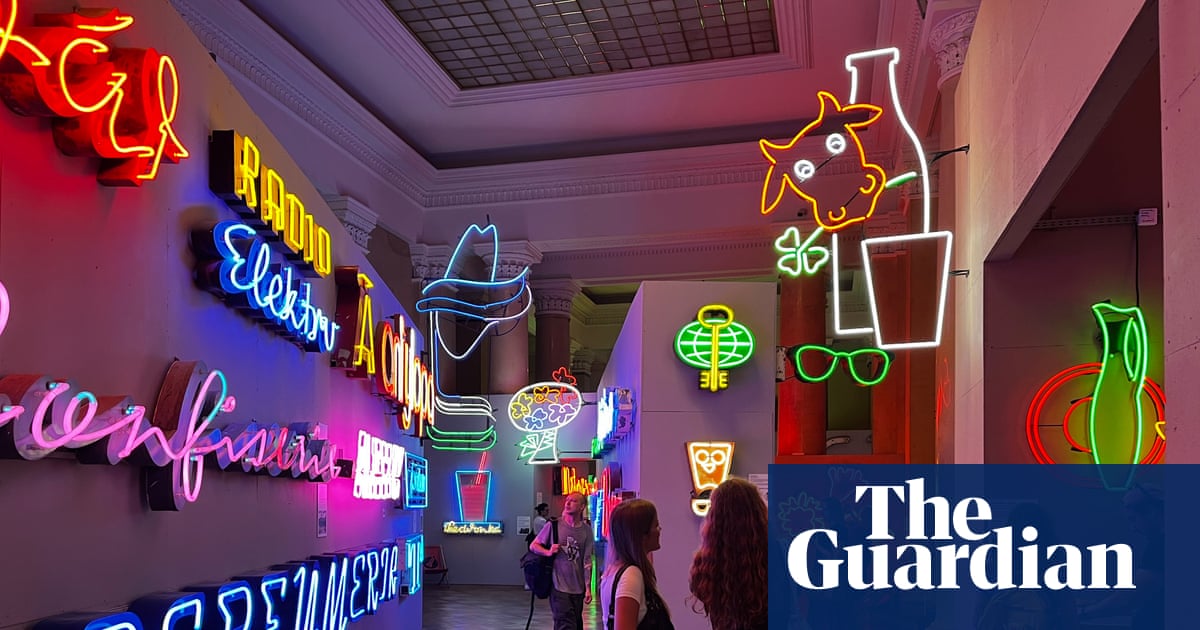

During the prolonged era of Cold War oppression, the neon signs of Warsaw emerged as beacons of brightness, color, and optimism for a more hopeful future. Initially intended as instruments of Soviet propaganda, these vibrant displays sparked a creative movement in the Polish capital that even the Communist regime could not suppress.
However, following the end of communism in the late 1980s, many of these signs lost their significance and began to deteriorate, either rusting in place or being dismantled and discarded.
Fast forward several decades, and neon is experiencing a revival in Warsaw. Numerous historic signs have been restored, while new ones have been custom-designed for bars and restaurants, paying homage to the past.
The Neon Museum in Warsaw, established in 2012 by Polish-British photographer Ilona Karwińska and graphic designer David Hill, draws over 100,000 visitors annually to view its collection of illuminated artifacts from the Cold War era.
“When we embarked on this project, the neon signs were neglected and unwanted. They were old and corroding, with many being dismantled and discarded,” Hill reflected about their initial fascination with the signs, which started during a visit in 2006.
“Ilona decided to document the remaining signs for a personal project. We thought it would only take a few months before returning to our regular lives. Instead, it has become our life’s work. We’ve transformed into neon enthusiasts,” he added.
After showcasing Karwińska’s photographs and publishing several popular books, individuals began reaching out to offer signs, leading to the museum’s opening in 2012. “This demonstrated the public’s interest and affection for these signs, even when they were regarded as lacking social or cultural significance,” Hill noted.
Neon signs first appeared in the early 20th century, following the discovery of the noble gas in 1898 by British chemists William Ramsay and Morris Travers. French engineer Georges Claude was instrumental in developing high-voltage electricity to illuminate sealed glass tubes filled with neon and argon gases. The first commercial neon sign was sold to a Parisian hairdresser in 1913, and by the 1920s, “liquid fire” advertisements made their way to the United States.
Warsaw’s inaugural neon sign was installed in 1926, but only a handful of the 70 that followed survived the devastation of World War II, during which the occupying Nazis destroyed up to 90% of the city in retaliation for the 1944 Warsaw Uprising by Polish resistance fighters.
The postwar “neonization” of Poland commenced in 1956 when the government of the then Soviet satellite state established the Reklama company to produce lights and luminous signs.
For the Communist regime, these signs represented an effort to brighten cities that were often dull and gray, or in Warsaw’s case, largely in ruins. Prominent graphic designers from the Polish poster school movement, such as Jan Mucharski and Tadeusz Rogowski, were responsible for creating many of these iconic signs.
“This initiative was part of a broader social and political vision associated with modernization and hope; it aimed to uplift the populace and convey the message that life was improving,” Hill explained.
“Of course, the authorities wanted to maintain control, but there seemed to be some leeway. Some strict Soviet bureaucrat had to approve each sign, and they were opposed to logos that hinted at Western commercialism.
“However, a creatively designed neon sign could become so popular that it would eventually be adopted as a logo. This must have put several officials in a difficult position,” he continued.
The neon signs also served a political purpose: during the imposition of martial law from December 1981 to July 1983, in response to the Solidarity movement, the lights were frequently turned off, casting Warsaw into darkness.
There has been debate about whether the signs should be displayed in a museum or preserved at their original locations. In response, Karwińska and Hill have begun restoring neon signs and returning them to their original sites or nearby locations. This includes a four-meter-tall red cockerel that once adorned a folk art warehouse, now demolished and replaced by an apartment building, as well as a Syrenka mermaid, the symbol of the city.
This revival has also encouraged a new generation of architects and designers to engage with neon art. One of the most notable recent installations, a sign reading “It’s nice to see you” in Polish, was designed by graphic artist Mariusz Lewczyk and placed on the Gdański Bridge over the Vistula River after winning a competition to create a new city symbol.
The museum houses neon signs from across the former Eastern Bloc, and Karwińska and Hill are planning to open a second museum in Budapest.
“There is undoubtedly a resurgence underway. The fascination with neon signs is reigniting,” he concluded.