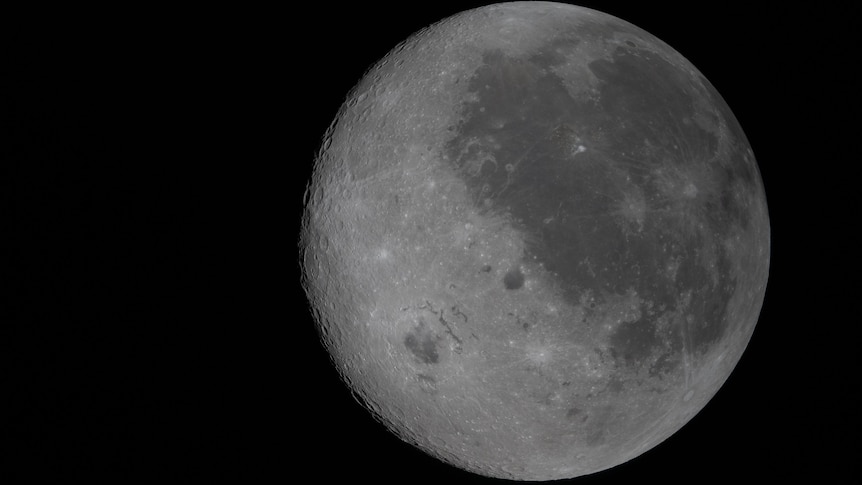

The astronauts aboard Artemis II have achieved a remarkable milestone by traveling farther from Earth than any humans have previously, breaking the record set by Apollo 13 in 1970.
This historic seven-hour lunar fly-by provided unprecedented views of the Moon’s far side, with NASA planning to release these images soon.
The mission represents a significant advancement towards a planned landing near the Moon’s south pole, scheduled for 2028.
After journeying deeper into space than any crew has ever ventured, the Artemis II team has directed the Orion spacecraft back toward Earth, concluding a lunar exploration that unveiled unseen aspects of the Moon’s far side.
Artemis II marks humanity’s first voyage to the Moon since 1972, successfully completing its seven-hour fly-by.
At 3:56 am AEST today, the crew surpassed the previous record distance of 400,171 kilometers set by Apollo 13.
The mission crew consists of three Americans and one Canadian, taking a significant step toward a lunar landing planned for two years from now.
Astronaut Jeremy Hansen expressed his awe via radio just before the fly-by, stating, “It is blowing my mind what you can see with the naked eye from the Moon right now. It is just unbelievable.” He encouraged future generations to continue pushing the boundaries of exploration.
The highlight of this nearly ten-day test flight was the lunar orbit, which is expected to conclude with a splashdown in the Pacific Ocean on April 11 (Australia time).
The astronauts ventured as close as 6,545 kilometers to the Moon’s surface, capturing images of over two dozen significant targets, including impact craters and other intriguing features using advanced cameras.
The crew includes Commander Reid Wiseman, Pilot Victor Glover, Mission Specialist Christina Koch, and Canadian Mission Specialist Jeremy Hansen.
Shortly after breaking the Apollo 13 record, the astronauts requested to name two newly observed lunar craters, suggesting the names Integrity, after their capsule, and Carroll, in tribute to Captain Wiseman’s late wife, who passed away from cancer in 2020.
Captain Wiseman became emotional as Hansen made the request to Mission Control, and all four astronauts shared a heartfelt embrace.
Once he regained his composure, Captain Wiseman described the view as “majestic” and began capturing photographs.
The team successfully photographed both the Moon and Earth in a single frame while providing live commentary to scientists back at NASA in Houston regarding their observations.
The eagerly awaited images of the Moon’s far side have yet to be released by NASA. The crew had spent years studying lunar geography in preparation for this mission, and their mentor, NASA geologist Kelsey Young, anticipates thousands of captured images.
One of their primary targets was the Orientale Basin, a vast impact area featuring three concentric rings, with the outermost measuring nearly 950 kilometers in diameter. They also spotted the landing sites of Apollo 12 and 14, serving as poignant reminders of NASA’s early exploration efforts over fifty years ago.
In addition to using high-powered Nikon cameras, the astronauts utilized their iPhones for some spontaneous photography, with Captain Glover noting that some peaks appeared so bright they looked snow-covered.
A total solar eclipse occurred as the Moon temporarily obscured the Sun from their viewpoint, allowing the crew to see Mercury, Venus, Mars, and Saturn against the backdrop of space.
The astronauts began their historic day with a wake-up message from Apollo 13 Commander Jim Lovell, recorded two months prior to his passing last August. Lovell, who also participated in Apollo 8, welcomed them to “my old neighborhood,” reminding them to appreciate the view amidst their busy schedule.
The crew honored Lovell by carrying with them a silk patch from Apollo 8, showcasing it as they neared the fly-by.
Commander Wiseman expressed his gratitude for the privilege of having the patch on board.
Looking ahead, Artemis II is NASA’s first crewed mission to the Moon since Apollo 17 in 1972, paving the way for Artemis III next year, which will involve another Orion crew practicing docking with lunar landers in orbit around Earth.
The ultimate lunar landing is planned for Artemis IV in 2028, where two astronauts will attempt to land near the Moon’s south pole.
While Artemis II follows a path reminiscent of Apollo 13, it shares similarities with Apollo 8, the mission that first orbited the Moon on Christmas Eve 1968.
Captain Glover reflected on the significance of flying to the Moon during Holy Week, observing the “beauty of creation” as Earth appeared as an oasis in the vast emptiness of the universe. He emphasized the importance of unity among humanity during this extraordinary journey, clasping hands with his fellow astronauts.