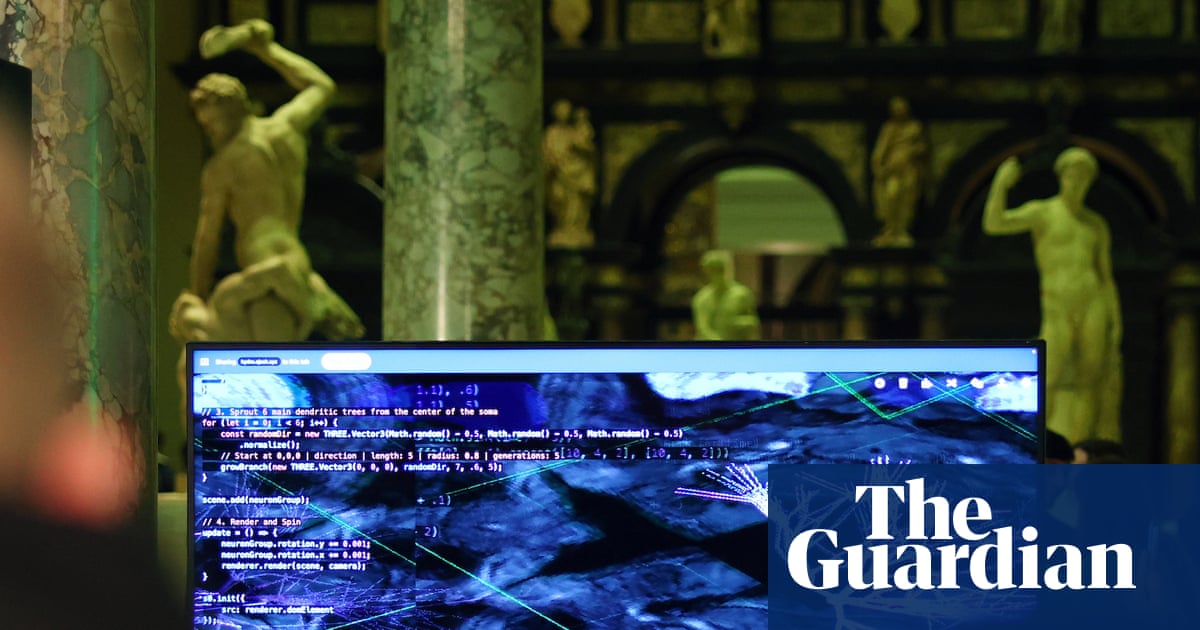

At the Victoria & Albert Museum, under a vast dome adorned with classical statues visible through nearby arches, a programmer and DJ is engaged in live-coding an electronic music performance filled with glitches. On either side of her, large LED screens display cascading lines of code and vibrant, pixelated visuals that pulse with the heavy bass. She is a member of London Live Coding, an innovative collective that creates music by writing and adjusting audio software. The atmosphere is loud, disorienting, and exhilarating, prompting thoughts about how Queen Victoria and her spouse might have reacted to such a spectacle.
This performance forms part of the museum’s ongoing Friday Late series, which collaborates with the London Games Festival. The event features a variety of indie video games and immersive interactive experiences, emphasizing the relationship between play and performance. Attendees were given maps to explore the museum’s halls and galleries in search of different installations. One highlight was the opportunity to play the Bafta-winning comedy game Thank Goodness You’re Here! on a massive screen situated beneath a 13th-century spiral staircase. In the dimly lit Prince Consort’s gallery, groups of laughter-filled friends engaged with the cheeky physics puzzle game Sex With Friends, where characters resembling ragdolls must be maneuvered into (consensual) sexual situations, much to the delight of onlookers.
According to co-curator Susie Buchan, the theatrical aspect of the event was crucial. “I was particularly fascinated by how playing a game in a gallery environment, especially on a grand scale with an audience, transforms players into performers,” she explained. “One of my favorite moments was witnessing the camaraderie among the audience while playing Sex With Friends. It was surprisingly wholesome to see a group of people at the V&A on a Friday night vocally engaging with a screen about sex positions.”
This is not the first time the V&A has delved into gaming culture; over the past decade, the museum has hosted an array of themed events and, in 2018, showcased a remarkable exhibition titled Design/Play/Disrupt, curated by Marie Foulston and Kristian Volsing. However, there was a recent pause in such programming, and Volsing, now a senior curator, was eager to reintroduce gaming and play into the museum. “It is essential to present and critically examine video games as a significant and serious aspect of our culture. Placing them in a museum context emphasizes a communal experience, fundamentally altering how we interact with these artifacts by inviting visitors to consider them alongside historically valuable items and to share these experiences with others,” he noted.
Participation and collaborative creativity were also key elements of the event. Comedian and writer Jamie Brew engaged the crowd with his performance piece, Robot Karaoke, which utilizes algorithms to create new lyrics for well-known pop songs from an array of unconventional text sources. A memorable moment was when the entire audience sang along to Dancing Queen, with lyrics sourced from negative reviews on Glassdoor. In the learning center, artist Fredde Lanka assisted participants in crafting their own video game fanzines. I was particularly taken with Jana Romanova’s lite-LARP experience, The Line is the Game, where participants were assigned roles and stood in character in an unruly queue in the corridor just outside the sculpture gallery.
Holly Gramazio, an author and game designer who has organized numerous video game events at museums and galleries globally, including the now-defunct Now Play This festival at Somerset House, believes that the intersection of gallery experiences, gaming, and performance is vital for presenting video games in these contexts. “There is something unique about how both video games and exhibitions draw upon various modes of expression,” she stated. “[They] often center on the experience of individuals navigating through a space and responding to it. This makes exhibitions an expressive and intricate means of sharing games along with their contexts and histories with an audience.”
In April, the London Games Festival will feature similar experiences across various venues in the city. It is encouraging to see comparable events occurring worldwide. Buchan recommends the Overkill festival in the Netherlands and A MAZE in Berlin; everyone I spoke with mentioned the New York-based art games collective Babycastles. The Game Arts International Network maintains a directory of organizations engaged in gaming events and installations. Veteran event curator and game designer V Buckenham, who contributed to the evening’s Car Boot Casino installation—a collection of new card-based bluffing games—views these spaces as mutually beneficial: players can envision games differently, while non-gamers may have their assumptions regarding the medium challenged, benefiting developers as well: “There’s an inherent thrill in showcasing your quirky game about sausages next to a centuries-old hand-carved mantelpiece. Or improvising algorave music and visuals beneath a Chihuly sculpture.”
In today’s climate, it is all too easy to perceive video games solely through the lens of the industry—focusing on the enormous profits generated by titles like Fortnite and Roblox, or the evolving power dynamics, acquisitions, and brand expansions. Spending a few hours experiencing games in unexpected settings, juxtaposed with Renaissance paintings and Baroque silverware, offers a fresh perspective and underscores their place in culture as much as in commerce.