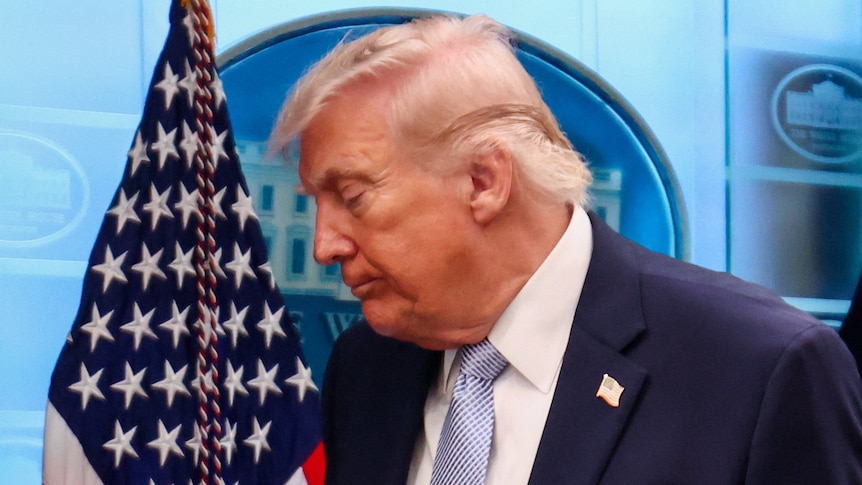

On Easter Sunday, President Donald Trump issued a stark warning to Iran, declaring that the nation would be “living in hell,” a statement that drew significant backlash from politicians across the United States, some of whom characterized his remarks as “unhinged.” The following day, he reiterated his threats toward Iran, this time humorously accompanied by the Easter Bunny.
Since early March, Trump has made over 30 claims asserting that the United States has “won the war” and “defeated Iran,” while simultaneously vacillating between declaring independence from foreign assistance and stating the need for international support. He has claimed that negotiations with Iran are ongoing, even as he threatens to send the country of 90 million people “back to the Stone Age.”
The inconsistency in Trump’s rhetoric has led to a perception that his words, which traditionally carry considerable weight for a sitting president, now hold similar significance to those of the “evil” regime he insists he has vanquished multiple times.
During a press conference at the White House on Tuesday morning (Australian time), the urgency of the situation was evident as Trump’s credibility appeared to be waning. After previously setting and then extending several deadlines, he emphasized that Iran had until 8 PM Tuesday US time (10 AM Wednesday AEST) to comply with his demands or face severe air strikes, which he claimed would leave the country in ruins for a century.
The United States has not publicly disclosed a comprehensive 15-point plan aimed at resolving the conflict, which was first introduced on March 25 and dismissed by Iran. According to Israel’s Channel 12, key elements of the plan purportedly include a 30-day ceasefire, the dismantling of Iran’s nuclear capabilities, a permanent commitment from Iran to abandon nuclear weapons development, restrictions on missile range and quantity, cessation of Iran’s support for regional militias, reopening the Strait of Hormuz, and the lifting of all sanctions against Iran.
Reportedly, Pakistan has proposed a two-phase initiative known as the Islamabad Accord, which calls for an immediate 45-day ceasefire and the reopening of the Strait of Hormuz. The final agreement would require Iran to commit to not pursuing nuclear weapons in exchange for relief from sanctions and the return of frozen assets.
Iran’s foreign ministry spokesman, Esmaeil Baghaei, stated that the country would categorically reject the US’s 15-point plan, labeling it as overly ambitious and illogical. In contrast, Iranian state media reported that Iran has presented its own ten-point plan to end the conflict. This plan includes guarantees against future attacks on Iran, a halt to Israeli operations against Hezbollah in Lebanon, and the lifting of all sanctions. In return, Iran would cease blocking the Strait of Hormuz but would impose a toll for passage, with proceeds allocated to infrastructure reconstruction.
There appears to be minor potential for compromise between the two proposals, such as the transformation of Iranian compensation claims into a fee for the Strait of Hormuz. However, Iran remains firm in its stance that it will not reopen the strait without a satisfactory agreement, viewing it as a crucial bargaining tool. The ongoing blockage of the strait presents a significant challenge for Trump, as it is adversely affecting the global economy and highlights Iran’s control over the situation despite US military strength.
In response to Iran, Trump has issued threats that some experts argue could be classified as potential war crimes, including targeting critical infrastructure such as bridges and power plants. The United Nations Charter prohibits unprovoked aggression against other states, asserting that member countries must refrain from using force against the territorial integrity or political independence of any nation.
Trump’s recent declarations signal an escalation of US intentions to potentially commit acts that could be deemed war crimes by stating his willingness to destroy Iranian infrastructure comprehensively. Under international law, military strikes against civilian infrastructure are permissible only if they contribute directly to military objectives while minimizing civilian harm. According to The Wall Street Journal, Trump’s aides have indicated that focused US military actions are justified as they aim to disrupt Iran’s capabilities to develop missiles, drones, and nuclear arsenals. When questioned about the legality of targeting civilian infrastructure, Trump replied, “I’m not worried about it,” further complicating the already tense situation.