
In the cemetery adjacent to Wilmington Priory in East Sussex, I encountered an ancient yew tree, its trunk so gnarled that it had enveloped part of a gravestone. The sight of its branches propped up by long poles sent a shiver down my spine. My visit aimed to witness something equally peculiar, yet far less eerie—the Long Man of Wilmington, who stands on the hillside across from the priory, traversing the steep slopes of the South Downs, holding a staff in each hand. As I ascended Windover Hill, just below the South Downs Way, I observed that this chalk giant, originally carved from the earth, now bears outlines marked by concrete blocks.
The Long Man’s origins may trace back to the Anglo-Saxon period, as its form resembles a design found on a buckle unearthed in Kent in 1964 by archaeologist Sonia Chadwick Hawkes, which likely depicts the god Odin (or Woden). However, it is also plausible that this figure is a more recent addition to the landscape, intended for visibility from the priory. The Long Man captivated photographer Lee Miller and her husband, artist Roland Penrose, who resided nearby. Penrose created a surrealist depiction of the Long Man on the inglenook fireplace of their home, Farleys, perceiving the figure as a guardian spirit. Additionally, the Long Man inspired Black composer Avril Coleridge-Taylor, the folk group Memory Band, and even attracted composer Benjamin Britten for a picnic at its base.
The Long Man of Wilmington ranks among the well-known chalk figures, mysterious engravings that embellish the hills of England—approximately 40 in total. These figures have always been significant in my life, striking a balance between familiarity and the extraordinary. They have intrigued a diverse array of individuals, including filmmakers, authors, musicians, and artists, and have garnered the interest of historians, archaeologists, and antiquarians. Their presence enriches walks and stimulates speculation.
Many hill figures—most notably horses, as well as crosses, crowns, regimental symbols, giants, and deities—are situated near ancient pathways that have historically been traversed by pilgrims, merchants, and warriors, as well as modern-day adventurers. In researching these paths for my book, The Tattooed Hills, I gained a deeper understanding of these enigmatic shapes.
My planned trek from the Long Man to the Litlington White Horse was interrupted by a thunderstorm—being in the hills during lightning is unwise—so I postponed my visit until the next day. This solitary figure gazes over the hill towards the English Channel near Cuckmere Haven and was clandestinely carved by local residents in a single night in 1924, serving as a successor to a previous, now-lost figure.
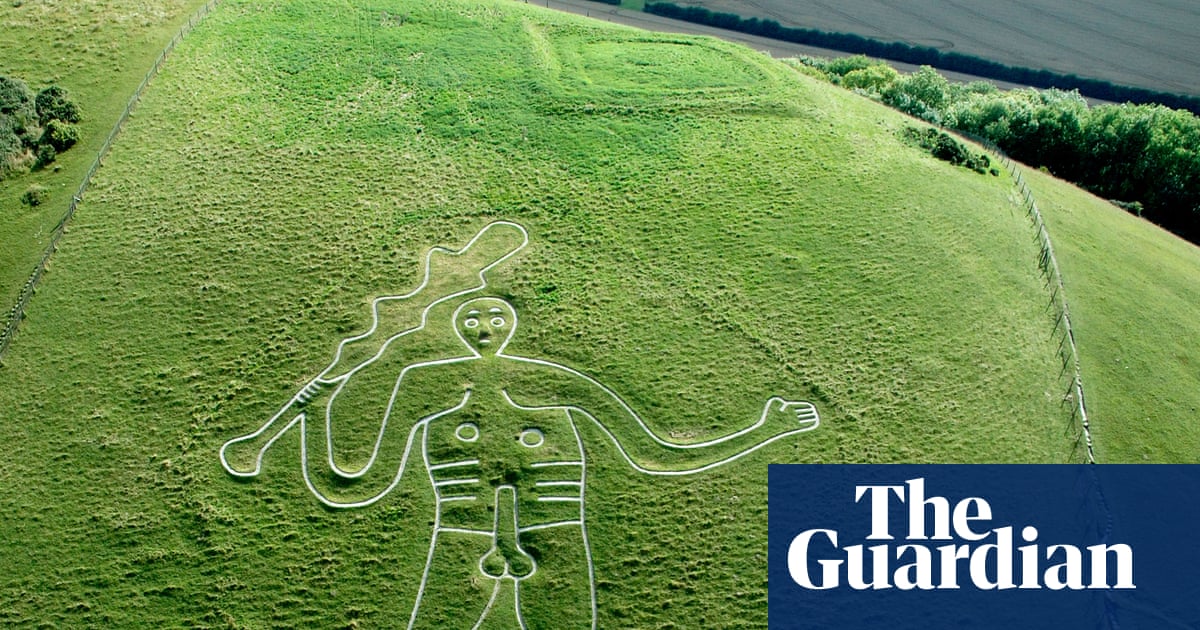
Near the coast in Dorset, I ascended the hill to see the enormous figure of King George III on his horse, Adonis, watching over his beloved seaside town of Weymouth. Carved in 1808 as a tribute to the monarch and a significant attraction for the town, the figure has now become somewhat weathered. Continuing north along the Wessex Ridgeway, I was both intrigued and intimidated by the imposing figure of the Cerne Giant, who looms over the secluded valley, brandishing a club. His origins have sparked much debate, with theories suggesting he could represent a Romano-British figure, a 17th-century marauder like Oliver Cromwell, or even the pagan god Helith. More likely, he symbolizes a Saxon depiction of Hercules or a local saint named Eadwold, embodying a sense of unpredictability.
Traveling along the Ridgeway through the chalk hills of Wiltshire leads one into a region renowned for its white horses, eight of which still exist. A midsummer journey from the slender Alton Barnes White Horse took me along the Wansdyke, an extensive defensive ditch and bank that spans miles of uninhabited countryside, offering views of the ancient Silbury Hill. I then proceeded to another horse at Cherhill, which is carved into the steep valley and overshadowed by a hillfort, prominently marked by the Lansdowne Monument, which adds an unsettling quality to the landscape.
Both horses are tied to music: the Alton Barnes horse briefly appeared in a music video for the Britpop band Dodgy’s single “Staying Out for the Summer.” The song weaves together nostalgic imagery of the era, such as VW camper vans and crop circles, presenting a specific vision of rural life as a backdrop for raves, while stripping away its rebellious essence. In their earlier guise as the Timelords, the KLF filmed the video for “Doctorin’ the Tardis” at Cherhill, an unremarkable song that nonetheless introduced audiences to their art-terrorist antics, complementing the horse with the area’s quirky landscape.
Continuing along the Ridgeway led me to the most significant and enigmatic figure—the majestic Uffington White Horse, also located beneath a hillfort. Archaeological evidence suggests this figure dates back to the late Bronze Age, approximately 3,000 years ago, making it an extraordinary relic. Through the generations, people have maintained this racing figure, ensuring its survival on the wind-swept hill. It has also inspired musicians, with Kate Bush’s “Cloudbusting” video filmed in the vicinity, and XTC’s album, English Settlement, featuring the horse on its cover. Andy Partridge from XTC mentioned that the landscape surrounding his hometown of Swindon profoundly influenced him, stating, “It marked me like an Avebury stone or the ripples across a hillfort. It made me.”
The Ridgeway intertwines with the Icknield Way, which traverses the chalk spine of the country toward East Anglia and through the verdant Chiltern Hills, home to several unique chalk figures, including two crosses—one atop a massive chalk pyramid known as the Whiteleaf Cross. Another figure, the Watlington White Mark, has been interpreted as an ancient…