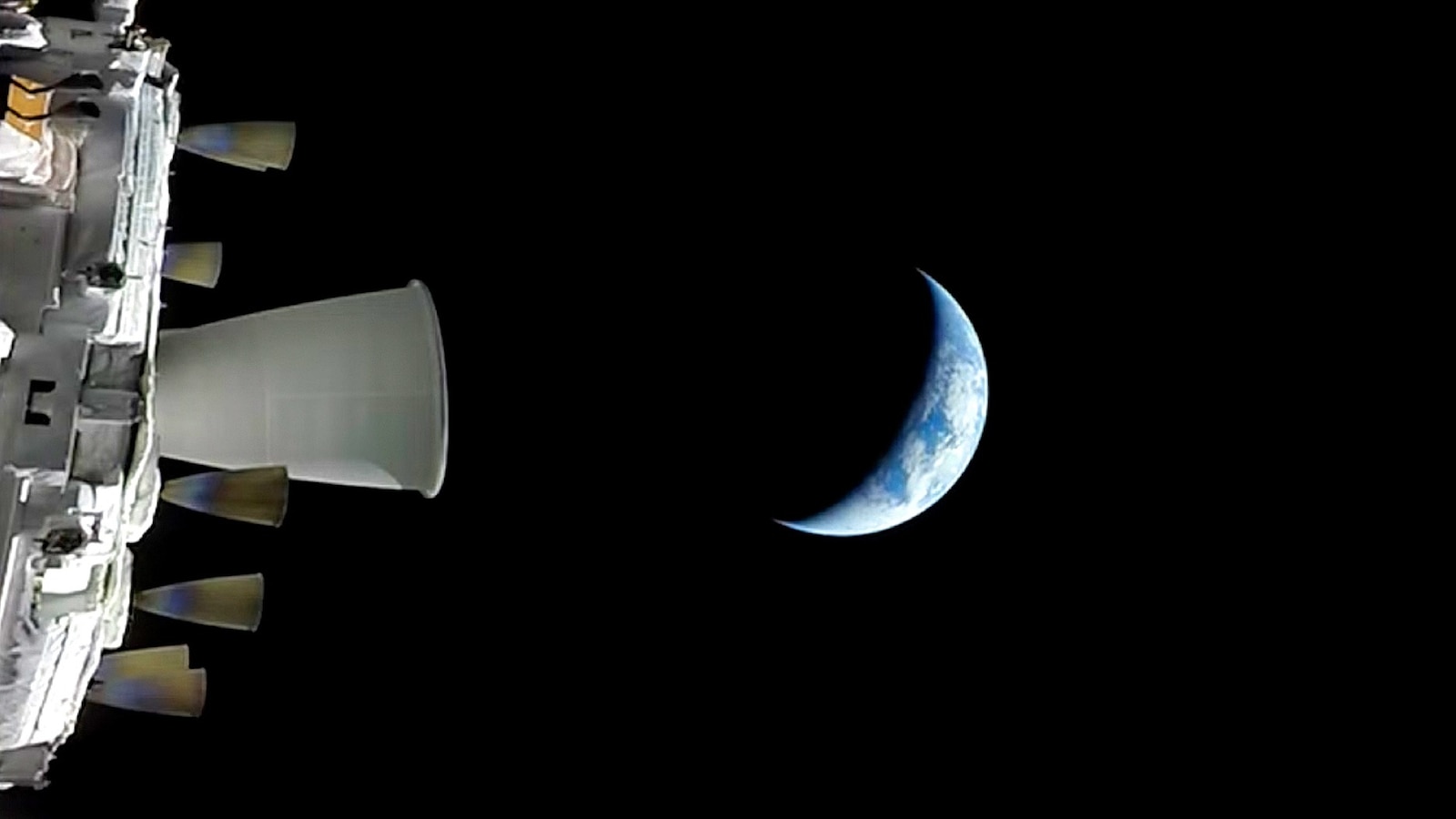

Following a triumphant launch from the Kennedy Space Center in Florida on Wednesday evening, the Artemis II team, consisting of four astronauts, has embarked on a ten-day expedition to the moon.
But how does a nearly six-million-pound rocket and its crew module achieve this ambitious journey?
The answer lies in the principles of physics.
When Artemis II took flight on April 1, the Space Launch System (SLS) rocket required an astonishing 8.8 million pounds of thrust to break free from Earth’s gravitational pull and propel the astronauts into space.
This immense force was generated by two solid rocket boosters in conjunction with four RS-25 engines, which elevated the rocket into Earth’s orbit. After the boosters completed their role, they detached and plunged into the ocean, allowing the four main engines to continue propelling the rocket into orbit.
Approximately eight minutes after liftoff, the Orion crew module, affectionately named “Integrity” by the astronauts, began to navigate its path in low Earth orbit when the main engines ceased operation, permitting gravity and inertia to take over.
At this stage, the emphasis shifted to evaluating the performance of Integrity, with the aim of eventually transitioning out of Earth’s orbit if the tests proved successful.
To achieve this, the spacecraft was required to conduct two essential burns known as perigee and apogee burns. These maneuvers enabled Orion to ascend to high Earth orbit, where the crew spent the majority of their initial day in space. Both burns were executed within the first few hours of the mission.
Following this, the interim cryogenic propulsion stage completed its function and detached from Orion, relieving the spacecraft of extra weight in preparation for its lunar flyby.
The crew then engaged in testing Orion’s capability for manual navigation in proximity to other spacecraft, a procedure NASA refers to as proximity operations. This demonstration lasted around 70 minutes, according to a NASA press release.
The following morning, the crew conducted a second perigee burn using Orion’s main engine to fine-tune its trajectory toward the moon, as stated by NASA.
The pivotal moment arrived with the Translunar Injection (TLI), during which Integrity departed from Earth’s orbit, setting its course for the moon.
Imagine the sensation of being pushed from a swing at a playground; TLI functions similarly, as it requires a precise boost from the module’s main engine to propel the astronauts toward the far side of the moon.
That trajectory to the moon is designated as a free return trajectory, providing a sort of “free ride” home. This path leverages the moon’s gravity to slingshot the spacecraft around the moon and back to Earth in what is termed a lunar flyby. It is crucial to understand that this lunar flyby differs from lunar orbit; as the name implies, the spacecraft will pass by the moon rather than entering into its orbit.
NASA anticipates that Orion will reach the moon by Monday, April 6. The crew aims to travel approximately 4,600 miles beyond the moon’s far side, offering them a view not witnessed by humans since the Apollo missions.
After navigating behind the moon, NASA estimates the return journey will take about four days. Upon receiving clearance from all teams, Integrity will proceed along its path, aided by several trajectory correction burns to ensure precise navigation for splashdown.
As Integrity re-enters Earth’s atmosphere, it will be traveling at around 25,000 miles per hour, when its heat shield will be put to the ultimate test to ensure the crew’s safe landing in the Pacific Ocean. This will conclude the historic mission and signify America’s return to lunar exploration.