
Individuals who have dedicated their life savings to post office investment schemes, as well as working professionals relying on this government-supported institution, find themselves ensnared in a bureaucratic situation that remains unresolved. This predicament also affects agents who have dedicated their careers to assisting clients navigate the system.
The core issue stems from a recent structural shift, as the Chinchwad East Sub Post Office transitioned into a full-fledged Head Office (HO) in February. This new office is now responsible for overseeing 30 post offices within the Pimpri-Chinchwad area. The intention behind this upgrade was to decentralize operations and enhance service efficiency, particularly regarding processes like death claim settlements. However, one significant hurdle remains: the new Head Office has yet to establish its own government bank account.
Previously, all post offices in Pimpri-Chinchwad operated under the Pune Head Office. When an investment matured—whether it was a Public Provident Fund (PPF), Monthly Income Scheme (MIS), Senior Citizen Savings Scheme (SCSS), or Recurring Deposit (RD)—the maturity funds would automatically be transferred to the customer’s chosen bank account, such as SBI or HDFC, via an Electronic Clearing Service (ECS).
Customers needed only to complete an ECS form and include a cancelled cheque from their selected bank. The Pune HO managed all payment distributions and cheque issuances. In cases where an ECS transfer failed, the Pune HO would issue a maturity cheque directly to the customer, who could then deposit it into their bank account.
With the Chinchwad HO now responsible for cheque issuances and maturity payments, the lack of a dedicated government bank account has resulted in widespread ECS failures. Unlike the Pune HO, the Chinchwad HO currently lacks the authority to issue maturity cheques, leading to payment delays that have persisted for over 45 days. A postal agent noted, “Previously, we only needed to fill out an ECS form and attach a cancelled cheque for payment processing by Pune HO. Now, with the Chinchwad HO unable to provide maturity cheques, payments are simply stalled.”
Efforts to find alternatives have not yielded successful results. Postal officials have recommended that customers open Post Office Savings Accounts to facilitate internal payments. However, many customers, particularly senior citizens, are hesitant to do so.
An agent commented, “Postal officials are advising the opening of new post accounts, but many customers are reluctant to manage multiple accounts, especially senior citizens.” Moreover, for those who have opened new accounts, the issuance of cheque books has been delayed for over a month.
New account holders experience additional setbacks. KYC forms must be physically sent to a Mumbai office for processing, which takes two to three weeks. Until KYC details such as signatures and photographs are updated in the system, cheque books cannot be issued, and without these, payments cannot proceed.
While net banking has been proposed as a potential solution, a significant portion of post office customers are elderly and not accustomed to digital transactions. Some senior citizens have expressed concerns that digital access could enable family members to withdraw funds without their knowledge.
Additionally, direct cash withdrawals from post offices have been promoted, but this approach presents its own challenges. An agent explained, “Many post offices are facing cash shortages, and customers needing to withdraw large sums, such as Rs 10 lakh, are instructed to return daily to withdraw only Rs 2 lakh at a time. This is impractical for working professionals and senior citizens alike.”
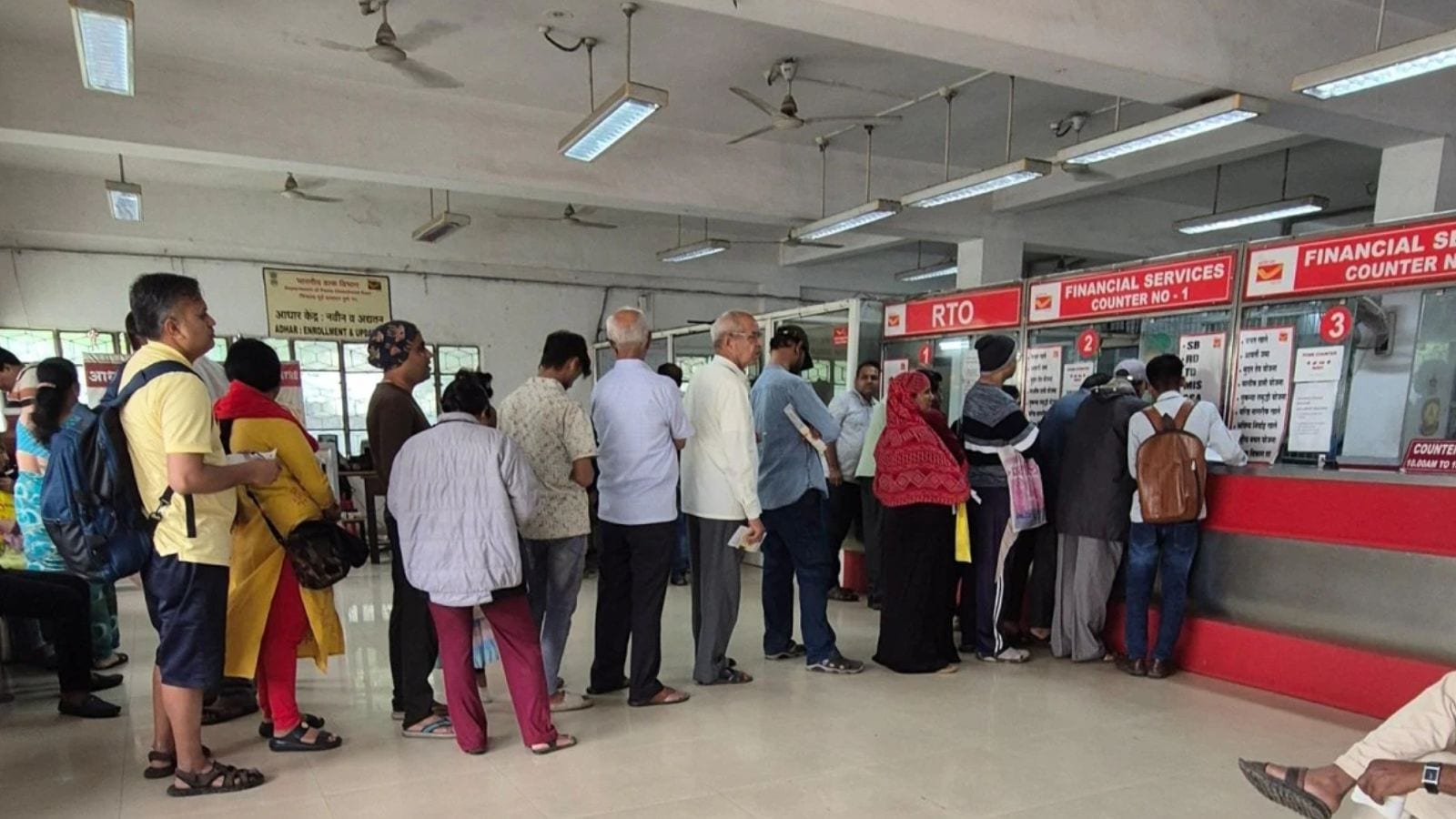
The ongoing payments crisis is exacerbating existing infrastructure deficiencies. Post offices within the Pimpri-Chinchwad region, including those in Chinchwad Gaon, Pimpri, Bhosari, Pradhikaran, Phule Nagar, and Tathawade, are limited in service counters, lack a token system, and do not provide self-service passbook printing machines.
A concerned customer remarked, “The Post generates crores of rupees in business annually, yet there is not a single self-service passbook printing machine like those found in banks. Even updating a passbook entry requires hours of waiting in line. Senior citizens are left standing for long periods, and disputes often arise when someone tries to take a seat to rest.”
Agents have reported that new passbooks for investments made in the last month have not yet been issued, leading to a decline in customer trust. “How can anyone trust us to invest in Indian Post?” lamented one agent.
Officials at the Chinchwad HO assert that this transition, despite its current difficulties, is a positive long-term development. “The conversion of the Chinchwad East Sub Office into the Chinchwad Head Office aims to decentralize operations and better accommodate the growing business in Pimpri-Chinchwad, leading to more prompt services,” explained a postal official.
Regarding the establishment of a government account, officials stated, “The process with SBI’s Kasarwadi branch involves coordination between SBI, the Director of Accounts (Postal) in Nagpur, and the Reserve Bank of India (RBI). This proposal is under review at DAP Nagpur, and SBI is in the process of integrating the post offices under the Drawing and Disbursing Officer (DDO) of Chinchwad HO.”
Officials anticipate that the process will conclude within eight days. “Once completed, we will be able to issue new cheque books with updated MICR codes for savings account holders, streamlining payments,” an official added. For urgent cases during this interim period, they mentioned that they have coordinated with Pune HO to issue some maturity cheques where ECS transfers have failed.
Customers and agents alike believe that this disruption could have been mitigated with better foresight. “The Indian Post should have planned better, established the new Head Office account in advance, and then initiated operations,” observed a customer. “Now, the situation is chaotic, causing significant inconvenience, especially for senior citizens.”
Shubham Kurale is a journalist based in Pune.