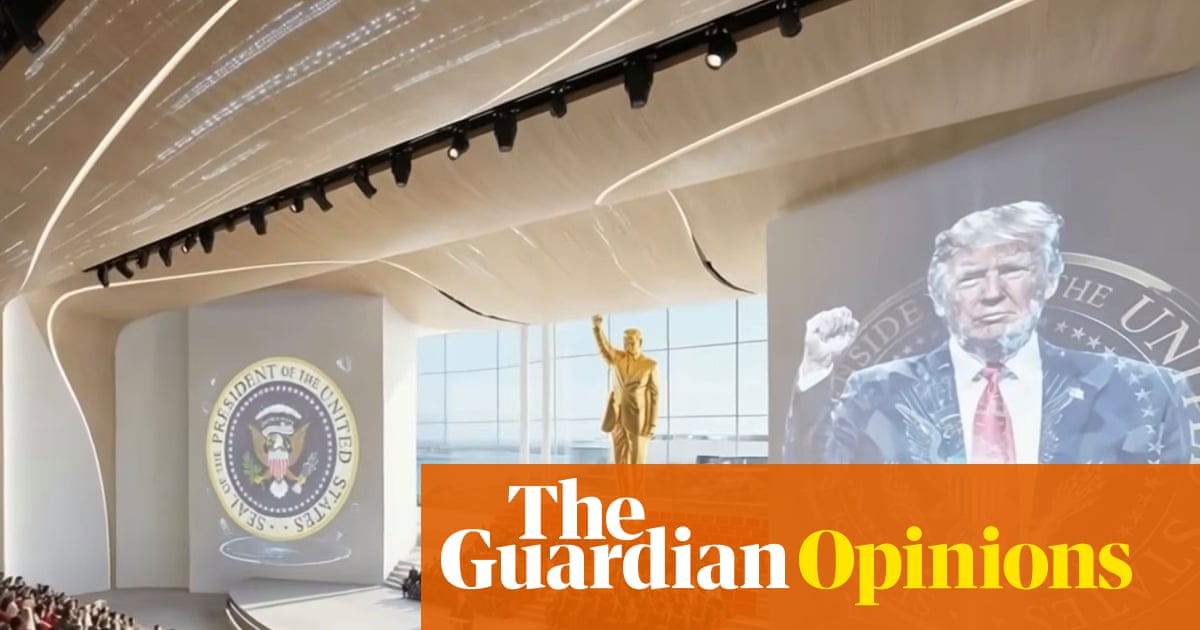

Recently, the Trump administration made two announcements that, on the surface, appeared to be unrelated: a lengthy legal document from the Justice Department that deemed the 1978 Presidential Records Act unconstitutional, and an AI-generated preview of Trump’s proposed “presidential library,” envisioned as a tall building by the waterfront in Miami. Despite their differing natures, both communications conveyed a similar message: the legal opinion, drafted by a judge known for his involvement in efforts to contest the 2020 election results, effectively allows Trump to eliminate evidence of any misconduct; meanwhile, the structure proposed for Biscayne Bay seems less like a traditional library and more akin to a luxurious hotel. Trump reassured skeptics about the library’s potential contents, stating, “I don’t believe in building libraries or museums.” These developments send a clear indication of an intent to evade accountability; it is crucial to begin strategizing against this politically motivated forgetfulness.
The legal opinion, considered by many legal experts to be fundamentally flawed, was authored by T. Elliot Gaiser, an Ohio-based proponent of election denial and a former clerk for Justice Samuel Alito. Gaiser claimed that Congress lacks the authority to mandate the president to preserve records, arguing that the requirement to maintain documentation serves “no legislative purpose” and could hinder the daily operations of the executive branch. The Presidential Records Act originated in response to the actions of Richard Nixon, who sought to control the destruction of his tapes and documents. After Nixon’s attempts to obstruct justice, Congress enacted the Presidential Recordings and Materials Preservation Act in 1974, ensuring government custody of Nixon’s records. Although Nixon challenged this in court, the Supreme Court upheld the legislation, affirming the importance of allowing the American public to access and understand their history. The subsequent Presidential Records Act, which succeeded the earlier legislation, had not been viewed as burdensome until Trump’s presidency.
Trump’s disregard for record-keeping has been evident for some time; following his first term, he took official documents with him to Florida. In an ironic twist, the report by Jack Smith, which resulted in 40 felony charges against Trump for mishandling classified materials, remains unreleased due to the actions of the controversial Trump-appointed judge Aileen Cannon. Furthermore, Trump dismissed the U.S. archivist last year, replacing her with Marco Rubio, who has no significant responsibilities at present. He also engaged the services of the president of the Richard Nixon Foundation, highlighting ongoing concerns about the potential loss of important documents. The implications at stake extend far beyond historical interest; they touch on the public’s right to hold leaders accountable.
Despite claims from Trump’s supporters about his administration being the “most transparent in history,” it has become glaringly obvious that Trump’s second term is characterized by a commitment to impunity and the erasure of historical truths, particularly for individuals willing to undertake illegal actions for him. Even those who took part in the violent events of January 6 received pardons, while individuals who aimed to establish the truth were removed from positions within the FBI and the Department of Justice. Data regarding charges and related videos also vanished from the Justice Department’s website.
These actions convey that Trump’s intentions for his second term extend only to vengeance; however, various influential figures may see his return as an opportunity to advance their own agendas, including interests in extraction industries, cryptocurrency, and extremist groups. There exists a troubling rationale behind the desire to replace a conventional presidential library with a grandiose statue and a private jet in the atrium: what achievements would he have to display?
It remains uncertain whether Trump will attempt to erase history by issuing pardons to his allies. Reports suggest that Corey Lewandowski, working at the Department of Homeland Security, claimed he could act without repercussions because Trump would pardon him, although Lewandowski has denied making such statements. Questions linger regarding whether Kristi Noem and Bondi were granted pardons prior to their dismissals; if Trump aims to maintain their loyalty and prevent any potential disclosures, he likely did not make any promises—he may even overlook some former associates who seek to evade accountability.
The challenge lies in countering this intentional amnesia and fostering accountability, thereby preserving the public’s right to understand its history. Democrats could advocate for the retention of records and condemn the removal of historical content from public platforms, although such efforts may have limited impact on what many consider the most unrepentant administration in U.S. history. They may also consider establishing a truth commission, which could offer a path toward reconciliation; while often criticized, the January 6 commission effectively interrogated witnesses and produced compelling evidence of the violence that some Republican members wish to forget.
As for the presidential pardon power, its origins lie in British monarchy traditions, with the expectation that any president who might abuse this privilege would face impeachment. Alexander Hamilton noted that fears of being perceived as weak would encourage careful use of this authority. While some legal experts have suggested the possibility of lawsuits over corrupt pardons, the Supreme Court’s ruling in 2024 granted the president substantial immunity, a precedent that Gaiser has exploited in his opinion.