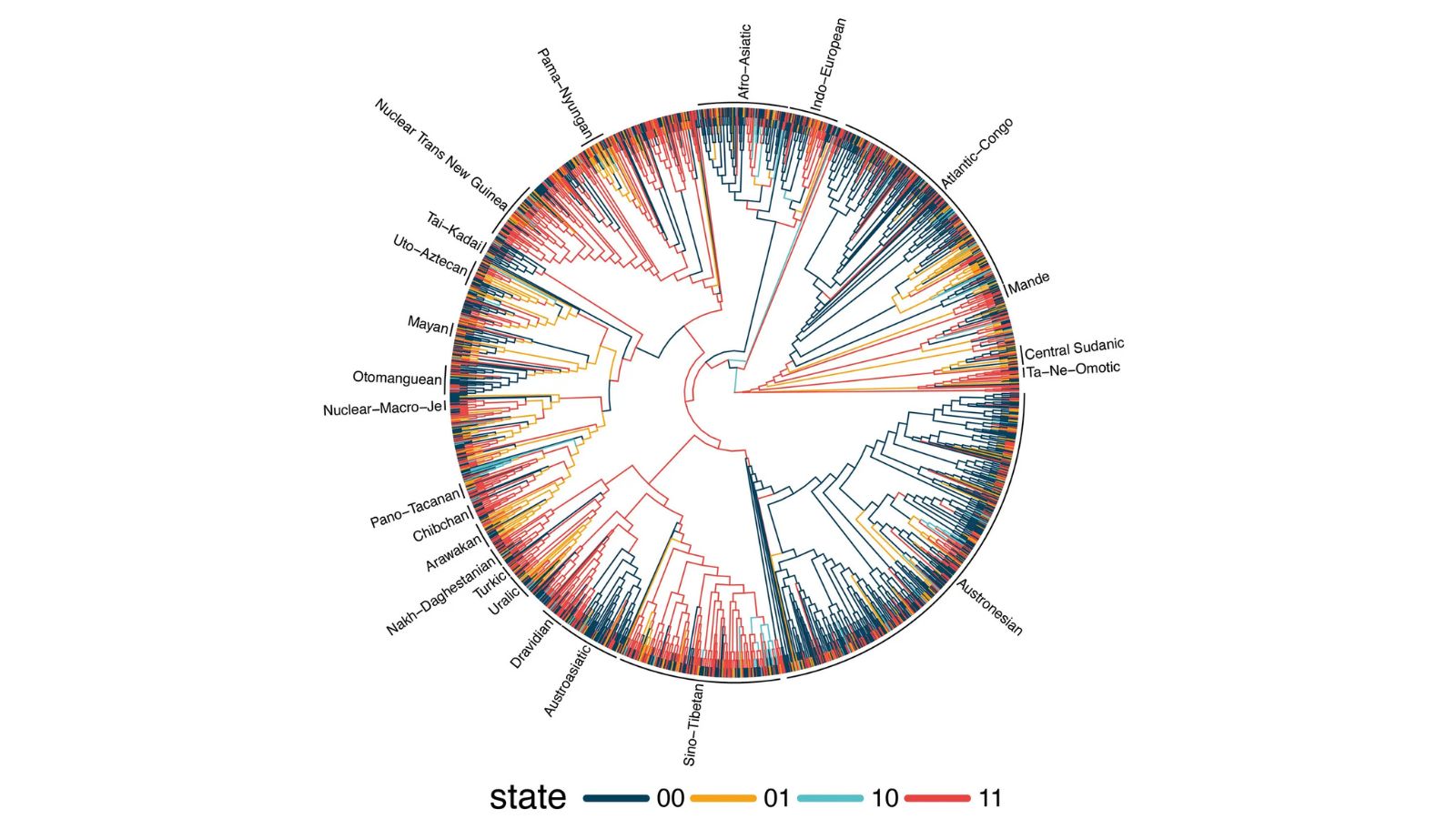

Despite the vast differences in pronunciation and writing among the world’s languages, recent research indicates that there is an underlying order to this diversity. An analysis of over 1,700 languages has revealed that many share structural similarities influenced by human cognitive processes.
This research offers new insights into long-standing discussions within the field of linguistics, supporting the idea that certain “universal” grammar principles do exist.
The study was conducted by an international collaboration led by Annemarie Verkerk from Saarland University and Russell D. Gray from the Max Planck Institute for Evolutionary Anthropology in Germany. Utilizing Grambank—an extensive database that compiles the most comprehensive range of grammatical features—the team examined 191 proposed linguistic universals.
This dataset encompassed languages from around the globe, representing one of the most significant efforts to explore the existence of shared grammatical rules across various cultures and regions.
Historically, linguists have attempted to reduce bias by only including languages from geographically distant areas, under the assumption that similarities in grammar might arise from historical connections or proximity. However, this method had its drawbacks, as it did not fully account for the relationships between languages and their evolution over time.
To overcome these challenges, the researchers applied Bayesian spatio-phylogenetic analysis. This innovative approach allows for the consideration of both the ancestral lineage of languages and their geographic contexts, leading to more impartial findings.
Through this analysis, the researchers found that approximately one-third of the proposed linguistic universals are supported by robust statistical evidence. While not all suggested rules are universally applicable, a significant proportion is indeed valid.
Additionally, the study revealed that language development follows discernible patterns rather than occurring randomly. “Amidst extensive linguistic variety, it’s fascinating to discover that languages do not evolve in a haphazard manner,” Verkerk stated on the Max Planck Society’s website. “I am pleased that our various analyses converged on similar outcomes, implying that understanding language change is crucial for explaining universals.”
This research identifies consistent patterns, such as the order of words in sentences—specifically the placement of verbs in relation to objects—and the organization of grammatical relationships. These recurring features can be found across languages from unrelated families and distinct geographical locations.
This phenomenon suggests that there are underlying factors influencing language evolution. The researchers propose that shared cognitive processes and communicative needs among humans may be pivotal in shaping languages.
Gray elaborated on the team’s viewpoint regarding their findings, stating, “We contemplated whether to present this as a pessimistic analysis—highlighting the many proposed universals that don’t hold true—or an optimistic one—emphasizing the solid statistical backing for around a third of them. Ultimately, we opted to focus on the recurring patterns, demonstrating that common cognitive and communicative pressures guide languages toward a limited array of preferred grammatical solutions.”
By identifying linguistic patterns that persist under close examination, this research not only highlights areas needing further investigation but also sheds light on the influence of human cognition on communication.
Although languages continue to evolve, this study suggests they remain bound by a universal trait inherent to humanity, which shapes how people communicate globally.