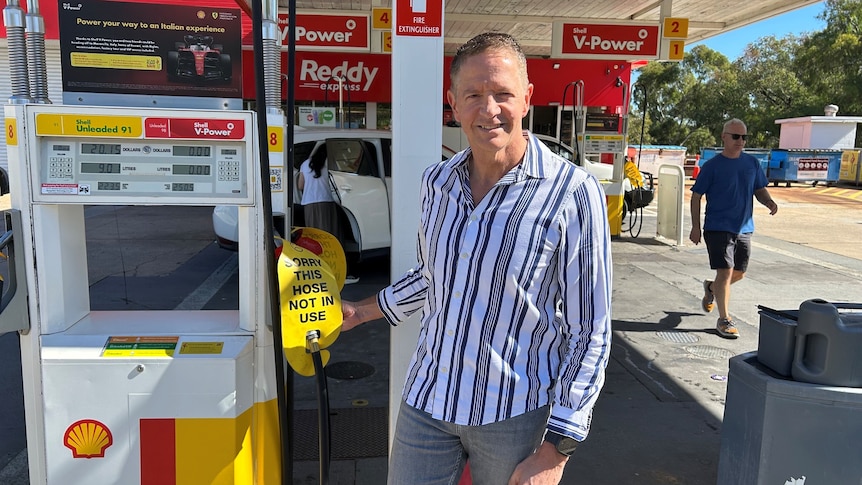

Concerns are rising among service station owners as consumers resort to filling various unconventional containers with fuel amid ongoing panic-buying behaviors. Experts caution that improper fuel storage practices, particularly excessive amounts in residential areas, can lead to significant safety hazards.
Regulations regarding fuel storage in homes are outlined by Australian Standards, yet the enforcement of these guidelines appears inconsistent across different states and territories. The trend of using makeshift containers for fuel stockpiling has caught the attention of authorities, raising alarms about potential dangers.
In the Northern Rivers region of New South Wales, service station operator Shahz Rana has implemented a policy prohibiting the filling of any containers, following instances where everything from large drums to soft drink bottles were being filled at his station. “Initially, we experienced a surge in panic buying. Now, we’ve set a limit of 50 litres per customer,” he explained. “If we notice customers attempting to fill up jerry cans or large containers, we kindly inform them that they are not permitted to do so. Fuel can only be dispensed into their vehicle’s tank.”
David Leaney, a lecturer at the Australian National University specializing in global supply chains and fuel management, emphasized the risks associated with using inappropriate containers for fuel. “Fuel should never be stored in containers not designed for it,” he warned. He noted that water containers, believed to be watertight, are not suitable for fuel storage as they cannot withstand the chemical composition over extended periods.
Mr. Leaney pointed out that non-compliant containers may lack the necessary structural integrity to manage fuel’s expansion, contraction, or gas buildup. In severe cases, fuel could leak from such containers, or flammable fumes could ignite if exposed to nearby sparks. “For instance, if fuel is stored in a garage just two meters from where tools like drills or circular saws are used, sparks could ignite the fumes, leading to an explosion,” he stated.
Joshua Fischer, Deputy Commissioner of Fire Rescue Victoria, echoed these safety concerns, advising against the storage of fuel within homes, including kitchens, bedrooms, or garages. “This includes areas near appliances such as hot water systems, refrigerators, or power tools,” he cautioned. “Petrol vapour, being heavier than air, can travel along the ground to an ignition source, posing a risk of flash fires even without direct contact with the fuel.”
Regulatory measures for fuel storage differ across states and territories, with some jurisdictions imposing severe penalties for unsafe practices. In New South Wales, for example, transporting over 1,000 litres of fuel requires a vehicle placard, while carrying more than 500 litres in a single container mandates both a placard and a dangerous goods license, a requirement mirrored in Victoria.
Australian Standards stipulate limits for fuel storage in residential settings under AS1940, which dictates that petrol storage is restricted to 5 litres within a dwelling, 25 litres in an attached garage, 100 litres in an outdoor structure within one meter of a house, and 200 litres in an outdoor structure more than three meters away. Diesel storage limits are set at 50 litres within a dwelling, 100 litres in an attached garage, and 500 litres in an outdoor shed or garage.
However, the enforcement of these regulations is less clear-cut. In New South Wales, local councils are responsible for regulating home fuel storage, yet inquiries to several councils regarding their specific regulations yielded no responses. In Victoria, the WorkSafe department oversees domestic petrol storage under the Dangerous Goods Act, where reckless storage could result in penalties of up to 10 years in prison or fines exceeding $700,000. Safework Tasmania indicated that while they do not regulate fuel storage in private residences, additional regulations apply for quantities exceeding 250 litres of petrol under workplace safety laws.
Mr. Leaney concluded by stressing the importance of common sense in fuel storage practices. “Panic buying is currently the largest issue affecting our fuel supply chain, and it is crucial for individuals to refrain from excessive stockpiling. Instead, we should aim to fill up in smaller amounts more regularly,” he advised.