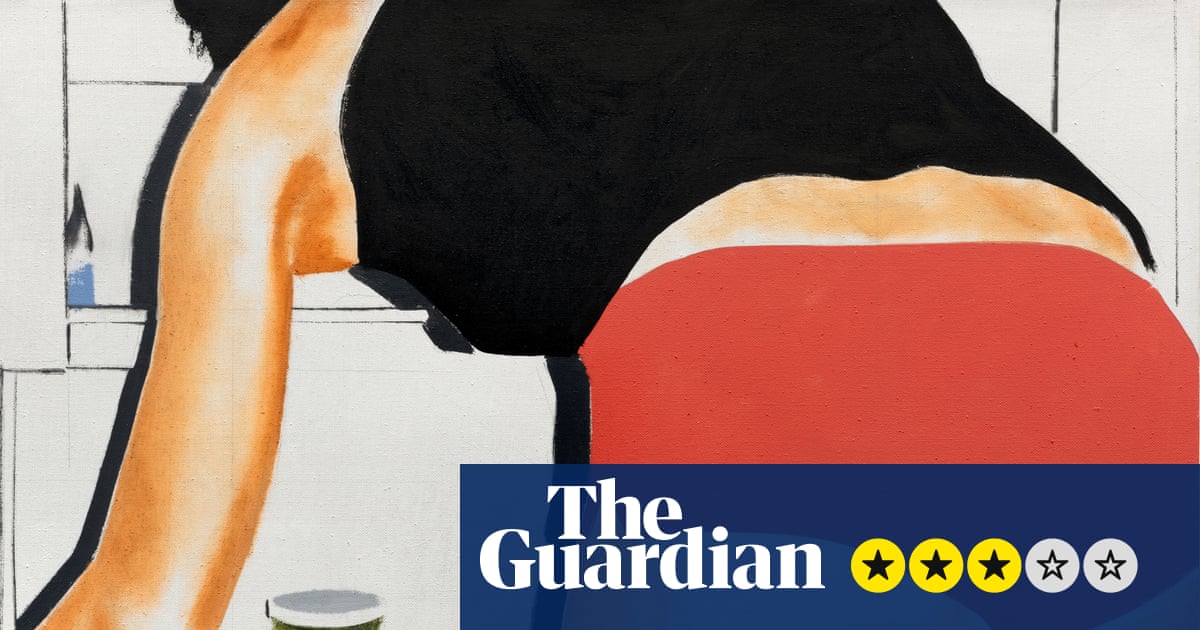

Wilhelm Sasnal has reimagined the ground floor of Sadie Coles’ stylish gallery as a showcase of fragmented imagery, featuring scenes such as the Oval Office, a haunting forest, a shattered tree trunk, depictions of the artist’s wife and daughter, a British post-punk band, and the current U.S. president amidst his advisors, with his face appearing scorched, akin to a photograph marred by a burning cigarette.
Many of these untitled paintings are “broken” in a manner similar to a disconnected online link, making it challenging to trace their origins. For example, it raises curiosity about the actual location of the tree depicted. Additionally, the artworks do not coalesce into a cohesive narrative, prompting questions about the relationship between the disturbing interior of the White House, characterized by garish greens and browns, and a haunting forest. What connection exists between President Trump and the pioneers of industrial music?
As viewers interact with these pieces, certain associations may emerge, driven by our innate tendency to seek patterns amidst randomness. The largest artwork prominently features the cover art of Throbbing Gristle’s provocatively titled album, “20 Jazz Funk Greats.” The title is ironic, given that this notoriously abrasive record was created by a band previously labeled as “wreckers of civilization” by a Conservative MP.
The album cover captures the band’s members posed in a serene landscape, resembling eager participants in the English folk revival. While Cosey Fanni Tutti appears innocuous, Genesis P-Orridge’s vacant stare hints at darker undertones, as the seemingly idyllic backdrop is the infamous Beachy Head—a location known for its tragic history of suicides.
Those familiar with Sasnal’s work may recognize parallels between the broad grass fields in which the band stands and the artist’s 2003 painting “Shoah (A Forest).” This juxtaposition connects a cultural artifact, like “20 Jazz Funk Greats”—an album one might display to signal progressive taste—with the Holocaust. Such associations can be jarring for gallery visitors, though they do not represent the most disquieting link.
As both a painter and filmmaker, Sasnal employs a montage-like technique that intertwines disparate images to suggest new meanings, reminiscent of cinematic techniques seen in films like “2001: A Space Odyssey.” This approach hinges on the viewer’s capacity to bridge contrasting elements, making the inclusion of the artist’s tender portrayal of his wife and daughter within this exhibition’s tapestry of violence and corruption particularly challenging. Any attempt to reconcile these images can feel inappropriate.
History often serves as a protective force for our loved ones, yet in this exhibition, the concepts of family and history are merely separated by a thin line, akin to the delicate division in poetry. In today’s social media landscape, even this fragile boundary has eroded, allowing personal moments to coexist with global tragedies, contributing to a crisis in visual perception—an issue that Sasnal’s artwork encapsulates.
On the upper level, there is a portrait of the artist’s son, Kacper, depicted lounging on a sofa with a book, reaching for his laptop like God extending his hand to Adam. This image contrasts the focused introspection typical of 19th-century portraiture with a contemporary distraction, as Kacper flits between various media. The unfolding of history is continuously present on our screens, yet we struggle to disengage.
Kacper’s portrait is accompanied by two smaller pastoral scenes that evoke tranquility. Similar to Sasnal’s reinterpretation of Georges Seurat’s “Bathers at Asnières,” these works feature solitary men by riversides. One figure draws from William Tylee Ranney’s 1850 painting, “The Lazy Fisherman.” While many fathers might encourage their sons to step away from screens and embrace the outdoors, Sasnal’s perspective is not one of naive optimism. His grandmother’s recollection of the summer of 1939, when the river near his hometown of Tarnów was filled with bathers, serves as a reminder that even idealized moments are vulnerable to historical context.
Following the dynamic opening of the exhibition, the upstairs galleries struggle to maintain viewer engagement, as family portraits and vacation scenes dominate. Lacking the confrontational elements present in the earlier sections, the energy wanes, leading to a sense of monotony by the time one encounters scenes of a band performing and two banal depictions of figures in shorts. Consequently, I found myself returning to the initial room, attempting once again to unravel its meaning.
Ultimately, I was unable to achieve clarity, and perhaps that is the intended message. Montage seeks to unveil deeper truths through the juxtaposition of contrasting images; however, Sasnal’s works do not fulfill this promise. Instead, they evoke a profound sense of discomfort. The coexistence of good and evil defies simple explanations, and we cannot entirely shield our loved ones from the weight of history. In a dual portrait, Rita and Anka turn away from the viewer, as if to protect themselves from scrutiny. They gaze out at a serene sea, distancing themselves from the surrounding horrors depicted on the walls.
“Wilhelm Sasnal: Family/History” is on display at Sadie Coles HQ in London until May 23.
For those in the UK and Ireland, Samaritans can be reached at 116 123, or via email at jo@samaritans.org or jo@samaritans.ie. In the United States, the 988 Suicide & Crisis Lifeline can be contacted at 988, or through their chat service at 988lifeline.org. In Australia, Lifeline offers support at 13 11 14. Additional international helplines are available at befrienders.org.