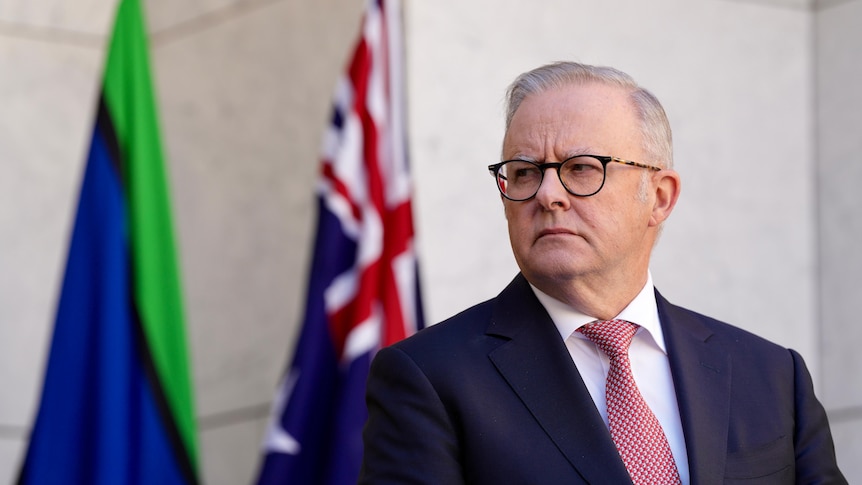

Australian Prime Minister Anthony Albanese has expressed concerns regarding Donald Trump’s recent statements on social media, branding them as unsuitable for a sitting president of the United States. Just before announcing a ceasefire with Iran, Trump made a provocative post threatening that “a whole civilisation will die tonight, never to be brought back again.” This statement drew immediate scrutiny.
Trump declared that the United States would halt military actions against Iran for a duration of two weeks, contingent upon the reopening of the Strait of Hormuz, a vital route for global oil transportation. Albanese condemned Trump’s language, emphasizing that such rhetoric is inappropriate for a leader representing the United States.
As the situation unfolded, the Australian government’s response evolved throughout Wednesday morning. Initially, several Labor party members refrained from commenting on the matter until Albanese addressed the ceasefire during an unanticipated television interview. In stark contrast, Nationals leader Matt Canavan vehemently criticized Trump’s escalating threats in two interviews prior to the ceasefire announcement, asserting that such language is unacceptable and has no place in diplomatic discourse.
Canavan, who has previously voiced skepticism regarding the conflict, insisted on the necessity for Australia to urge its American allies to rapidly de-escalate tensions. He remarked that the situation had quickly spiraled out of control, a common occurrence in such scenarios, and emphasized that now is the time for the Australian government to clarify its stance against this type of confrontational approach.
Welcoming the proposed two-week suspension of U.S. attacks, Albanese described it as “positive news,” expressing hope that it would lead to a long-term resolution and de-escalation of the conflict. Trump revealed this development shortly before his self-imposed deadline for reaching an agreement.
In response to Trump’s alarming social media comments, Albanese stated that he found such language inappropriate for a U.S. president and acknowledged the potential for public concern. He reiterated that any military engagement must adhere to international law, ensuring the protection of civilians not involved in the conflict.
This shift in rhetoric from Labor was notable compared to their earlier remarks leading up to the ceasefire announcement, where some frontbenchers had chosen not to directly address Trump’s aggressive comments. Resources Minister Madeline King had previously stated the importance of allowing the U.S. president to manage his own social media presence without Australian interference.
Assistant Foreign Affairs Minister Matt Thistlethwaite also emphasized the need for de-escalation and compliance with international law during an earlier interview. Employment Minister Amanda Risworth echoed similar sentiments, focusing on the urgency of reducing tensions and upholding international legal standards. Attorney-General Michelle Rowland had avoided commenting on Trump’s prior threats against Iranian infrastructure, reaffirming Australia’s serious commitment to its international legal obligations.
Within the Coalition, views diverged regarding the conflict. Canavan’s remarks urging Albanese to take a stand against U.S. actions contrasted sharply with Liberal leader Angus Taylor’s initial approval of the American military strategy. Taylor sidestepped questions about Albanese’s condemnation of Trump, stating that while he wouldn’t use Trump’s exact words, he was focused on the outcome, specifically the reopening of the Strait of Hormuz. He expressed support for the ceasefire and the resumption of shipping activities.
Additionally, Liberal frontbencher Andrew Hastie had previously criticized the war initiated by the United States and Israel, describing it as a significant error. He argued that given Australia’s close relationship with the U.S., it has the right to pose challenging questions regarding military decisions made without prior consultation with allies.