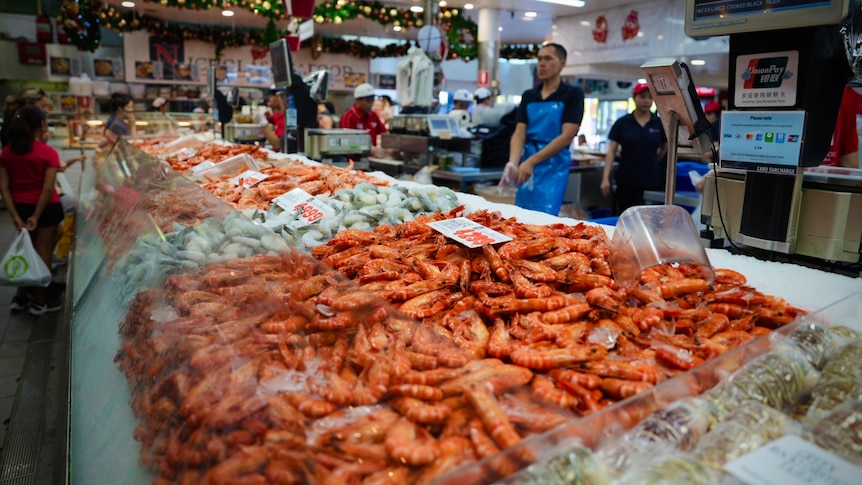

Seafood prices in Australia are anticipated to rise significantly unless fuel supply issues are resolved. Paul Schenk, the general manager of Mooloolaba Fisheries, has stated that without intervention, wild-caught seafood will only be affordable for the affluent.
The Seafood Industry Association is advocating for consumers to prioritize Australian seafood over imported alternatives. Currently considered a luxury, sustainably sourced wild-caught seafood may soon be out of reach for the average Australian household, according to Schenk, due to ongoing uncertainty regarding fuel supplies.
“The harsh reality is that in the near future, only the wealthy will be able to afford Australian wild-caught seafood,” Schenk expressed.
According to Seafood Industry Australia, only 30 percent of seafood consumed nationwide is sourced locally, with the majority being imported. In a surprising move, Mooloolaba Fisheries is now exploring the possibility of purchasing fish fillets from Bali for the first time in its 42-year history.
“I believe the local wild-caught industry is already struggling,” Schenk remarked. “We are on the brink of collapse. While it may not be a total wipeout, it will be a significant loss.”
During a recent unloading of three boats by Mooloolaba Fisheries, Schenk noted that two of the vessels consumed between 30,000 and 35,000 liters of fuel per trip. “Before the war began, it cost $54,000 to fill each boat; today, it’s $100,000 upfront,” he added.
The Australian seafood supply has already been compromised by a recent permanent ban on commercial fishing for demersal species along an 800-kilometer stretch of Western Australia. Furthermore, the collapse of A Raptis and Sons, Australia’s largest wild-caught prawn operation after 60 years in business, is further disrupting the seafood supply chain.
Mooloolaba Fisheries had been sourcing two tonnes of reef fish and one tonne of flathead weekly from Raptis, along with at least one tonne of Australian prawn meat or cutlets monthly. Administrators appointed in March indicated that this wholesale seafood business is likely to cut over 200 jobs across South Australia and Queensland while liquidating assets.
“This is a devastating blow to the industry,” Schenk lamented. Adam Mourad, chief commercial officer at Sydney Fish Market, also shared his condolences, emphasizing the emotional toll on those connected to Raptis. “We extend our thoughts to everyone impacted, including the fishermen and the team at Raptis,” he stated.
Mourad expressed gratitude to customers who heeded the industry’s call to support local seafood during the recent Easter weekend, noting that the markets experienced record attendance, with around 65,000 visitors on Good Friday alone.
In response to rising costs, the Sydney Fish Market recently implemented a temporary levy of 81 cents per kilogram on seafood sold at auction. This measure is intended to support commercial fishers, with an average daily sale of about 50,000 kilograms, primarily consisting of wild-caught seafood. “This levy will be reassessed every two weeks as fuel prices fluctuate,” Mourad explained.
John Ackerman, CEO of Seafood Industry Australia, announced that starting July 1, the existing Country of Origin labeling found in supermarkets will be extended to menus in Australian restaurants and cafes. The new “AIM” labeling system will categorize seafood as either “A” for Australian, “I” for imported, or “M” for mixed origin. “We encourage consumers to watch for the prominent ‘A’,” Ackerman stated.
Kyri Toumazos, executive officer of Seafood Industry South Australia, noted that the industry’s profitability is on the decline. “We are willing to accept lower profits to ensure seafood availability for the local community in the short term, but this unsustainable cost structure cannot persist indefinitely,” he remarked.
In Victoria, Anthony Woodland, general manager of Lakes Entrance Fishermen’s Co-operative, mentioned that while fishers currently have access to fuel, the future remains uncertain. “For larger boats to continue fishing, several factors must align,” he said. “Some vessels have already ceased operations, finding the current fuel prices unmanageable for their type of fishing.”
Heidi and Pavo Walker, founders of Walker Seafoods, Australia’s largest wild-caught tuna and swordfish company based in Mooloolaba, expressed that the ongoing fuel crisis is severely impacting their business, despite having weathered past economic challenges. “We are considering tying up our boats until conditions improve,” Ms. Walker stated.
Walker also pointed out that the federal government’s decision to reduce the fuel excise and lower heavy vehicle road use charges is a step in the right direction.