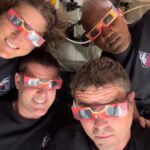

While the thrilling aspects of the Artemis II mission capture the imagination, it is the everyday experiences of the four astronauts orbiting the Moon that create a relatable connection. From their hair floating in zero gravity to playful interactions during a call with the President, and the cheerful wake-up music curated by NASA, which includes popular tracks from artists like Chappell Roan and CeeLo Green, these moments add a human touch to their extraordinary journey.
So far, there have been no reports of the astronauts experiencing any strange sounds reminiscent of the eerie whistling noted during the Apollo 10 mission in 1969 when the crew lost contact with Earth. The astronauts of Apollo 10 reported an unsettling noise while on the far side of the Moon, a phenomenon that sparked various conspiracy theories due to the delayed public release of the transcript until 1973. This sound was eventually attributed to interference between two VHF radio transmitters aboard the spacecraft, rather than any extraterrestrial communication.
Imagining the Apollo 10 astronauts in that moment—cut off from Earth’s signals and enveloped in cosmic solitude—heightens the intrigue. The unsettling sounds ceased once they re-established communication with Houston, which only added to the mystery surrounding their experience.
It is important to note that actual sounds do not exist in the vacuum of space, as there is no atmosphere to carry sound waves. Instead, space is filled with electromagnetic energy, which poses a threat to the safety of the Artemis astronauts, who are shielded only by a thin layer of aluminum and glass. However, this electromagnetic radiation can be transformed into sound frequencies through a process known as “sonification,” allowing us to perceive the energy of celestial bodies as sound.
NASA’s sonifications evoke profound emotions and wonder, providing a tangible connection to the dynamics and energies of planets like Jupiter and Saturn. For instance, the Huygens probe’s landing on Titan, Saturn’s moon, offers a direct auditory experience without the need for sonification due to Titan’s dense atmosphere, creating an extraordinary link between our world and another.
Author Samantha Harvey beautifully articulates the essence of these cosmic sounds in her Booker Prize-winning novel, “Orbital,” where she describes the soundscapes of planets in vivid terms. Her final reflections center on Earth, depicting its light as a harmonious blend of countless elements that briefly unite before dissolving into a chaotic symphony of the universe.
Harvey’s analogies resonate not only artistically but also scientifically. The ancient Greeks spoke of the “music of the spheres,” a concept linking cosmic ratios to musical vibrations. In contemporary physics, Michio Kaku theorizes that the universe’s fundamental structure is akin to cosmic music resonating through multiple dimensions.
This interplay between sound and the universe reflects a profound connection; every aspect of existence, from dark matter to supernovae, is composed of vibrating energy frequencies, paralleling the music we experience on Earth. Although silence reigns in the cosmos—consistent with Ridley Scott’s portrayal in “Alien” that “in space, no one can hear you scream”—the universe is alive with dynamic frequencies that produce harmonious and dissonant sounds alike.
In the realm of music, Sir Karl Jenkins’ “The Armed Man: A Mass for Peace,” dedicated to the victims of the Kosovo War, has recently become the first piece by a living composer to top Classic FM’s Hall of Fame. Reflecting on the enduring impact of his 1999 composition, Jenkins emphasized the importance of music in honoring those lost and fostering hope for healing.
However, I personally find Benjamin Britten’s “War Requiem” to be the most poignant anti-war choral work of our era. Premiered in 1962 during the consecration of Coventry Cathedral, rebuilt after World War II bombings, it powerfully critiques the nature of humanity’s propensity for war and offers a chance for reflection and transformation. Regrettably, Britten’s work is absent from the Hall of Fame, which I hope will change in the future.
This week, Tom has been enjoying the performances of pianist Olga Pashchenko, who describes herself as a “keyboard diversity advocate” on Instagram. Her recordings of Mozart’s piano concertos, particularly No. 17, showcase an improvisational style that breathes new life into Mozart’s original performance practices.