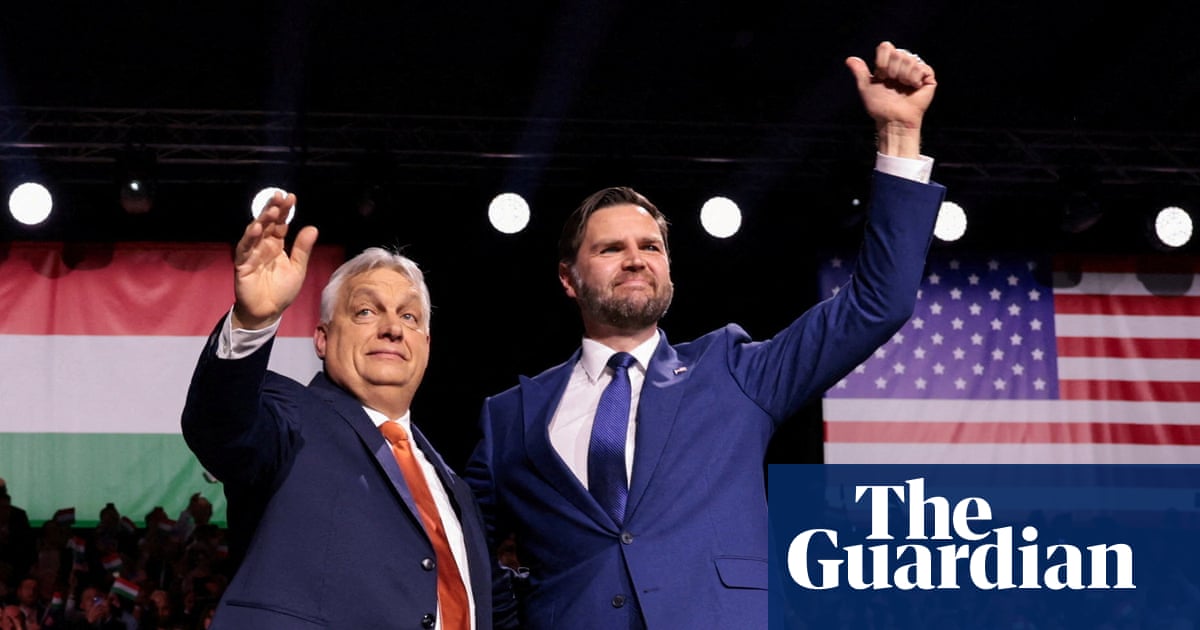

JD Vance has refuted allegations suggesting that the United States is meddling in Hungarian politics, labeling these claims as “darkly ironic.” This response follows polling data indicating that the opposition Tisza party may secure a supermajority in the upcoming elections.
During his initial day in Budapest, Vance criticized the European Union, claiming it is responsible for one of the “worst examples” of foreign interference. He spent part of Wednesday morning addressing a think tank and educational institution associated with Hungary’s Prime Minister, Viktor Orbán.
With only four days remaining before Hungarians head to the polls and Orbán trailing in most surveys, Vance recognized the uniqueness of his visit. “It’s unprecedented for an American vice-president to come the week before an election,” he stated, explaining his decision was based on what he termed the “garbage happening against” Orbán during the campaign. “We had to show that there are actually lots of friends across the world who recognize that Viktor and his government are doing a good job and are important partners for peace,” he added.
Despite his efforts to support the struggling campaign of the right-wing populist leader, whose version of “illiberal democracy” has inspired the MAGA movement, Vance asserted that this did not equate to foreign interference. “I find it darkly ironic that people are accusing me of engaging in some kind of foreign influence,” he remarked.
In response, the German government dismissed Vance’s allegations, asserting that the EU is not involved in Hungary’s electoral process. A spokesperson stated, “The fact that Vance is in Hungary already shows, or speaks for itself, who is interfering in what.”
Though the EU refrained from extensive commentary on the issue, a spokesperson indicated that the bloc would communicate its concerns through diplomatic channels to Washington.
On the previous day, upon Vance’s arrival with his wife, Usha, Péter Magyar, the leading opposition candidate, issued a clear statement: “No foreign country may interfere in Hungarian elections. This is our country. Hungarian history is not written in Washington, Moscow, or Brussels – it is written in Hungary’s streets and squares.”
Magyar, a former member of Fidesz’s inner circle, gained prominence two years ago after he publicly accused Orbán’s party of widespread corruption. His claims have evolved into a campaign that has significantly mobilized voters’ frustrations over declining public services, rising housing costs, and economic stagnation, making the upcoming election one of the most pivotal in recent history.
The campaign has become highly polarizing, with Orbán and Fidesz framing the EU and Ukraine as major threats to Hungary, casting the election as a stark choice between peace and conflict, while Magyar has concentrated on domestic concerns.
On Wednesday, a forecast from the polling agency Median suggested that the Tisza party could achieve a two-thirds majority in Hungary’s 199-seat parliament. Although accusations of vote-buying and gerrymandering complicate predictions, a Tisza supermajority would empower the party to amend the constitution and key legislation, potentially unlocking EU funds.
As Vance engaged in Hungarian electoral matters, he appeared to align with Orbán’s narrative, attributing Hungary’s challenges to the EU despite evidence indicating that the country has received more EU funding than any other major post-communist nation, both in terms of GDP and per capita. Furthermore, studies have shown that Orbán’s administration has been linked to increased corruption in the EU.
Vance also criticized Ukrainian President Volodymyr Zelenskyy, describing his remarks as “completely scandalous” and accusing Kyiv of manipulating energy supplies to exert influence over Hungary. This comment referred to Zelenskyy’s controversial statements made after Orbán vetoed additional EU sanctions against Russia and a significant loan for Ukraine. These remarks reportedly led to European allies urging Zelenskyy to temper his rhetoric.
Expressing disappointment in European political leadership, Vance noted their lack of interest in resolving the conflict, contrasting this with Orbán’s stance, which diverges from most EU nations by refusing to provide financial or military assistance to Ukraine. Vance claimed that Orbán had been instrumental in helping the U.S. appreciate the perspectives of both Ukrainians and Russians.
Throughout his visit, Vance did not address the recent controversies highlighting Russian influence on Orbán’s government, including allegations that Russian intelligence services were attempting to sway the election and a reported conversation in which Orbán assured Vladimir Putin, “I am at your service.”
Amid accusations against Hungary’s foreign minister, Péter Szijjártó, for allegedly sharing confidential EU meeting details with the Russian foreign minister, leaked audio suggested Szijjártó promised to amend the EU sanctions list to align with Russian interests.
On Tuesday, Vance suggested that the resolution to the ongoing Russian invasion of Ukraine might require territorial concessions from Kyiv. “We’re talking about haggling at this point over a few square kilometers of territory in one direction or another,” he remarked.
As Vance arrived in Budapest to rally support for Orbán, Senator Jeanne Shaheen, a leading Democrat on the Senate Foreign Relations Committee, highlighted his omission regarding Hungary’s relationship with Russia. A recent report indicated that Hungary’s dependence on Russia has increased since the onset of the full-scale invasion.