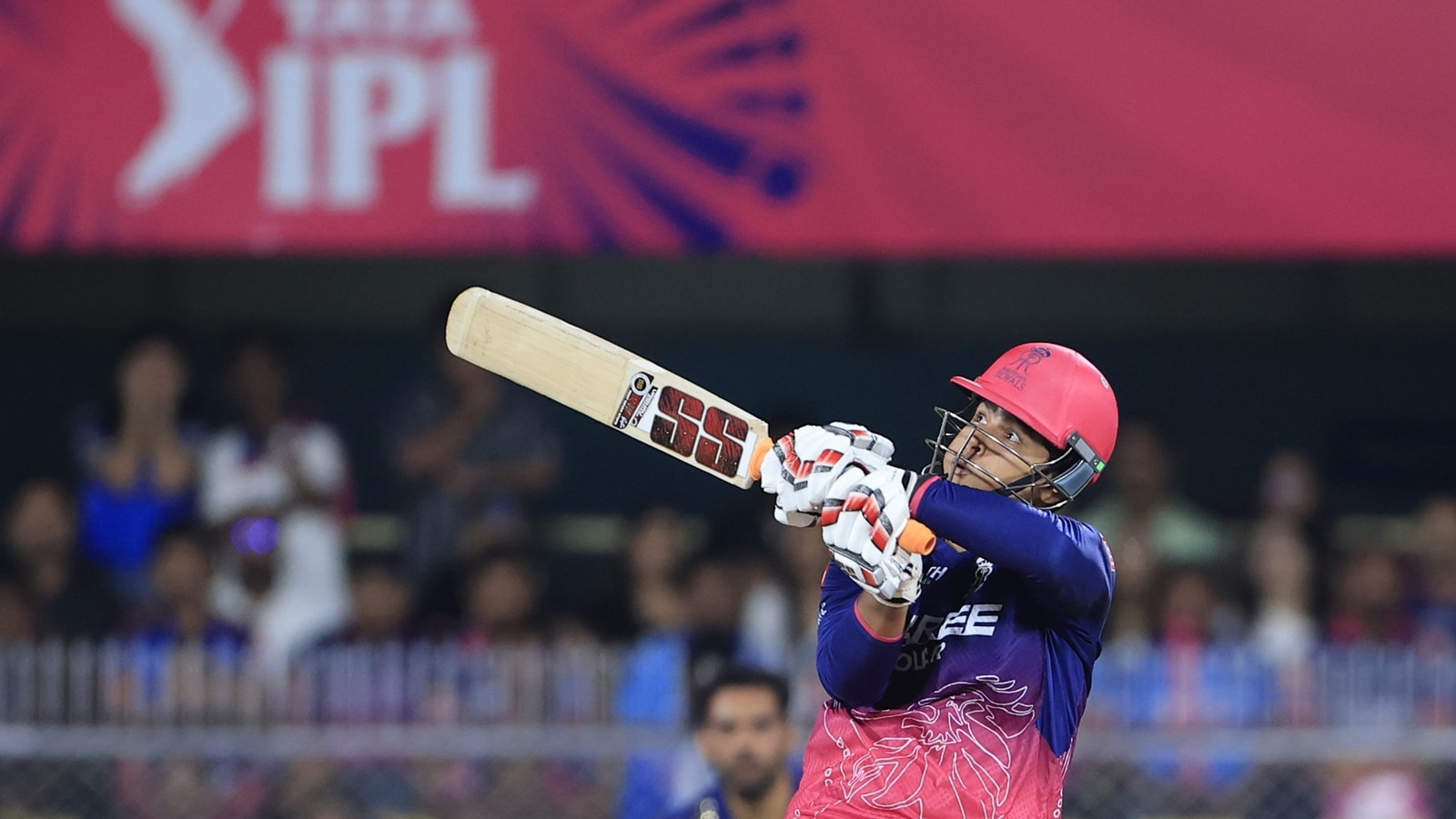

On Tuesday, the persistent rain in Guwahati paused just in time for the eagerly awaited IPL match between the Mumbai Indians and Rajasthan Royals. As Jasprit Bumrah delivered his first ball, it found its way into the hitting zone on the leg-and-middle line, and Vaibhav Sooryavanshi’s bat was perfectly positioned. The ball soared toward the long-on stands, showcasing Sooryavanshi’s distinctive high backlift, which captivated the audience once again.
Zubin Bharucha, who has coached Sooryavanshi since he was 13, commented, “Whenever someone mentions that his backlift is too high and could lead to problems, I can’t help but laugh. He’s hitting deliveries at speeds of 155 kmph, facing bowlers like Bumrah and Jofra Archer. That’s his unique strength, and it sets him apart.”
Bharucha elaborated on the significance of Sooryavanshi’s backlift, which he believes provides “time and space.” These are critical elements that batsmen strive for but often struggle to achieve against top-tier fast bowling. “The idea that his high backlift could cause him to be late on the ball is a misconception. The swing of the bat actually allows him more time, which many refer to as playing late. The farther back he positions the bat, the more time he creates, and the wider the swing goes, the more space he has. This is part of his unique batting style,” Bharucha explained.
Reflecting on his first encounter with Sooryavanshi at the trials, Bharucha recalled noticing the young player’s unique gait and grip on the bat. When he inquired about Sooryavanshi’s cricket idol, he expected a contemporary player like Rishabh Pant, but was surprised to hear, “Nahi sir, Brian Lara.”
Bharucha was impressed; it was unusual for a 13-year-old from Bihar, who likely only saw Lara play through videos, to idolize a player whose career had already concluded. However, the influence of Lara was evident the moment Sooryavanshi played his first ball. “Sanju Samson has a high backlift that reaches almost above his head, while Riyan Parag’s goes even higher. Dhruv Jurel’s is moderate, and Yashasvi Jaiswal’s also rises significantly. Yet, no one matches Vaibhav in how his wrists can snap back even further and extend wider,” he noted.
Bharucha highlighted how Sooryavanshi’s backlift goes extraordinarily far back, nearly reaching a vertical position and even further as the wrist snaps the bat back, resembling a catapult action. “This level of flexibility is quite rare, and it appears effortless for Vaibhav,” he remarked.
Additionally, Bharucha observed that Sooryavanshi’s head position at the crease reminded him of Sachin Tendulkar. “Watch how his head leans over his toes while waiting for the bowler, often positioning it outside the off stump depending on his stance,” he advised. While traditionalists might interpret this as a flaw, Bharucha counters that understanding how the upper and lower body move independently shows that a forward-leaning head can still allow the feet to advance toward the ball. “Every batsman should adopt a forward head position like Vaibhav,” Bharucha suggested.
The slight bend in Sooryavanshi’s back that supports this head position is advantageous. “The ball is rarely outside his eyeline; it typically remains within it as he approaches,” Bharucha explained. This capability allows Sooryavanshi to effectively deal with deliveries on the off-stump line. “He can effortlessly redirect the ball to the leg side, facilitating his natural movement toward the ball,” he added.
Bharucha went further, drawing parallels to Tendulkar’s early career. “Look at footage of a young Sachin. His head was positioned over his front foot, just outside the off stump, which helped him avoid LBW issues. It was only later, when he adopted a more upright stance, that he began experiencing such dismissals,” he noted.
This comparison is significant and analytical. The head position that conventional wisdom might label as flawed was, in fact, a key factor in keeping one of cricket’s greatest batsmen free from LBW trouble during the initial phase of his career.
As for Sooryavanshi’s footwork, Bharucha emphasized that the back foot must move forward to maintain balance and facilitate a smooth transition into the shot. “When the back foot remains stationary, that can cause issues with the head position. Like Tendulkar, Vaibhav’s back foot shifts in harmony with his movements, placing him in an optimal position,” he elaborated.
Bharucha also saw elements of Rahul Dravid’s technique in Sooryavanshi. “Do you recall Dravid’s wrist flick to align his bat with the stumps? Once his bat reached its peak during the backlift, he would snap it down with a wrist motion, especially for deliveries targeting the stumps. Vaibhav mimics this from a wider angle, but his elbows remain straight at contact, giving him greater power than Dravid while retaining that stylistic imprint,” he explained.
Sooryavanshi is currently addressing the challenges posed by bowlers who target deliveries on length or back-of-length, responding with impressive bat speed. He effectively deals with full-length balls, but the ones that swing in pose a greater threat. While he manages to execute a Dravid-like wrist snap to redirect the bat quickly, Bharucha noted it’s a work in progress. “At present, the bat often angles toward mid-off, creating an impression of jabbing. We’re focusing on directing his hands toward the umpire, which will enable him to utilize that forward head position more effectively, allowing for straighter drives or flicks to midwicket and square leg,” he explained.
In a recent match against the Chennai Super Kings, left-arm seamer Khaleel Ahmed tested Sooryavanshi’s technique with a delivery that swung in, striking him on the back thigh. The following morning, Bharucha sought to analyze…