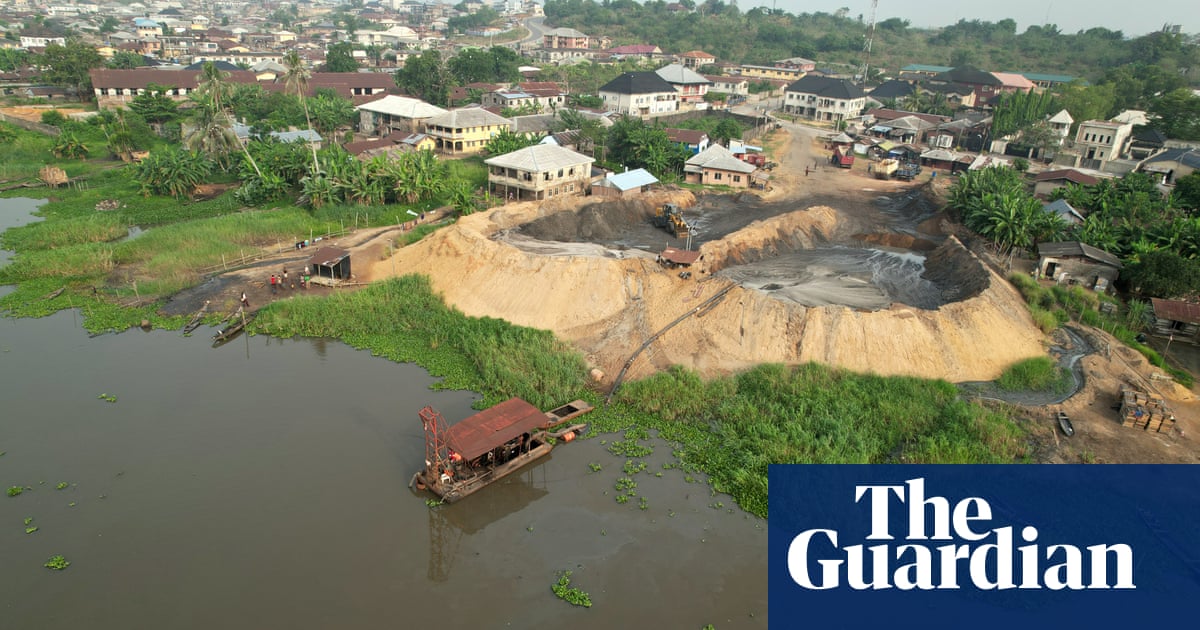

Before the sun rises in Lagos, the sounds of the city’s danfo buses and the hum of generators fill the atmosphere, while the lagoon begins to awaken. This activity is not due to fish jumping or boats moving, but rather the dredging machines, with their extensive suction pipes, extracting material from the lagoon floor and ejecting wet sand for use in constructing high-rise buildings, residential areas, and overpasses.
The process of sand dredging is under the oversight of the Lagos state government and the waterways authority; however, in a bustling metropolis of over 20 million residents where demand for sharp sand is at an all-time high, many dredging operations are occurring outside legal parameters.
A study conducted by the Nigerian Institute for Oceanography and Marine Research (NIOMR) reveals that unregulated dredging has led to a seabed erosion of nearly six meters in the area between reclaimed Banana Island and the nearby Third Mainland Bridge. This region constitutes a vital five-kilometer stretch of the primary lagoon channel that connects the island districts of Lagos to the mainland.
The impact of dredging is visible along the shores of the Lagos Lagoon in Epe, where dredging barges are active, leaving behind sediment trails as they extract resources from the riverbed.
Dr. Nnimmo Bassey, director of the Health of Mother Earth Foundation (Homef), emphasizes the consequences of large-scale dredging without adequate environmental assessments, stating, “It devastates certain species, jeopardizing fisheries and the livelihoods of those who rely on them.”
The repercussions of dredging stretch beyond the immediate vicinity, resulting in significant ecological harm and threatening local fisheries, marine biodiversity, and the coastal communities that depend on these resources.
Communities along the Lagos coast, including Epe, Oto-Awori, Era Town, and Makoko, are facing these challenges directly.
Fasasi Adekunle, a fisherman from Epe, sets out in his canoe before dawn. For over three decades, he has followed this routine: mending nets, gauging tides, and interpreting the wind. Now, however, the constant noise of dredging machines pervades his mornings.
“In the past, we would cast our nets at 7 p.m. and return before noon with enough tilapia to make at least 30,000 naira (£16),” recounts the 55-year-old Adekunle. “These days, we venture farther, spend more on fuel, and often come back with barely any catch.”
The lagoon, once a reliable source of sustenance, has become increasingly erratic for fishermen and fish traders. “The water is no longer friendly to us,” Adekunle laments.
Residents have expressed concerns that each rainy season brings their homes closer to the encroaching waters. Ogbemi Okuku, a 20-year-old from Era Town, voiced frustration, stating, “As Lagos expands, our land disappears. They construct estates using sand from our waters, but no one is building for us.”
The sand dredging occurring near the busy Third Mainland Bridge spills into Makoko, Nigeria’s largest floating community, where new sandbanks are forming in the lagoon.
Ajoke Orebiyi, a 42-year-old fishmonger in Oto-Awori, shares her struggles as she negotiates for a modest amount of tilapia from a returning fisherman. “Ten years ago, I needed three boatloads to satisfy demand,” she explains. “Now, fishermen are traveling much farther and spending more on fuel, yet they return with hardly anything.”
Her income has plummeted by nearly 50% over the past five years, forcing her to stretch her earnings to cover essentials like food, school fees, and rent. When fish are scarce, prices surge, and despite customer complaints, she has no control over the situation.
Declining fish stocks are a common concern among coastal communities and are frequently attributed to climate change, which alters water temperature, rainfall patterns, and fish distribution. Additionally, fishermen and fish traders report that the lagoon’s bottom has transformed, with deeper channels, murkier waters, and turbulent currents causing nets to get snagged on an uneven surface.
Experts indicate that dredging contributes to increased turbidity, muddying waters and disrupting breeding habitats. However, for those reliant on daily harvests, survival takes precedence over scientific explanations.
Elizabeth Ayara and Balogun Taiwo, fishmongers in Epe, report significant difficulties in making a living as their sales have dwindled due to the ongoing dredging of the lagoon.
The situation in Lagos reflects a broader global narrative. Sand, the second most extracted resource after water, is essential for concrete, glass, and asphalt production. Coastal and marine sand, particularly sharp sand, is highly prized by the construction industry.
However, in Lagos, the implications are particularly dire due to its low-lying, flood-prone geography, which is susceptible to rising sea levels and sediment disruption.
Dr. Joseph Onoja, director general of the Nigerian Conservation Foundation (NCF), cautions that unchecked dredging threatens more than just fish populations, endangering sea turtle nesting sites and habitats for migratory birds, potentially driving regional species towards extinction.