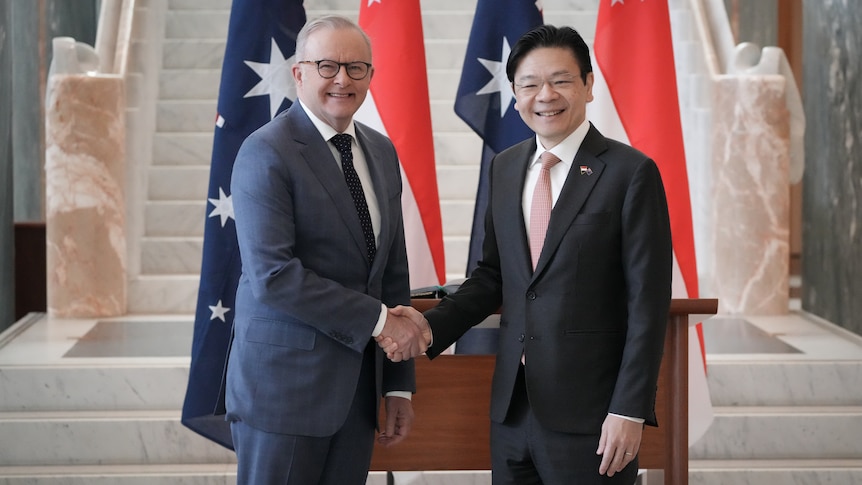

The Prime Minister of Australia is set to engage in discussions with his counterpart from Singapore as the ongoing international fuel crisis unfolds.
Anthony Albanese is scheduled to depart for Singapore on Thursday, following revelations about Australia’s vulnerabilities in fuel supplies due to the conflict in Iran.
This visit is part of a broader strategy by the government to strengthen partnerships with regional allies to enhance fuel reserves.
Albanese’s trip to Singapore is a response to escalating concerns that the global energy situation could deteriorate significantly if more refineries reduce their output and additional nations implement export restrictions.
As former President Donald Trump announced a two-week ceasefire with Iran, contingent on the regime’s immediate reopening of the critical Strait of Hormuz shipping route, the Prime Minister readied himself for a direct meeting with Singapore’s Prime Minister, Lawrence Wong.
The primary objective of this meeting is to persuade Singapore to prioritize Australia as a fuel supplier should the ceasefire collapse and the situation worsens.
This crisis has laid bare a significant weakness for Australia. Being an island nation, Australia relies on imports for 90 percent of its liquid fuels. A substantial portion of the petrol, diesel, and jet fuel essential for its economy is sourced from Asia.
Singapore stands out as a major oil trading and refining center, serving as Australia’s leading supplier of unleaded petrol. According to Malcolm Roberts, CEO of the Australian Institute of Petroleum, approximately half of the 80 fuel shipments arriving in Australia each month originate from Singapore.
Roberts noted, “Around 55 percent of our petrol comes from Singapore, making it our top supplier for petrol and our second-largest source for diesel and jet fuel. This represents a substantial fuel supply from Singapore.”
Singapore’s three refineries, located on Jurong Island, have the capacity to process up to 1.5 million barrels of crude oil daily; however, their operations have been impacted. The majority of crude oil typically arrives via the Strait of Hormuz, leading to reduced refinery output.
Oriano Lizza, a sales trader at CMC Markets in Singapore, explained that the Singapore Refining Company is currently operating at only 60 percent of its capacity due to supply shortages, highlighting a need for strategic self-sufficiency.
In a pre-recorded message to his citizens, Prime Minister Wong acknowledged the significance of Australia as a key exporter of liquefied natural gas (LNG), especially as Singapore seeks to adapt its production strategies and find alternative crude oil sources beyond the Middle East.
Wong stated, “Our refineries and chemical companies are adjusting their operations while our LNG importers are securing supplies from various global producers. To enhance resilience, we are collaborating with trusted partners, particularly Australia, which supplies over one-third of our LNG needs, and we aim to strengthen this partnership further.”
Albanese’s status as a prominent gas supplier grants him leverage in discussions with Wong. However, there are reservations about how much the Singaporean government may influence private-sector supply agreements.
Anthony Patten, an energy lawyer with Herbert Smith Freehills in Singapore, indicated that the privately owned refineries do not have direct government involvement in their operations. He noted that while there may be encouragement from the Singaporean side regarding the importance of their relationship, any support would likely be informal rather than directive.
In recent weeks, Thailand has restricted its fuel exports, while South Korea and China, major suppliers of diesel and jet fuel to Australia, respectively, have also implemented some export controls.
As part of his diplomatic outreach, Albanese recently discussed energy security with Chinese Premier Li Qiang, with both leaders agreeing on the need for improved government communication concerning energy matters, as noted in an official statement.
Following his visit to Singapore, the Prime Minister is expected to engage with other key fuel suppliers. Ahead of his trip, he also spoke with Sultan Haji Hassanal Bolkiah of Brunei to address fuel issues and the Iran conflict, emphasizing the importance of maintaining global energy supply chains.
Currently, Australia’s fuel supplies are secured until “well into May,” an improvement from the previous week’s assessments, as shipments are typically confirmed about two months in advance. However, with a crucial oil transit point disrupted, supply chains are under significant stress as producers scramble to redirect cargoes to fulfill their contracts.
Fuel that usually arrives from Asia is now being sourced from the Gulf of Mexico, Sudan, and even the United Kingdom, which adds considerable time and costs to shipments.
Roberts remarked, “This is not a conventional approach. The additional shipping time and costs, along with the efforts required to ensure fuel meets Australian standards, are challenges that some of my members are navigating.”
These increased costs are ultimately passed on to consumers, creating pressure on importers who are trying to maintain stability in the supply chain. For the moment, the system is managing to hold up, aided by the Australian government’s commitment to support future fuel shipments.