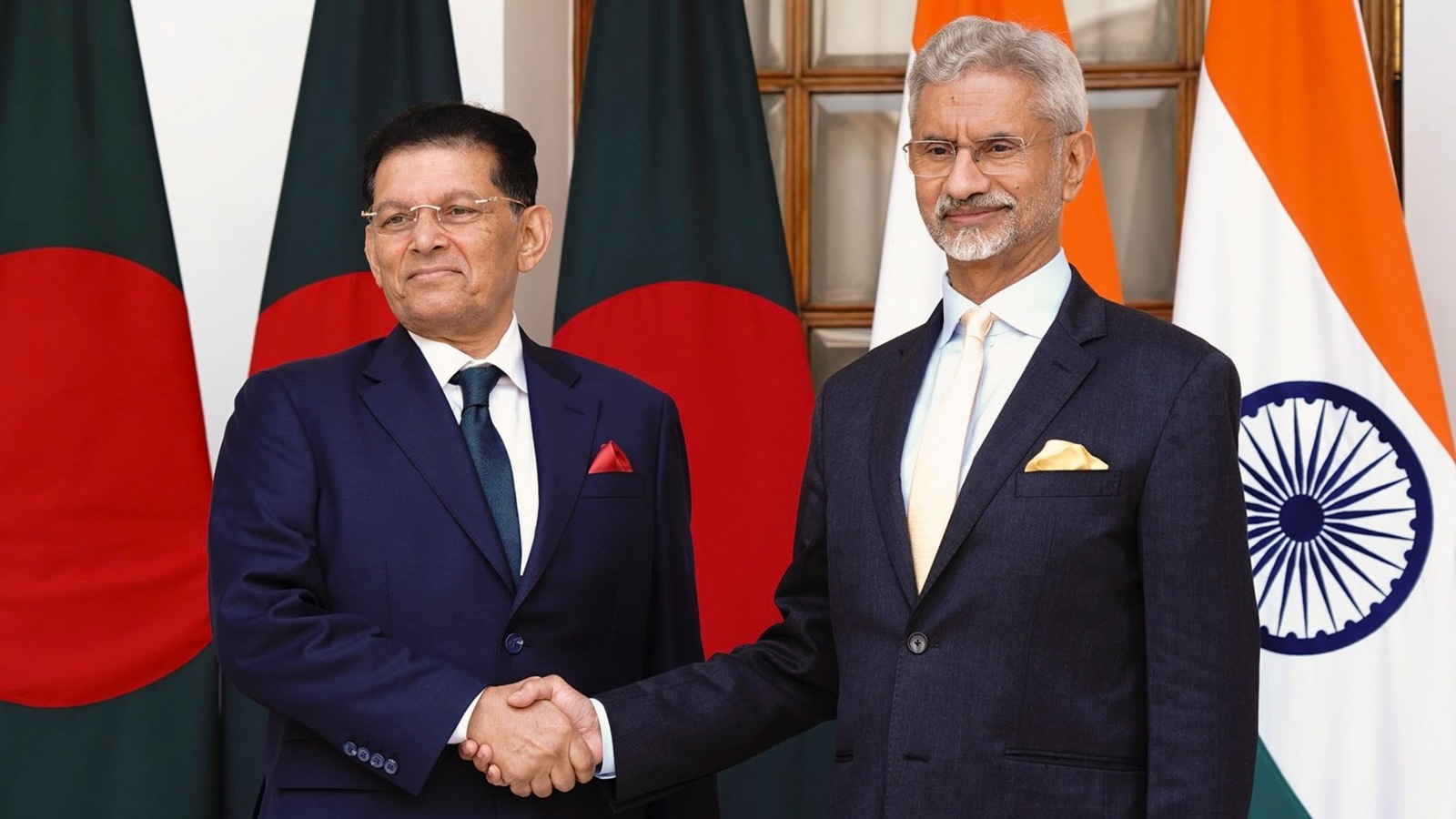

The Foreign Minister of Bangladesh, Khalilur Rahman, has communicated to India’s External Affairs Minister, S. Jaishankar, and National Security Advisor, Ajit Doval, that the newly elected government, led by Prime Minister Tarique Rahman, intends to implement a “Bangladesh First” policy grounded in mutual trust, respect, and reciprocal advantages.
In an official announcement made on Wednesday, the Bangladeshi Foreign Ministry reiterated its demand for the extradition of Sheikh Hasina and her Home Minister, Asaduzzaman Khan Kamal, who have been sentenced to death by the International Crimes Tribunal. Sheikh Hasina has been residing in Delhi since her removal from power following extensive protests in August of the previous year.
The statement also indicated that Bangladesh is seeking an enhancement in the supply of diesel and fertilizers from India.
As per the Ministry of External Affairs in Delhi, Jaishankar expressed India’s willingness to engage constructively with the newly formed government in Bangladesh to further enhance bilateral relations.
The two nations have agreed to investigate initiatives aimed at strengthening their partnership through relevant bilateral mechanisms. Additional official meetings are anticipated in the near future, with both sides exchanging perspectives on regional and global matters of common interest, according to the MEA.
This visit marks the first significant political engagement with Delhi from the new government in Dhaka, which came to power in February after the Sheikh Hasina administration was ousted 18 months earlier.
During his visit, Foreign Minister Rahman, accompanied by Humayun Kabir, Foreign Affairs Adviser to the Bangladeshi PM, met with NSA Doval on Tuesday. The two had previously convened in November when Rahman visited Delhi as NSA.
The discussions emphasized the importance of advancing bilateral relations across various dimensions while also covering significant regional and international issues, as noted by the Bangladeshi Foreign Ministry.
Rahman expressed gratitude to the Indian government for apprehending suspects involved in the murder of youth leader Shaheed Osman Hadi. Both parties agreed that the arrested individuals would be returned to Bangladesh in accordance with the established extradition treaty.
On March 8, two Bangladeshi nationals, accused of Hadi’s murder, were detained in West Bengal’s Bongaon area. Hadi succumbed to his injuries on December 18, 2025, following a shooting in Dhaka six days prior. He had risen to prominence during the 2024 student-led uprising that contributed to Sheikh Hasina’s loss of power. His assassination sparked significant protests and unrest in Bangladesh.
During their talks, Jaishankar mentioned that the issuance of Indian visas, particularly for medical and business purposes, for Bangladeshi nationals would be facilitated in the coming weeks. Visa issuance had been restricted during the Yunus-led interim government, with Bangladesh also pausing visa processes during the elections; however, operations resumed over the past month. Dhaka has noted that full-scale visa issuance for all Bangladeshi nationals wishing to travel to India remains pending.
The discussions also addressed the ongoing energy crisis in Bangladesh, exacerbated by the conflict in West Asia, as well as the supply of oil and gas. Rahman expressed appreciation to Indian Petroleum Minister Hardeep Puri for the recent diesel shipments to Bangladesh and requested an increase in both diesel and fertilizer supplies. Minister Puri indicated that the Indian government would consider this request favorably.
Additionally, both parties agreed to consult on crucial bilateral matters.
From India’s perspective, enhancing security along the India-Bangladesh border and effective border management were key topics of discussion.
Sources have indicated that the two sides also deliberated on the Ganga water treaty, which is due to expire in December, with plans to renew the agreement. Dhaka is expected to urge India to conclude the long-stalled Teesta water-sharing pact, which has faced delays for the past 14 years due to opposition from the West Bengal government.
Rahman’s visit occurs just weeks prior to the Assembly elections in West Bengal, where immigration and infiltration issues are prominent in the electoral discourse.
Delhi also aims to advance various connectivity projects that would strengthen ties between the two nations, particularly linking India’s Northeast region with Bangladesh. This has been a contentious point in Bangladeshi politics, and India must address concerns that these connections will be advantageous for both populations.
Following his meetings in Delhi from April 7-9, Rahman is scheduled to travel to Port Louis, Mauritius, for the Indian Ocean Conference on April 11-12.
This visit comes a month after Bangladesh dispatched its top intelligence official to India. Major General Kaiser Rashid Chowdhury, Director General of the Directorate General of Forces Intelligence (DGFI), visited Delhi from March 1 to 3, where he met with the chief of the Research and Analysis Wing (R&AW), Parag Jain, and the Director General of Military Intelligence, Lieutenant General P. S. Raman.