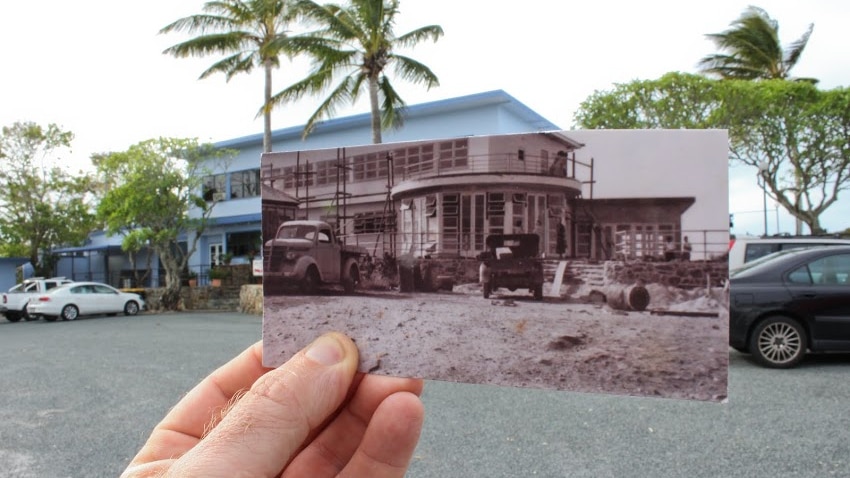

A historic pub in Mackay faces demolition if a proposal for a resort-style development receives approval from local authorities.
Community members have expressed their worries about the potential disappearance of the venue’s unique character and historical significance.
The current owners have announced that the pub will continue its operations for the next two years while the Mackay Regional Council reviews the development application.
The Eimeo Hotel, situated on a headland between Sunset Bay and Eimeo Beach, has long been a favored spot for visitors drawn by breathtaking views of the Whitsunday Islands, migrating whales, and beautiful beaches.
This establishment, located approximately 15 kilometers north of Mackay, has been a gathering place for various activities, including live music performances and even the occasional horse at the bar.
However, the proposal to replace the pub with a resort-style complex has raised concerns among locals regarding the potential loss of the site’s historical and cultural essence, as well as its accessibility to the public.
As detailed in a development application submitted to the Mackay Regional Council, the existing building from the 1950s would be dismantled to pave the way for a new development that includes a 53-room hotel, a bar, a restaurant, and 133 residential units spread across three levels. This project would also necessitate significant construction on the cliffside.
The application, which was filed on March 27 by Jewell Planning Consultants on behalf of the current owners, is currently under review by the council’s planning department. Although there is no obligation for public consultation on this application, Aletta Nugent, the council’s director of planning, growth, and sustainability, indicated that the proposal is still in its initial stages. She noted, “It is not uncommon for designs to evolve as they move through the application process.”
The proposal includes plans for 166 parking spaces, and the heritage-listed Mango Avenue would remain the primary access route with minor enhancements.
The site has a rich history dating back to 1880 when Jerimiah Armitage established a boarding house and orchard, naming it after Eimeo, which is now known as Moorea in French Polynesia. In 1931, Lavinia Walters, the great-grandmother of the current licensee, acquired the hotel.
Local historian Doug Petersen, who authored a book about the pub, highlighted its long-standing role as a community hub. He remarked, “If we were working and McCready’s creek was flooded, everyone would head to Eimeo pub for the day. Those were the best days for storytelling and camaraderie at Eimeo.”
The development proposal has elicited mixed reactions from the public. Local resident Heidi Thompson, who frequently brings guests to the pub, expressed her hope that it retains its accessibility for the community. “It’s a great Mackay institution,” she stated. “I just hope they continue to keep it for the local community.”
Another resident, Dorothy Newton, acknowledged that the building could use some updates but worried that increased traffic from the new establishment might overwhelm local roads and disrupt the area’s tranquil environment. “We already struggle with traffic getting in and out of town,” she noted. “More people will only worsen the congestion.”
In response to concerns, hotel manager Llewellyn Stayte reassured the community that there is “no cause for concern” and emphasized that the pub is “not going anywhere anytime soon.” He added, “It’s a place we truly love and are proud to continue sharing with the community.”
The management’s statement urged the public to respect the privacy of the staff and their families and mentioned that events and functions are planned for the next two years.
Historian Doug Petersen acknowledged that the hotel has adapted over the years and that change is inevitable. “You can’t stop progress, and nothing stays the same forever,” he commented. However, he cautioned that it is crucial to safeguard the distinctive character of the venue. “At present, it feels like it belongs to everyone,” he said. “Perhaps we should cherish it while we still can.”