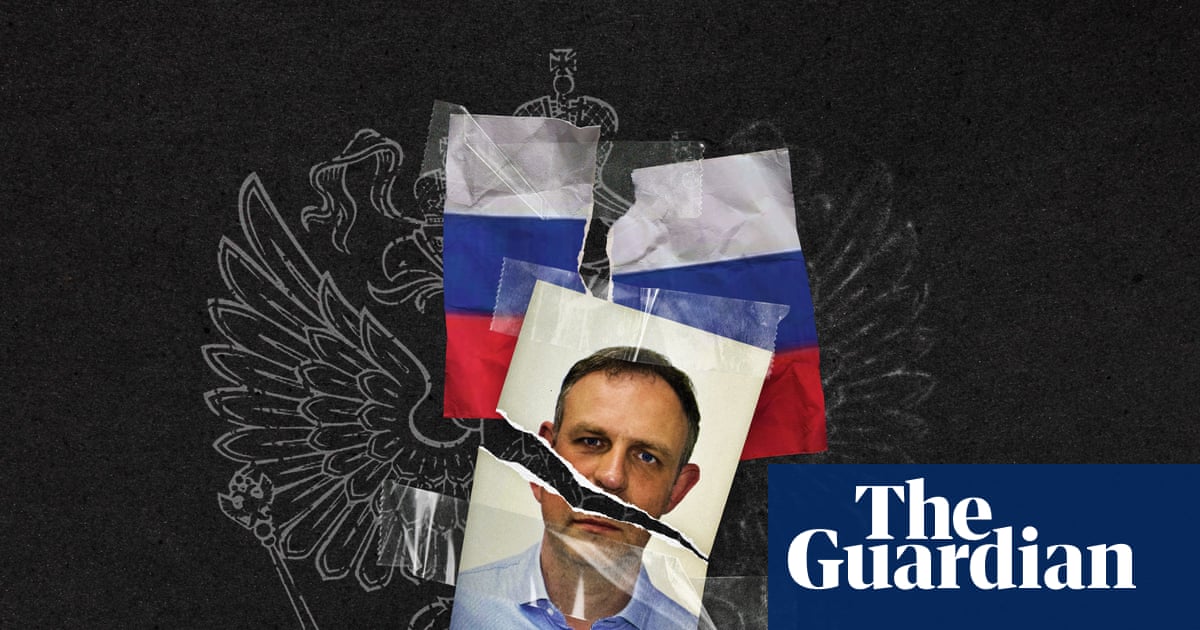

On a May morning in 2025, I hurried along Bayswater Road, which borders London’s Kensington Gardens, until I arrived at the entrance of the Russian embassy. The imposing outer wall, already fortified with razor wire, was now further secured by a barrier meant for crowd control. However, the only person present was a solitary man, quietly protesting from across the street. In the initial days of the conflict, the embassy had faced a barrage of angry demonstrators. Back then, the Ukrainian flag was a common sight on British streets, but those days had long passed.
As I approached, a guard ushered me inside after conducting a routine security check, patting me down and examining my backpack. This was a familiar process for me, reminiscent of my previous visits. The guard, a congenial man from Nepal with limited Russian vocabulary, had remained unchanged over the years. I had come here in the past to renew my Russian passport and, notably, to participate in the Russian presidential elections in March 2000. Today, my visit had a different intent: I was there to renounce my Russian citizenship.
Born in 1980 to Ukrainian parents, I spent my childhood on Sakhalin Island in Russia’s far east. Anton Chekhov, who had visited Sakhalin nearly a century earlier, characterized it as a “gloomy little world,” dominated by steep cliffs, crashing waves, and dark skies that elicited “oppressive thoughts and drunkenness” among its sparse inhabitants, who had once populated a remote penal colony of the Russian Empire. The Sakhalin I knew in my youth was much the same: still forbidding and desolate, crumbling like much of the dilapidated Russian provincial areas, with Soviet-era apartment buildings juxtaposed against aging Japanese structures, a testament to the region’s complex history of occupation.
At the age of 15, I was accepted into a U.S.-funded exchange program that took me to East Texas. Within weeks, I had embraced the local culture, donning cowboy boots and adopting regional phrases while eagerly adjusting to life in a distinctly different environment. Although East Texas and Sakhalin were worlds apart, both felt like remote outposts on the globe.
The noble purpose of this exchange program was to immerse young Russians in American life, exposing them to ideals of freedom and democracy in hopes of influencing Russia’s future. Among the other participants was Margarita Simonyan, who later became editor-in-chief of Russia Today.
However, unlike Simonyan, who emerged as a prominent propagandist for Vladimir Putin, I chose not to return to Russia after my year in Texas. Instead, I traveled extensively, engaging with diverse cultures and mastering different languages, feeling like a post-Soviet wanderer caught in the currents of change. My identity felt vague, yet I still identified as a Russian, bound to my homeland through familial and legal ties, despite my limited connection to it.
In the early 2000s, I relocated to the UK to study international relations at the London School of Economics (LSE). This era was marked by optimism surrounding globalization, which promised increased trade and cross-border relationships. The LSE embodied this ethos, and I felt at ease among aspiring bankers, consultants, and diplomats. Yet, I often pondered what it meant to be Russian in a world that was becoming increasingly borderless.
Unlike many Russians—oligarchs, dissidents, and ordinary citizens—who settled in London, I could not afford to stay. My restlessness drove me to exchange my cramped LSE living quarters for the expansive landscapes of Mongolia. I spent many evenings engaging in heartfelt discussions with Mongolian herders, sharing their sparse diet of aaruul (dried curd) and airag (fermented mare’s milk). Although I donned traditional garments and spoke fluent Mongolian, I remained an outsider, recognized as a “gadaad hun,” or foreigner.
The experience of feeling like an “outsider” is something many can relate to; however, I struggled to find a place that felt like home. I drifted like tumbleweed, never truly establishing roots anywhere.
While teaching at the University of Nottingham’s campus in China, I witnessed the eruption of mass protests in Moscow following the December 2011 parliamentary elections, which were widely deemed fraudulent. The demonstrations persisted for months, leading to a crackdown by the Kremlin, with numerous protesters arrested, including notable figures like former deputy prime minister Boris Nemtsov and the opposition leader Alexei Navalny. This brutal response marked a pivotal moment for the regime, as Putin responded to the threat of popular revolt by increasing repression. Russia appeared to be heading toward tyranny.
Although I monitored these events with interest, I was primarily an academic and not an activist. I did not participate in the flawed elections, as the nearest Russian consulate was distant and my focus lay elsewhere. Nevertheless, Russia remained a constant in my life, and I identified simply as “eluosiren” (a Russian) to inquisitive taxi drivers in China. Their typical response was to express admiration for Putin, which I generally chose not to contest.
As I ascended the stairs into the embassy hallway, I encountered a stout man in an ill-fitting suit, ready to continue my journey through the process that would mark a significant change in my life.