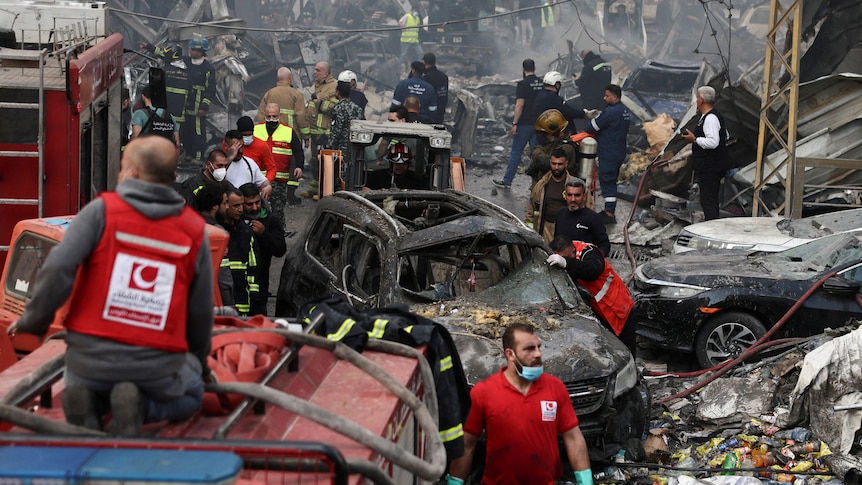

Rescue teams have been tirelessly working overnight to extract individuals trapped following an Israeli airstrike targeting a building in the Tallet El Khayat area of Beirut.
Concerns are mounting among the Lebanese populace regarding a potential escalation of hostilities, particularly after Israel conducted a series of airstrikes on the capital, Beirut, during the night. These attacks were reportedly aimed at Hezbollah positions and coincided with a ceasefire announcement reached between the United States and Iran.
Peace talks are set to commence in Pakistan on Friday, but it remains uncertain whether the violence in Lebanon will abate, as both the US and Israel have indicated that the ceasefire agreement does not extend to Lebanese territory. This has resulted in a heightened atmosphere of fear and anxiety among the residents of Beirut.
Israel’s recent wave of airstrikes constitutes the most extensive assault seen thus far in the current conflict, with reports indicating that as many as 100 strikes were executed within a span of just ten minutes. Targets were specifically identified as being affiliated with Hezbollah, which has been labeled as an Iranian-backed militant organization.
Eyewitness accounts describe the chaos that unfolded during the bombardment, with one individual recounting how he narrowly escaped the blasts near the Corniche, Beirut’s coastal promenade. He described the scene as one of devastation, with storefront televisions crashing to the ground, power outages, and panicked civilians fleeing in all directions.
As the sounds of drones filled the air, ambulances could be heard racing to the scenes of destruction, attending to the injured and retrieving the deceased. Black smoke lingered over parts of the city for hours following the attacks, while reports from Lebanon’s civil defense services indicate at least 250 fatalities and over 1,000 injuries across the nation.
In the aftermath of the assaults, a Lebanese soldier expressed concerns about the deteriorating situation and advised civilians to remain indoors for their safety. Streets that were once bustling with activity became mostly deserted as residents sought refuge from the violence.
One of the few individuals still on the streets shared a grim outlook, stating, “I believe it’s going to get much worse. I am currently looking for safe places for my family and myself away from Beirut.” This sentiment emerged just hours after the announcement of a ceasefire between the US and Iran.
The ceasefire, however, appears to be precarious, especially after Israel declared that Lebanon was not included in the agreement just as US President Donald Trump confirmed a two-week suspension of military actions against Iran. This declaration followed Trump’s earlier ultimatum to Iran, which was extended from 48 hours to ten days, demanding safe passage through the Strait of Hormuz.
Despite claims of a victorious position by Iran, the inclusion of Lebanon in the ceasefire was contested by Israeli Prime Minister Benjamin Netanyahu, who later received support from Trump affirming that Lebanon was never part of the truce. In tandem, Australian Prime Minister Anthony Albanese welcomed the ceasefire, while Foreign Minister Penny Wong emphasized the importance of including Lebanon in the agreement.
Although Hezbollah had temporarily ceased fire against northern Israel and Israeli forces in Lebanon, the subsequent Israeli airstrikes contradicted the newly formed ceasefire. Lebanon’s president condemned these actions as a “new massacre,” accusing Israel of violating international laws.
Iran viewed the strikes as a violation of the ceasefire, leading to discussions of potential retaliation against Israel. Iranian officials have since issued an ultimatum to the United States, demanding a comprehensive ceasefire across the Middle East or risk the resumption of wider conflicts.
The ceasefire, which was announced less than 24 hours ago, is now teetering on the brink of collapse.
In light of the ceasefire announcement, many displaced residents of Lebanon, who had fled their homes due to threats of Israeli attacks, were hopeful about returning. Approximately 1.2 million individuals have been forced to evacuate, particularly from southern Lebanon and parts of Beirut.
Ahmad, a resident of Dahiyeh, a suburb of Beirut known for its Hezbollah presence, has been living in a makeshift tent near the Corniche after abandoning his home weeks earlier due to Israeli threats. “If there truly is a ceasefire, of course, I would want to return home,” he remarked. “What could be better than one’s own home?” However, Ahmad expressed skepticism about the feasibility of returning, questioning, “They announced a ceasefire last night, yet Israel did not adhere to it. So how are we supposed to go back?”