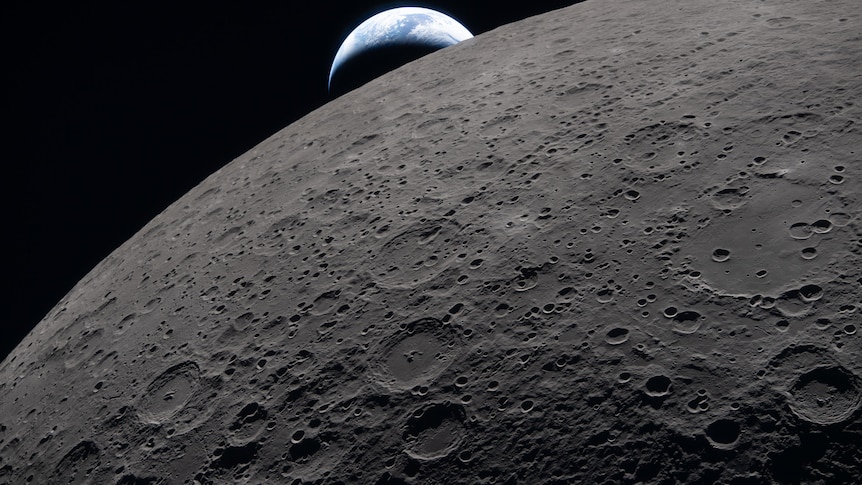

As the quest to send humans to Mars progresses, both scientists and private enterprises are investigating the potential for mining on the Moon. This endeavor presents a variety of technological hurdles, alongside ethical, legal, and environmental concerns that must be addressed before lunar mining can proceed.
Since Neil Armstrong’s historic moonwalk nearly six decades ago, only a limited number of samples from the lunar surface have been returned to Earth, providing insights into the minerals present in the lunar regolith. Upcoming missions, such as Artemis II, aim to enhance our understanding of the Moon’s environment and resources.
Experts have identified several challenges linked to lunar mining, encompassing physical, environmental, legal, and ethical aspects. Jonathon Ralston, a senior principal research scientist at CSIRO Mineral Resources, is actively engaged in the development of mining technologies for both the Moon and Mars. He emphasizes that the initial focus should be on comprehending the lunar environment, akin to the prospecting processes employed before resource extraction on Earth.
“The fascinating aspect is that we’ve conducted a few missions to the Moon through Apollo, yet there remains a wealth of knowledge to be gained, along with numerous uncertainties,” Dr. Ralston noted. He added that the term “mining on the Moon” should be more accurately described as scientific exploration aimed at identifying local resources before any extraction activities can commence.
Sophia Casanova, an Australian scientist working with ispace, a private firm dedicated to transporting payloads to the Moon, remarked that the technology needed for lunar mining is still in its early stages. However, companies are beginning to deploy small components of the future mining process into space.
In 2019, on the 50th anniversary of Apollo 11, NASA revisited its lunar samples. “Extensive studies have been conducted to analyze the materials, leading to the creation of analogues for testing on Earth,” Dr. Ralston explained. He further stated, “While satellite technologies have been utilized to scan the Moon’s composition, our current goal is to obtain ground truth through more ground-based missions that can validate these findings.”
Research has shown that the lunar regolith comprises approximately 50% silica, alongside various trace metals and minerals. Certain missions have also discovered ice in permanently shadowed regions of the Moon. “The prospect of water ice on the Moon is particularly exciting, as it could serve as a vital resource for life support and propulsion systems, utilizing hydrogen and oxygen,” Dr. Ralston noted.
NASA estimates that the Moon holds about one million tons of helium-3, an isotope that is scarce on Earth. Additionally, the presence of rare earth metals, essential for advanced technologies and devices like smartphones and computers, has been confirmed by Boeing research. Seattle-based Interlune, a private enterprise, aims to be the first U.S. company to commercialize lunar resources, starting with helium-3, which is valuable in applications such as cryogenics.
Dr. Ralston mentioned that opinions vary regarding the concentration of helium-3 on the Moon and acknowledged that a significant challenge lies in developing efficient methods for its recovery and transport back to Earth. Dr. Casanova pointed out that current efforts are largely focused on understanding the environmental conditions at the lunar south pole, indicating that large-scale extraction processes remain a distant prospect.
The lunar surface also contains ilmenite, rich in oxygen, as well as metals like iron and titanium that are potential targets for extraction. Furthermore, the concept of resource extraction on the Moon often implies that materials would be utilized in space rather than brought back to Earth. Water, for instance, can be separated into hydrogen and oxygen, which can serve as propellant or fuel for spacecraft.
“This idea essentially resembles a ‘petrol station in space,’ which is crucial for future missions involving human travel to Mars and deeper space exploration,” Dr. Casanova explained. However, she noted that operating on the lunar surface presents significant challenges due to extreme temperature fluctuations and the abrasive nature of the regolith material, which can create dust that interferes with rover operations.
Rovers, designed to traverse the Moon’s surface, have been instrumental in gathering data that aids scientists in tackling the complexities associated with operating in such a harsh environment.