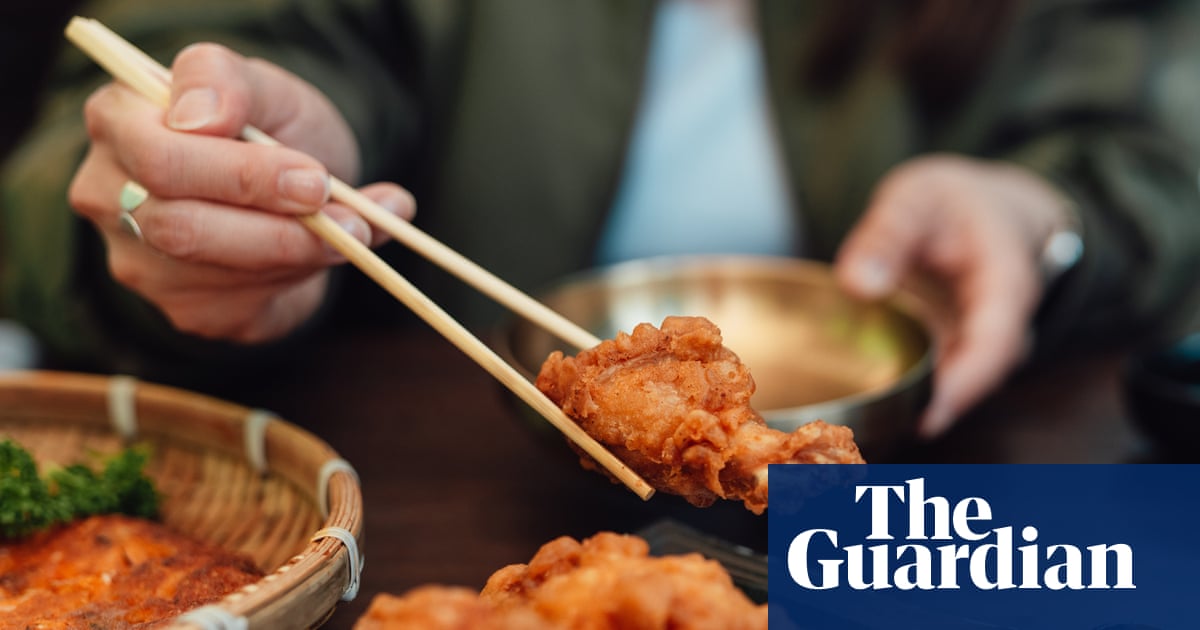

In a culinary training facility southeast of Seoul, I find myself preparing a whole chicken, which has been cut into eight pieces. I carefully coat each piece in batter before dipping it into a bowl of powdered mix, ensuring it’s enveloped in a light, airy layer.
A chef observes closely, advising, “Be gentle; don’t rub it.”
The chicken, pre-soaked in a secret brine, is then placed into a fryer containing a blend of olive oil heated to 170 degrees Celsius. I lower the chicken pieces in gradually, ensuring I drop them in away from my body to prevent splashing, and set a timer for ten minutes.
This establishment is known as Chicken University, a large campus featuring a prominent chicken statue at its entrance. It serves as a training ground for aspiring franchise owners of the BBQ Chicken chain, offering a two-week residential program that has seen over 50,000 participants graduate.
While fried chicken is a straightforward dish and not inherently traditional to Korean cuisine, it has become a national obsession, gaining international recognition as part of the global K-food phenomenon. South Korea has humorously been referred to as the Republic of Fried Chicken.
With approximately 40,000 fried chicken outlets, the country is only a few thousand short of the total number of McDonald’s locations worldwide. Most of these are small, family-operated businesses. However, Korean chicken brands have expanded to operate over 1,800 outlets in around 60 countries, nearly doubling their presence in just a decade. Korean fried chicken can now be found on menus from London to Los Angeles.
According to a South Korean government survey involving around 11,000 consumers across 22 cities in Asia, Europe, the Americas, and Australia, fried chicken ranks as the most favored Korean food among international patrons.
Interestingly, South Korea’s most significant culinary export is not rooted in its traditional cuisine. Fried chicken was introduced to the country by American soldiers following the Korean War, but the distinctively Korean preparation method developed later.
In the 1980s, a chicken shop owner in Daegu named Yoon Jong-gye noticed that customers tended to leave behind chicken that had cooled and become dry. To address this, he began experimenting with brining techniques to maintain juiciness and added a chili powder glaze. A local grandmother suggested incorporating corn syrup.
The outcome was yangnyeom chicken—a sweet, sticky, and spicy variant that remained appetizing even at room temperature. Yoon never secured a patent for his recipe and passed away in December 2025 at the age of 74, having witnessed his creation gain popularity far beyond his modest shop.
Korean chicken brands began their international expansion in the early 2000s, but their cultural breakthrough occurred in 2014 with the hit Korean drama “My Love from the Star,” which became immensely popular in China. A memorable line from the show, suggesting that “on the day of the first snow, one should enjoy chicken and beer,” reportedly led to long lines outside Korean chicken restaurants, even during a bird flu outbreak.
The term “chimaek,” a combination of the Korean words for fried chicken and beer, has since become a cultural reference, even making its way into the Oxford English Dictionary. It represents not just a meal, but a communal experience where friends gather around a table with a platter of chicken and cold beer.
Every July, Daegu hosts a chimaek festival that attracts over a million attendees.
One of the unique aspects of Korean fried chicken is its serving style. Kim Ki-deuk, who has operated a chicken shop near Korea University in Seoul with his wife Baek Hye-kyeong for more than two decades, emphasizes this point: “In fast-food restaurants, customers might purchase one or several pieces. Korean chicken is served as a whole bird.”
Technique also plays a crucial role, although methods can differ. At Kim and Baek’s shop, chicken is fried twice. “We fry it once initially, and then fry it again when the customer orders,” he explains. “If we don’t, it becomes soggy. This method ensures extra crispiness.”
The batter, typically made from potato or corn starch, is designed to withstand sauces—whether the sweet-spicy yangnyeom glaze or a soy-garlic coating—so it retains its crunch even after being packaged for delivery.
Professor Joo Young-ha, a cultural anthropologist specializing in food culture at the Academy of Korean Studies, asserts that the global popularity of Korean chicken can be attributed to its straightforward nature. “Chicken transcends religious dietary restrictions, unlike pork. It is also immediately identifiable as a meal, unlike kimchi, which is often served as a side dish, or bibimbap, which may not be as easily recognized.”
The rise of fried chicken in South Korea also reflects broader societal changes. Professor Joo links its popularity to the 1980s and 1990s, a period of urban living, dual-income households, and the growth of delivery culture. Fried chicken, being quick, convenient, and easily packaged for takeaway, fit perfectly into this evolving lifestyle.
The industry has attracted many mid-career professionals looking to transition back to income after leaving corporate jobs, although it remains a highly competitive market with slim profit margins.
Back at their chicken shop, Kim Ki-deuk prepares another batch of chicken gizzards, another favorite item on the menu. “Just like usual,” a customer remarks.