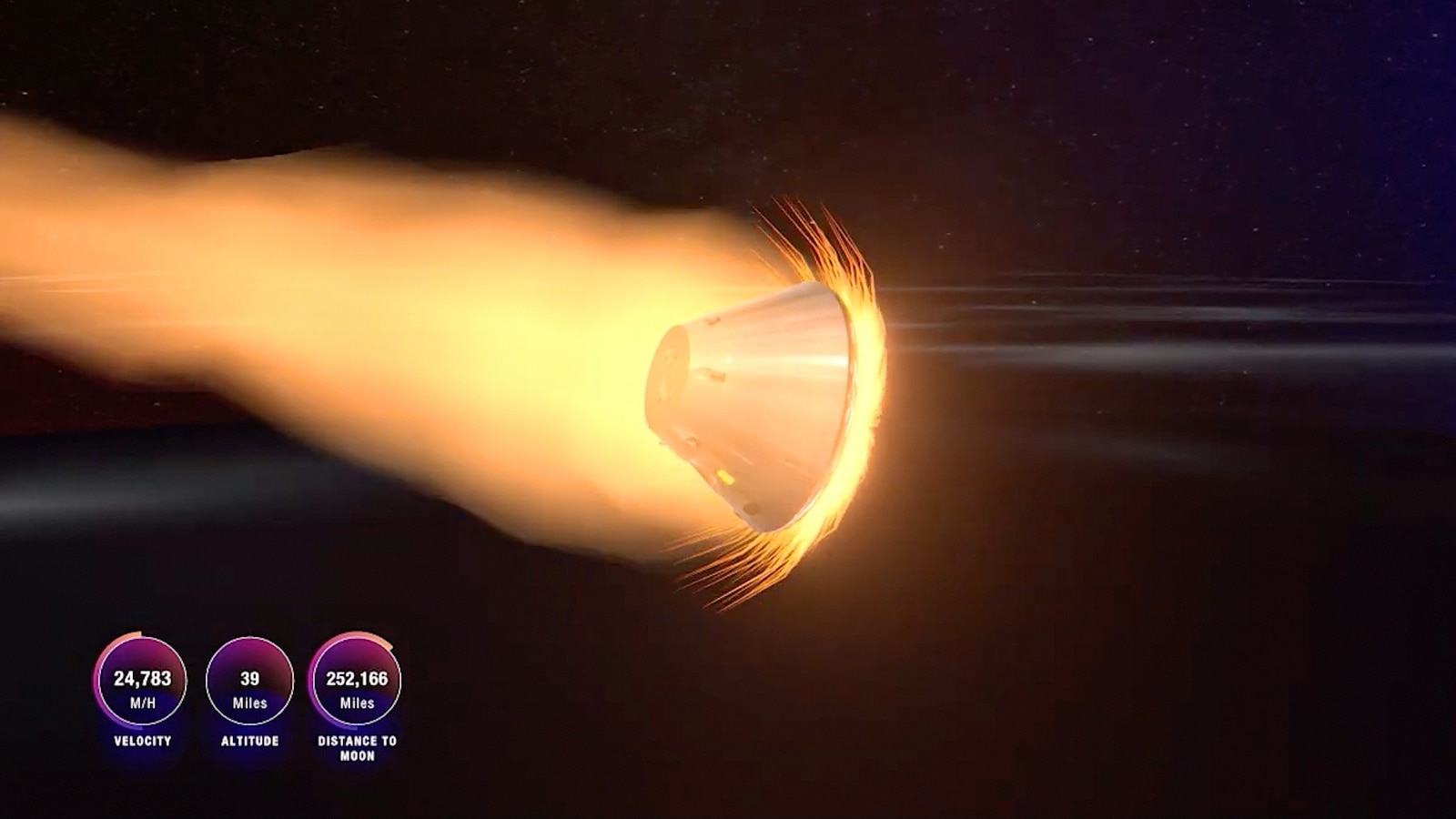

After their groundbreaking lunar flyby, the Artemis II crew is approaching the conclusion of their 10-day mission, set to wrap up on Friday with a crucial and challenging phase: reentry into Earth’s atmosphere, followed by a splashdown.
This phase is pivotal as it tests the spacecraft’s ability to safely return its crew home. However, as reentry commences, a wait of approximately six minutes will ensue, during which Mission Control will lose contact with the Artemis II crew.
Live coverage of the Artemis II crew’s return will begin at 7 p.m. ET on ABC News Live, Disney+, and Hulu, with special programming starting at 7:30 p.m. ET on ABC.
In contrast to the 40-minute communication loss experienced when the Orion crew module passed behind the moon, which obstructed radio signals, the communication blackout during reentry occurs due to Orion’s interaction with Earth’s atmosphere.
As Orion descends towards Earth at speeds exceeding 24,000 mph, it will encounter the atmosphere, which will decelerate the spacecraft through friction, generating extreme heat—up to 5,000 degrees Fahrenheit, over twice the temperature of volcanic lava—causing Orion to blaze like a fireball.
The journey from space to splashdown, approximately 400,000 feet, will take Orion around 13 minutes, culminating in a landing off the coast of San Diego, California.
“The dynamics are entirely different,” commented retired NASA astronaut Barry “Butch” Wilmore in an interview with ABC News. “The return speeds from deep space are significantly higher.”
NASA explains that the combination of atmospheric friction and compression creates a plasma sheath around Orion, inhibiting radio transmissions. As the spacecraft begins its descent, the crew will immediately lose contact with ground control, marking the start of what NASA has designated a “planned six-minute blackout period.”
“You are aware that the blackout is imminent,” Wilmore, who has undergone reentry from space three times, shared. “Given that knowledge, you proceed with your standard operations, keeping an eye on everything. There isn’t much you can do at that point.”
According to Wilmore, the astronauts focus intensely on monitoring the spacecraft’s systems during their atmospheric descent. He noted that the crew trains for various potential failures, emphasizing the importance of concentrating on their tasks during this critical time.
“You cannot allow anxiety to interfere during those moments,” Wilmore advised. “You must concentrate on your responsibilities and execute them, as failure to do so could have serious consequences.”
During the six minutes of radio silence, Orion’s heat shield—located on the bottom of the spacecraft—performs its vital function, safeguarding the crew from the extreme temperatures encountered during reentry. Maneuvering jets onboard help maintain the correct orientation to keep the heat shield directed towards Earth.
Once Orion exits the atmosphere and communication is restored, it will still be traveling too rapidly to safely splash down in the Pacific. At this point, a series of specially engineered parachutes will deploy, reducing Orion’s speed to a safer 20 mph at the moment of landing.
The scheduled splashdown of Orion is set for 5:07 p.m. PT/8:07 p.m. ET on Friday, April 10, at a designated site off the San Diego coast.