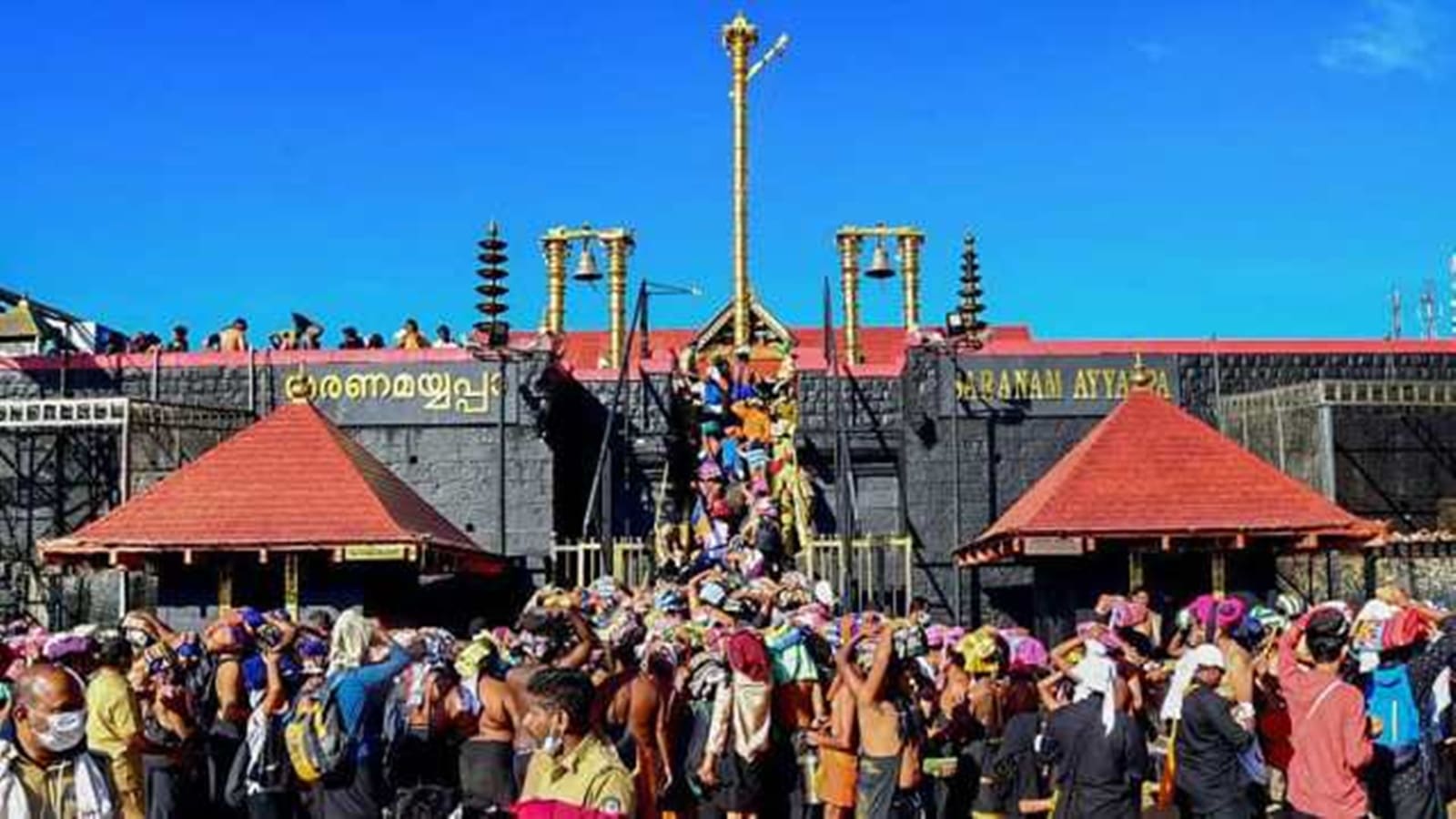

Emphasizing that public morality should take precedence over constitutional morality in matters of faith, the Centre concluded its arguments on Thursday before the nine-judge Constitution Bench reviewing the 2018 decision, which deemed the prohibition of women entering the Sabarimala temple unconstitutional.
Additional Solicitor General K. M. Nataraj articulated that public morality should be the guiding principle, stating, “The determination of essential religious practices is unworkable within the diverse Indian religious context. The concept of essential religious practices cannot be uniformly applied due to this plurality.” He stressed that the term “religious denomination” should be interpreted within an Indian framework, noting that the Court has previously maintained that only the essential religious practices of a group recognized as a separate denomination are protected under the Constitution.
Justice B. V. Nagarathna, a member of the bench, remarked that access to temples must be open to everyone, asserting that excluding any group from denominational temples is not in the best interests of Hinduism.
Senior Advocate C. S. Vaidyanathan, representing the Nair Service Society, highlighted the necessity for religious denominations to enjoy full autonomy under Article 26(b) when determining essential rites and practices, referencing the pivotal 1954 Shirur Mutt case ruling.
Additional Solicitor General Vikramjit Banerjee, also representing the Centre, advocated for a “swadeshi and Indic approach” to constitutional interpretation, suggesting that constitutional rights should be grounded in India’s own civilizational context rather than relying on Western legal principles. He urged the court to refer to the 1950 Hindu version of the Constitution to clarify the term ‘religious denomination’ as stated in Article 26.
Article 26(b) grants religious denominations or any segments thereof the authority to manage their own religious affairs, provided they adhere to public order, morality, and health requirements.
In the 2018 Sabarimala ruling, the majority opinion concluded that Ayyappa devotees do not form a “separate religious denomination.” Conversely, Justice Indu Malhotra’s dissenting opinion indicated that the Sabarimala temple meets the criteria for a separate religious denomination, asserting that such practices are safeguarded by Article 25, which guarantees the freedom of conscience and the right to freely profess, practice, and propagate religion.
Solicitor General Tushar Mehta, who also wrapped up his arguments on Thursday, contended that denying denomination status to Ayyappa devotees was incorrect. However, he cautioned that the rights of denominations under Article 26(b) to govern their own religious matters could lead to conflicts between denominations regarding temple access, potentially resulting in social divisions. Vaidyanathan expressed his disagreement with the Centre on the issue of denominational rights, stating that the right to manage affairs could extend to “private temples,” highlighting that ancient family temples in places like Kerala are exclusively visited by their family members.
In response, Justice Nagarathna expressed concern, remarking, “Keep aside the Sabarimala controversy. If we consider the right of entry for Venkataramana Devaru, which excludes everyone except Gowda Saraswat Brahmins, it could negatively impact Hinduism.”
She referenced a landmark 1958 Supreme Court ruling that sought to balance religious freedom with social reform, which affirmed that while a denominational temple has the right to manage its own affairs, it cannot exclude others from accessing the temple. “We will be dividing society,” echoed Justice Aravind Kumar.
Justice Nagarathna concluded by stating that regardless of the outcome concerning the Devaru judgment, it is crucial to ensure that the essence of the religion is not compromised.
Ananthakrishnan G. serves as a Senior Assistant Editor at The Indian Express and has over 23 years of experience in journalism. He began his career as a freelancer in the late 1990s, contributing to publications such as The Hindu. With a background in law, he practiced in Kerala’s District judiciary for about two years before transitioning to journalism. His first permanent position was with The Press Trust of India in Delhi, where he covered lower courts and various commissions of inquiry. He has reported from both the Delhi High Court and the Supreme Court of India during his initial tenure with The Indian Express from 2005 to 2006. Currently, he is in his second term at The Indian Express, focusing on Supreme Court reporting and issues related to law and justice administration, while also having extensive experience in political and community reporting. He is known for his commitment to factual accuracy and has authored several significant stories.