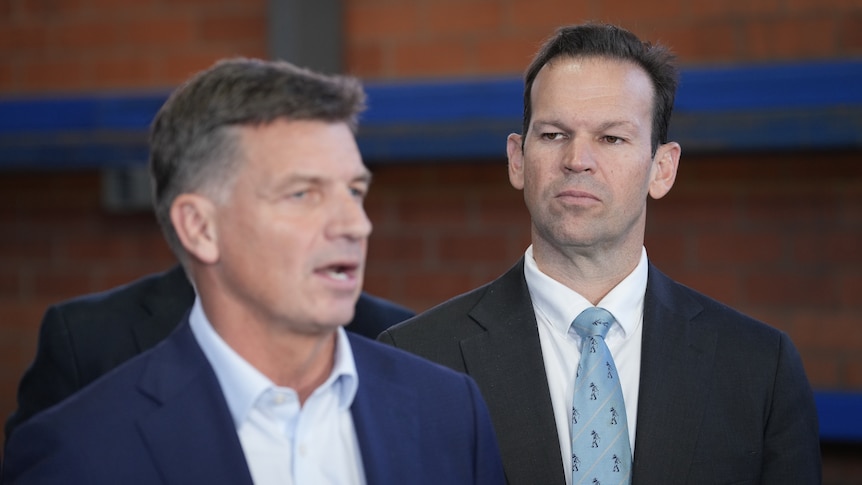

In assessing the contrasting responses of Liberal Party leader Angus Taylor and Nationals leader Matt Canavan to a recent alarming statement by US President Donald Trump, notable differences in their political approaches emerge. When questioned about Prime Minister Anthony Albanese’s critique of Trump’s remarks as inappropriate, Taylor remarked, “Those aren’t the words I would choose.” In stark contrast, Canavan firmly stated, “The president’s post last night went too far and crossed the line of acceptability.”
This disparity highlights two key aspects of their leadership styles: Taylor appears to be cautious, refraining from directly confronting the president, while Canavan, a staunch advocate for the US alliance, emphasizes the importance of honesty in challenging moments. Canavan’s outspoken stance on international conflicts is well-documented; he expressed his aversion to wars, emphasizing the tragic loss of life that typically accompanies such events. His sentiments resonate with many Australians, as a recent Sky News poll indicated that 71% of the population disapproved of Trump’s management of the ongoing conflict with Iran.
The ongoing struggles within the Coalition parties have become a familiar narrative, with both the Liberals and Nationals facing significant challenges. The Liberals are grappling with a loss of support to One Nation while struggling to win back voters who have shifted to the teal independents. Meanwhile, the Nationals are experiencing internal competition as One Nation poses a threat to their voter base.
Recent leadership changes within both parties have sparked discussions about their effectiveness. Canavan’s selection as the Nationals leader appears promising based on initial observations. Conversely, the decision to elevate Taylor to replace Sussan Ley, bypassing Andrew Hastie—who was discouraged from running—raises questions about strategic foresight.
In today’s political climate, where voters are demanding transparency and concrete plans, Canavan’s performance at the National Press Club demonstrated a level of straightforwardness that resonates with the public. This bluntness, however, presents a challenge for the Liberals; while he and Taylor may share a cordial relationship, their economic philosophies differ significantly. Canavan advocates for a selective tariff strategy to bolster Australian industries, criticizing what he perceives as the outdated thinking of traditional economic policies.
Canavan, who has a background with the Productivity Commission, articulates his views effectively, though they contrast starkly with Taylor’s free-market stance. He referenced an editorial from the Australian Financial Review during his speech, which warned that the Nationals’ populist tendencies could jeopardize the Liberals’ economic reset, a prediction that remains relevant. Canavan expressed a desire for an economic revolution rather than a mere reset, aligning more closely with Hastie’s protectionist views than with Taylor’s approach.
Kos Samaras, a political consultant from Redbridge Group, noted that democracies worldwide are undergoing significant realignments, with recent changes resembling those of the 1930s when leadership styles shifted dramatically. In this current environment, voters seek leaders who are willing to assert their positions and engage in combat over ideas rather than mere administration. While Canavan and Hastie exemplify this approach, the broader Coalition seems slow to adapt.
Despite the Nationals’ limited presence in urban areas, the potential for opponents to leverage Canavan’s views against the Coalition remains. His vocal opposition to net-zero emissions may attract criticism in city settings, though he may not capture public attention as vividly as former National member Barnaby Joyce. Nonetheless, the Nationals could still hinder the Liberals’ efforts against the teal independents.
As Taylor prepares for a challenging period ahead, he has yet to unveil any significant policies, a criticism that plagued his predecessor Ley. Specifically, Ley faced backlash for postponing an immigration strategy, an area where Liberal sources suggest Taylor is also considering a release, although recent crises have complicated these plans.
Moreover, Taylor is on the verge of facing a critical test in the upcoming Farrer by-election. Current assessments suggest that the Liberals have a slim chance of retaining Ley’s former seat, with the contest likely being a contest between One Nation and independent candidate Michelle Milthorpe. The by-election is scheduled for May 9, just days before the budget on May 12. Following a potentially disappointing outcome, Taylor will need to deliver a robust budget reply, setting a high expectation for his immediate future.