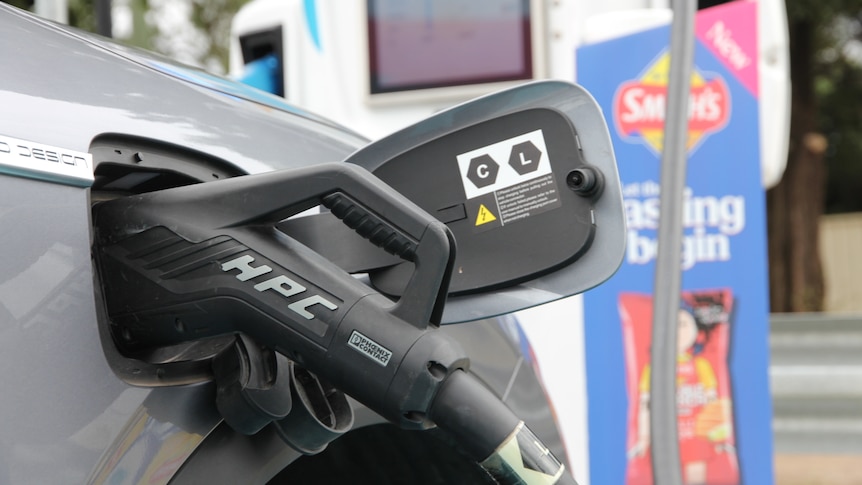

During the Easter long weekend, long queues formed at electric vehicle (EV) charging stations in regional New South Wales, underscoring the deficiencies in the area’s charging infrastructure amid a significant rise in EV sales.
The concentration of EV chargers is primarily in eastern New South Wales, leaving a noticeable scarcity in the west. The New South Wales government has stated its commitment to developing a cohesive network of charging stations throughout regional areas.
Reports indicate that the high demand for EV chargers was particularly evident on Easter Monday at Coolac, located 20 kilometers from Gundagai along the Hume Highway, where over 20 vehicles were observed waiting for access to one of the 12 available chargers.
Cameron Dooner, a resident of Wagga Wagga, expressed his reluctance to venture inland with his new EV, which he acquired three weeks ago. “While I feel comfortable driving to the capital cities, I wouldn’t consider traveling much further west than Wagga,” he noted. He described driving around Wagga Wagga in his EV as liberating compared to the $30,000 he spends weekly on diesel for his farming business, but the limited availability of charging stations discourages him from longer trips.
Mr. Dooner emphasized that owning an EV in remote areas is currently impractical. Recent statistics from the NRMA EV charging network indicated a 19% rise in charger usage during the penultimate week of March, a trend that is anticipated to continue as fuel prices rise.
The Electric Vehicle Council (EVC) reported a record in EV sales for March, accounting for 22.9% of all vehicle sales—an increase of 69.6% compared to the previous year. EVC chief executive Julie Delvecchio remarked that this surge in sales contributed to the heightened demand for charging stations over the Easter period, stating, “This Easter was one of the biggest tests yet for Australia’s public charging network. The surge was not unforeseen given the ongoing fuel crisis, but it clearly indicates challenges ahead.”
As demand for charging facilities grows, concerns arise about the pressure this will place on already limited infrastructure, particularly in regional areas of New South Wales.
A representative from the Department of Climate Change, Energy, the Environment and Water (DCCEEW) mentioned that the department has co-funded over 2,000 chargers now operational. The NSW government’s EV Public Charging Master Plan, launched in 2021, aims for electric vehicles to comprise 50% of new car sales by 2030, supported by a $209 million investment to enhance charging coverage.
The EVC has advocated for a unified national charging strategy to address this increasing demand. Ms. Delvecchio emphasized the need for a strategic framework that supports both passenger and freight transport, ensuring the nation is prepared for the future of electrified transport.
Furthermore, collaboration between industry and government is essential to establish dependable charging infrastructure in rural areas, preventing these regions from being left behind. Gemma Purcell, who has owned an EV for over a year, typically limits her driving to short distances for errands and local activities. However, she noted an increase in EV usage in her town over the Easter weekend and anticipates this trend will continue.
Ms. Purcell plans to take her EV on a longer trip to regional Victoria this year, acknowledging the need for more patience during charging stops compared to traditional refueling. The DCCEEW representative reiterated the government’s focus on developing an interconnected network of chargers from Sydney’s suburbs to major highways and regional centers, including Dubbo, Wagga Wagga, and Tamworth. This initiative aims to instill confidence in EV drivers for longer journeys.
Nevertheless, Mr. Dooner remains cautious about taking his EV beyond Wagga Wagga, stating, “I certainly wouldn’t venture off the main roads at this time, given the limited infrastructure available.”