
Fiona Copeman, the manager of the Malabar wastewater treatment facility, describes a particular section of the plant as the “four-bus area” while pointing to a model displayed on a table within the facility. This area refers to a 300 cubic meter underground chamber that contains what has been referred to as a “fatberg,” a massive congealed accumulation of fats, oils, and grease, which Guardian Australia reported in January. This fatberg is significant enough that it has been implicated in the closure of several Sydney beaches due to the creation of “poo balls.”
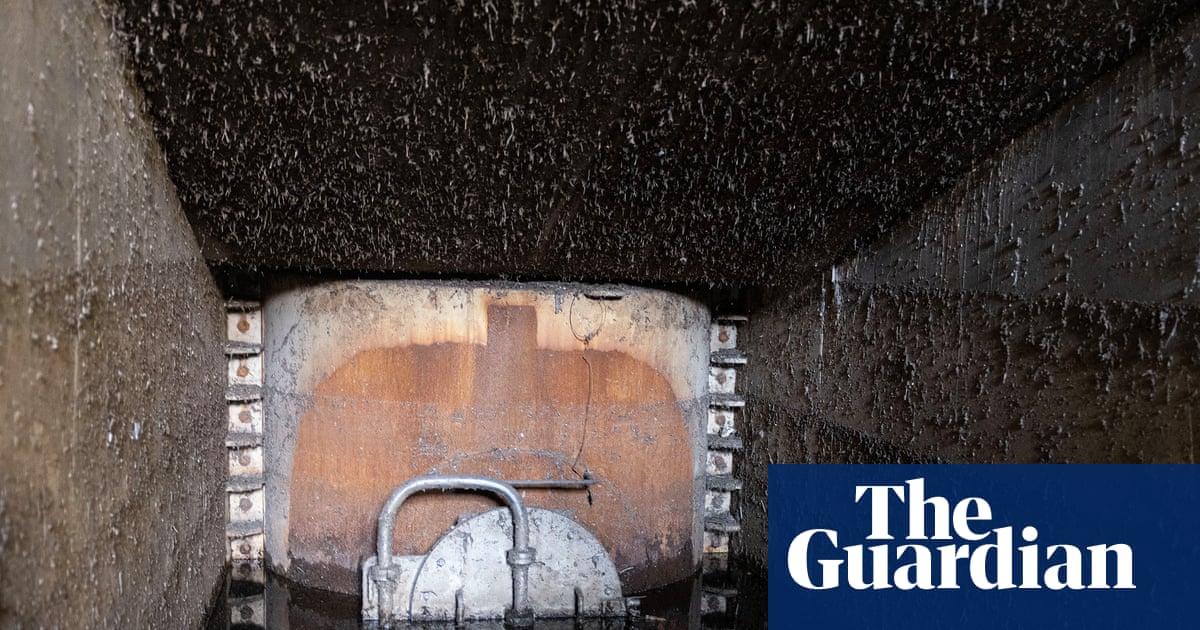
After a brief tour, Copeman leads us down a concrete corridor to a rusted metal door situated in water that reaches waist height. This door, known as the bulkhead door, separates the accessible areas from the fatberg located in an “inaccessible dead zone.”
Sydney Water has not been able to determine the exact dimensions of the fatberg. Efforts to investigate its size included deploying a drone into the confined space above the mass of congealed waste and beneath the concrete ceiling. Unfortunately, the drone faced difficulties flying straight because of turbulence caused by sewer gases and the swift flow of treated effluent heading to a deep-water outfall located 2.3 kilometers offshore.
The utility company theorizes that shifts in pumping pressure may dislodge portions of the fatberg during “sloughing events.” These events have previously occurred due to power outages or heavy rain, causing fragments of the fatberg to be pushed through large diffusers—structures resembling upside-down shower heads—that release effluent from the ocean floor at the end of the outfall.
In late 2024 and early 2025, these fragments were washed back onto land by ocean waves and wind, resulting in the closure of numerous beaches in Sydney, including Coogee, Bondi, and Manly. In February of this year, the New South Wales Environment Protection Authority (EPA) mandated a pollution reduction program for Sydney Water, which includes extensive measures such as the removal of the fatberg from the Malabar deep ocean outfall bulkhead area.
Our visit coincides with the launch of the Artemis II moon mission, a stark reminder that addressing the fatberg issue, while significant, seems smaller in comparison to humanity’s broader aspirations.
There is a 5-meter-long section accessible behind the bulkhead door at specific times, terminating at treated wooden stopboards that reach nearly to the tunnel’s ceiling. The fatberg itself lies just beyond this barrier. During periods of high flow, debris often spills over the stopboards, making it dangerous to open the bulkhead door. However, during lower flow periods, especially during a lunar low tide with minimal rainfall, crews can periodically access this smaller chamber to clear some overflow, typically every four to six months.
A team of six workers is responsible for pumping out rainwater that accumulates between the door and the stopboard. They open a hatch—not the entire door—and use a hose to remove approximately two hours’ worth of fatberg material. Above ground, a more straightforward method involves opening a gas vent and lowering a hose 20 meters to extract fat from the area in front of the stopboards. Most of the troublesome material removed to date, including 53 tonnes in April 2025, has been cleared this way, but new accumulations regularly appear, leaving the “four-bus area” undisturbed.
Having worked at Malabar for nearly 15 years, Copeman has observed the various forms of accumulated fats, oils, and grease. She notes that their texture varies, at times being gritty or scummy. “We are curious individuals, so we’ve handled it ourselves and examined its properties,” she explains. “Occasionally, we’ve attempted to roll it into balls and understand what it is.” When asked about its odor, she candidly states, “Sewage.”
Sydney Water maintains that most of the outfall tunnel is too hazardous for personnel to access. The corporation asserts that the only viable way to reach the fatberg would involve shutting down the city’s largest ocean outfall for an extended period, redirecting treated sewage to the cliff face. A confidential Sydney Water report from August 2025 indicated that this method had “never been done” and was “no longer deemed an acceptable approach.”
Copeman explains that the original maintenance strategy for the deep-water ocean outfall, established in the 1990s, was to take it offline, redirect the flow to the cliff face, and maintain the tunnel.
At the bulkhead door, there is an unusual absence of odors, a stark contrast to the pungent atmosphere in Sedimentation Room Area 4, part of the primary treatment facility. Upon entering, the air quickly shifts from a mild seaside scent to a strong, meaty odor that fills the nostrils. The combination of smells is so overpowering that they seem to cancel each other out. While we wear hearing protection, none of the staff have masks over their noses. “I think you’re either suited for sewage work, or you aren’t,” Copeman remarks.
In the facility’s sedimentation tanks, dark water flows quietly, tinted by ferric chloride applied for odor management. The water’s gentle movement is almost imperceptible until you notice small bubbles and fat particles on the surface, resembling a galaxy. Slower flow rates enhance the sedimentation process, allowing more solids to settle at the bottom, where they are scraped for further treatment before being used in various industries, such as forestry. The remaining liquid, known as effluent, is then released into the sea.
On dry days, the Malabar facility processes approximately 485 megalitres of wastewater daily—equivalent to 194 Olympic swimming pools—while this volume can surge to 1,300 megalitres during rainy periods. Increased volumes result in shorter sedimentation times and fewer solids being separated.
One sedimentation tank is currently being emptied to upgrade its scrapers as part of the pollution reduction initiative. Copeman notes that improvements are also being made to the “scum” transfer pumps, which move the fats and oils from the surface of the sewage to a cogeneration plant on-site, typically supplying 80% of the Malabar facility’s energy needs. On favorable days, the plant even exports surplus electricity to the grid.
These enhancements form part of a broader $3 billion upgrade program being undertaken by Sydney Water across its existing facilities.