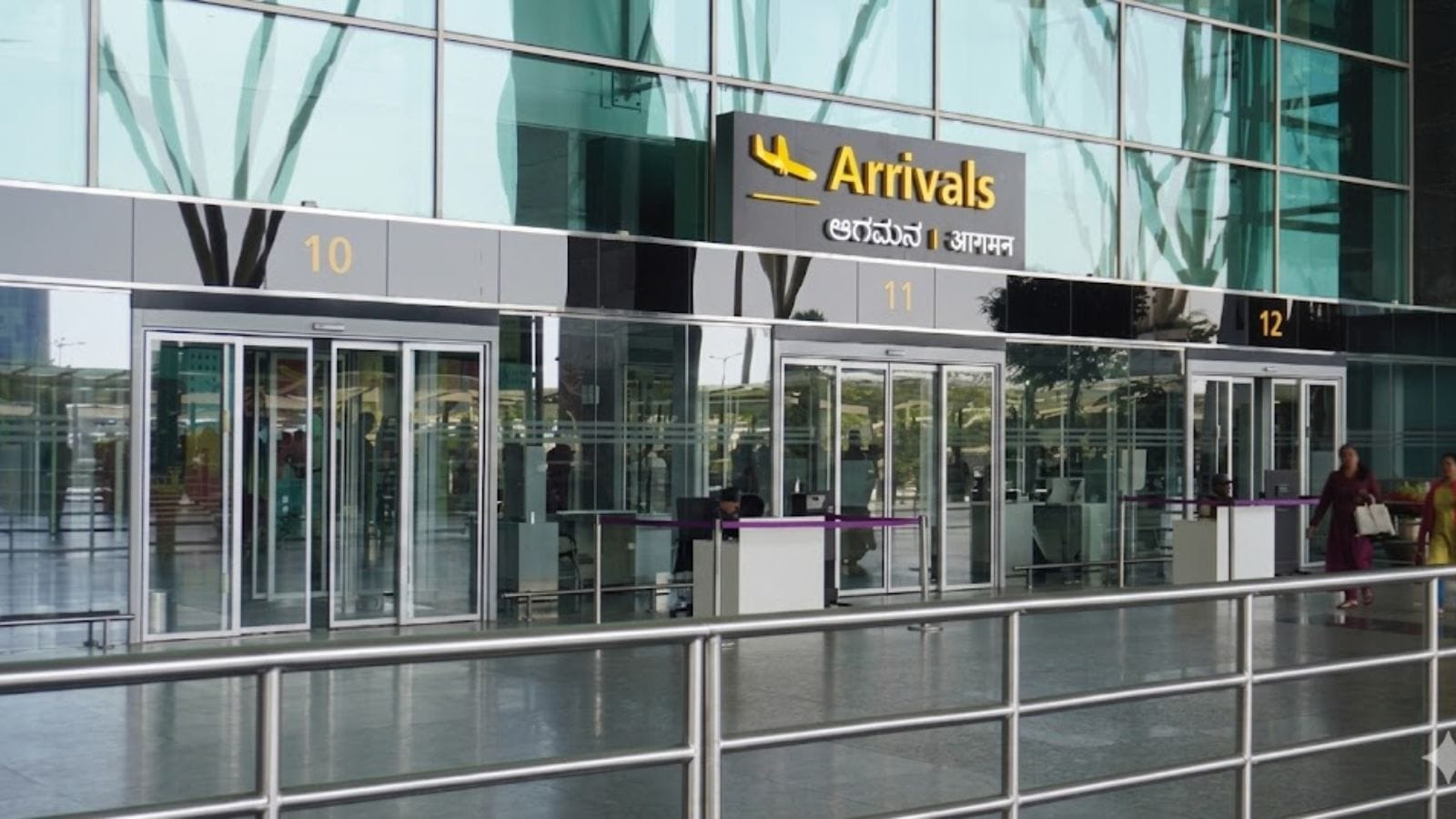

Bengaluru’s Kempegowda International Airport is poised to accommodate as many as 80 million passengers each year by the year 2030. The current capacity of its two terminals stands at 51.5 million passengers annually, while the actual passenger traffic recorded for the fiscal year 2026 was approximately 44.5 million.
Murlidhar Mohol, the Minister of State in the Ministry of Civil Aviation, conveyed in a written statement to the Lok Sabha on April 2, 2026, that the airport’s operator intends to enhance the terminal’s capacity to 80 million passengers per year by 2030. This expansion will also include the gradual development of taxiway and apron facilities from 2027 to 2030. The airport currently features a dual parallel runway system.
Additionally, the Union Minister mentioned that the airport has a current cargo handling capacity exceeding 1 million metric tonnes, while the actual cargo throughput is around 0.53 million metric tonnes.
Terminal 2 of Kempegowda International Airport was officially opened by Prime Minister Narendra Modi on November 11, 2022, with an investment of approximately Rs 5,000 crore. This terminal has been designed as a homage to Bengaluru, known as the Garden City.
The Ministry of Civil Aviation has outlined that the design of Terminal 2 is guided by four key principles: integration of gardens within the terminal, sustainability, incorporation of technology, and reflection of art and culture.
This airport is recognized as the first Greenfield Airport in South India. It became operational on May 24, 2008, and was renamed Kempegowda International Airport on July 17, 2013.
On December 10, 2012, both the Karnataka Legislative Assembly and the Legislative Council passed a unanimous resolution to rename Bengaluru International Airport as Kempegowda International Airport.
Anish Mondal, a journalist with over nine years of experience in reporting on railways and roadways, is currently part of the editorial team at Indianexpress.com, focusing on significant sectors.
Professional Background: Anish started his career at Rajya Sabha Television (now Sansad TV), gaining a solid understanding of legislative affairs and national governance. In 2018, he shifted to the realm of digital financial journalism at FinancialExpress.com, spending nearly six years honing his skills in market analysis and corporate reporting. Before joining The Indian Express in 2025, he was an influential contributor at ETNowNews.com.
Education and Specialization: Anish’s journalism is supported by a strong academic foundation in communication and the humanities:
- Master of Journalism and Mass Communication (MJMC) – Apeejay Stya University
- Post Graduate Diploma in Journalism and Production (PGTVRJP) – Apeejay Institute of Mass Communication
- Bachelor of Arts (English Honours) – University of Calcutta
Areas of Focus: Anish covers connectivity extensively, reporting on the growth of the Indian Railways and National Highway systems.
Stay connected with the latest updates – Follow us on Instagram.