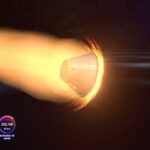

The crew of Artemis II is scheduled to return to Earth on Friday after completing a groundbreaking 10-day mission that involved a lunar flyby. NASA officials have detailed the intricate logistics required for their safe return.
During the return journey, the Orion capsule will travel at speeds approaching 24,000 mph before executing a final splashdown a few miles off San Diego’s coast. This operation necessitates collaboration among multiple teams to ensure the crew can be safely retrieved from the spacecraft.
At a press briefing on Thursday, NASA’s associate administrator Amit Kshatriya expressed appreciation for the team’s efforts, stating, “Tomorrow is a day for every engineer and technician who has contributed to this mission. The crew has completed their mission; now it’s our turn to fulfill our responsibilities.”
Jeff Radigan, the mission’s lead flight director, highlighted the exactness required for the re-entry phase, mentioning that the team has “less than a degree of an angle” to maintain the correct trajectory. He remarked, “We need to hit that angle precisely; a failure to do so would jeopardize a successful re-entry.”
Radigan provided a timeline for the spacecraft’s return. The Orion crew module is scheduled to separate from the service module at 4:33 PM PT (7:33 PM ET, 12:33 AM UK time), with the service module burning up upon re-entering the Earth’s atmosphere. Following this, a crew module raise burn is planned for 4:37 PM PT, with the entry interface occurring at 4:53 PM PT, which will result in a brief communication blackout. Drogue parachutes are expected to deploy at approximately 5:03 PM PT, followed by the main parachutes, culminating in a splashdown at 5:07 PM PT.
He noted that the splashdown will take place well offshore from Southern California, adding, “The trajectory we’re following should not be visible to the public in California. We are coordinating with the Department of Defense to recover the capsule in a designated exclusion zone, so we advise everyone to steer clear of that area.”
Radigan also mentioned the potential debris resulting from the re-entry process: “We collaborate with recovery teams to mitigate the risk of debris impacting them.”
Branelle Rodriguez, the Orion vehicle manager, elaborated on the types of debris anticipated during the splashdown. “As the crew module descends, the forward bay cover—located at the top of the module—will detach, releasing the first set of parachutes. Three sets of parachutes will deploy, and as each one is released, they will land in a designated ‘keep-out zone’ in the water where the public should avoid.”
The USS John P. Murtha is prepared to assist with the recovery efforts, which will occur in stages and are projected to last between one to one and a half hours. Radigan explained, “A series of systems must be activated for an orderly shutdown, after which the crew will need to orient themselves and secure the spacecraft to safely open the hatch, which takes some time.”
Initially, recovery teams will maintain a safe distance from the capsule. “Simultaneously, the recovery teams must keep a significant distance due to the potential for debris,” he added.
“Once we confirm that there is no danger, which takes only a few minutes, they can approach the spacecraft to initiate the process of extracting the crew. It requires time for the recovery personnel to access the capsule and assist the crew in exiting onto the flotation device, which is part of the recovery operation,” Radigan explained.
After their extraction, the crew will receive post-mission medical assessments before being flown to NASA’s Johnson Space Center in Houston, Texas.
The press conference on Thursday followed a late briefing on Wednesday, during which the Artemis II crew shared their reflections on the mission.
Pilot Victor Glover, who made history as the first Black individual to travel beyond low Earth orbit, remarked, “We must return safely. The data we’ve collected is just the beginning; we have so many more images and stories to bring back.” He added, “Experiencing a fireball during re-entry is truly extraordinary.”
Additionally, mission commander Reid Wiseman, who named a crater after his late wife Carroll, who passed away from brain cancer in 2020, stated, “There is a lot for us to process mentally, and it feels like a true blessing.” He also described the 40-minute communication blackout while they were behind the moon as “surreal.”