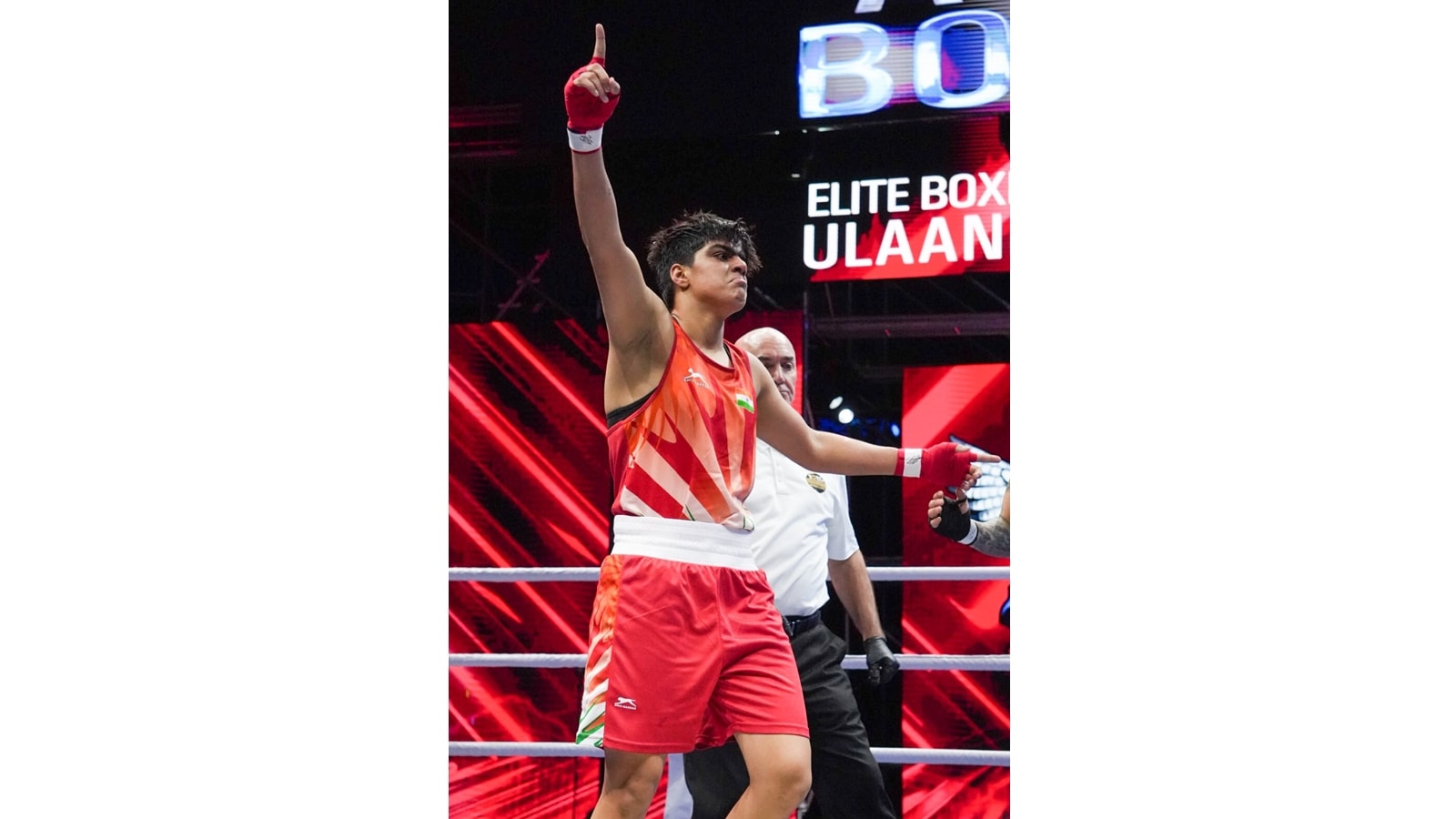

Mahendra Ghanghas fondly recalls the moment in 2016 when his youngest daughter Priya approached him with a request to join a boxing academy in Dadri, Haryana. Her inspiration stemmed from witnessing another girl heading out for training. Fast forward to Thursday, and that initial determination bore fruit as 20-year-old Priya secured the gold medal in the 60kg category at the Asian Boxing Championships held in Ulaanbaatar, Mongolia. She achieved this triumph by decisively defeating North Korea’s Won Un-gyong with a score of 3-0 in the final match.
“Her relentless spirit and ambition have propelled her to this point and will continue to do so,” Mahendra remarked. “I had no prior knowledge of boxing—my background is in construction. However, when Priya expressed her desire to pursue boxing, my wife and I immediately supported her.”
For seven years, Priya trained under Ravi, a former national champion who also provided guidance to Manu Bhaker, a medallist at the upcoming Paris Olympics, at the Dadri facility. She often trained alongside her older brother, Neeraj. When the pandemic disrupted their routine, the family relocated to their ancestral village, Dhanana, situated in Bhiwani district, which has produced renowned boxing champions like Sakshi and Neetu Ghanghas.
In 2022, Priya became a part of the Sports Authority of India Training Centre in Bhiwani, where she trained under Mahavir Singh, a recipient of the Dronacharya award. This center has fostered the careers of notable athletes such as Beijing Olympics bronze medallist Vijender Singh, Commonwealth Games champion Akhil Kumar, and Asian Games champion Vikas Krishan. At the center, Priya began her journey without even holding a district championship title, training alongside around a hundred peers.
Her hard work began to pay off, as she first claimed a district title in Bhiwani, followed by a state title in Haryana in 2023. This was succeeded by a bronze medal at the U19 Asian Championships later that same year, as well as a silver at the U22 Asian Championships held in Thailand, and a bronze medal at the Thailand Open. She also reached the national finals in the 57kg category, where she faced Jaismine Lamboriya and suffered a loss.
Reflecting on that setback, her coach Mahavir noted that it only intensified her determination. “She told me, ‘Sir, I need to improve from here,’” he recounted. Subsequently, they decided to move her up to the 60kg weight class, where her height and build could offer her a competitive edge.
Mahavir focused on rectifying her early technical shortcomings, such as her habit of dropping her hands and allowing her elbows to stray outside the target zone, before emphasizing physical conditioning. “True to the Bhiwani boxing tradition, she trained twice a day for two and a half hours each session, honing her strength and fundamental skills. There were days when she voiced her concerns, but I reminded her that even legends like Felix Savon built their careers on mastering the basics through relentless practice,” he explained.
At the championships in Ulaanbaatar, Priya faced tough competition. She began her quest for gold against Kazakhstan’s Rimma Volossenko, a World Championships quarter-finalist, and secured a convincing 5-0 victory. In the quarterfinals, she narrowly defeated Chengyu Yang from China, a former world champion and last year’s World Championships bronze medallist in the 60kg category, with a split 4-1 decision. She then triumphed over the local favourite, Namuun Monkhor of Mongolia, with another 5-0 win, leading her to the final, which she won with ease.
Santiago Nieva, India’s women’s head coach, expressed admiration for Priya’s ability to manage the challenges posed by a demanding competition bracket. “Her performance against Volossenko in the initial round was outstanding. While she did show signs of fatigue in the third round, her pacing through the subsequent bouts—finishing strongly in each—will significantly enhance her confidence,” he noted. “Her jab effectively controls the bout, her right hook is a reliable weapon, and her defense is robust enough to allow her to engage effectively up close.”
India concluded the day with four gold medals, three of which were in Olympic weight categories. World champion Minakshi Hooda secured the 48kg title with a 5-0 victory against Mongolia’s Nomundari Enkh-Amgalan. Preeti Panwar triumphed over three-time world champion and Tokyo 2020 bronze medallist Huang Hsiao-wen from Chinese Taipei with a 5-0 win in the 54kg final, while Arundhati earned the 70kg gold after defeating Kazakhstan’s Bakyt Seidish 4-1.
For Priya, the focus now shifts to enhancing her existing skills. The women’s 60kg category has been part of the Olympic program since the sport’s introduction for women at the London 2012 Games, and it features a highly competitive field, including formidable contenders from Ireland, France, Brazil, and Finland, in addition to Asia’s top fighters. Nieva understands the challenges ahead. “In the upcoming months, we will concentrate on fine-tuning her pacing—learning when to accelerate and when to conserve energy—and exposing her to various boxing styles. Our goal now is to build on her current success,” he stated.