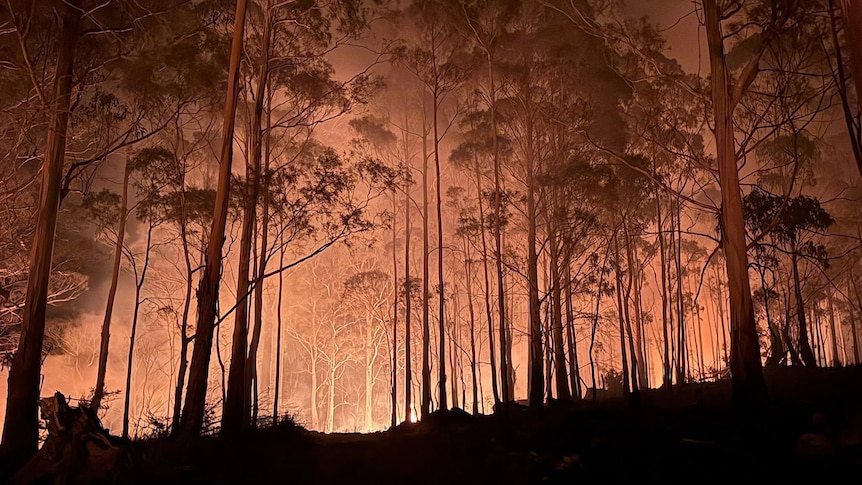

A recent study has revealed that logging practices contribute to the severity of bushfires, as younger eucalyptus trees, which are more flammable, replace older trees that serve as effective fire barriers. The research indicates that approximately 20% of Tasmania’s tall wet forest consists of regrowth trees aged under 40, primarily due to extensive logging and significant wildfires in the past few decades.
Co-author David Bowman, a professor specializing in pyrogeography, emphasizes that the risks associated with regrowth have not been sufficiently addressed. He calls for a shift in approach to managing these areas to enhance community safety and protect the state’s timber industry. The findings, published in the journal Environmental Research Letters, support previous studies that suggest younger trees have denser canopies, making them more susceptible to igniting in the event of a fire.
Bowman also pointed out a growing concern within the global insurance sector regarding the rise in destructive wildfires, stating, “There needs to be a fundamental change in how we manage regrowth to safeguard lives and properties.” He stressed the undeniable issue of regrowth and its link to increasing fire hazards.
Hughie Nicklason, a forest campaigner with the Wilderness Society Tasmania, echoed these sentiments, asserting that the research aligns with numerous other studies indicating that native forest logging elevates bushfire risks. He advocated for the protection of remaining mature forests and the development of restoration strategies to ensure community cohesion.
Professor Bowman further articulated that the focus should not solely be on whether logging will persist, but rather on how to manage regrowth areas effectively. He noted that mature forests can mitigate fire severity by acting as buffers against advancing flames. However, he expressed concern that the opportunity to manage regrowth has already slipped away.
He urged for a redirection of resources toward land management efforts to address the risks posed by regrowth, suggesting that more funding should be allocated to fuel management rather than primarily firefighting efforts.
Suzette Weeding from Sustainable Timber Tasmania (STT) acknowledged the significance of continued research on bushfires but emphasized that multiple factors influence fire risks. She argued that the presence of regrowth areas does not necessarily escalate fire spread or landscape-level risks, a statement supported by the study’s findings that highlight the protective role of mature trees.
Despite the study’s findings contradicting earlier claims made by the state government regarding logging reducing bushfire risk, the government maintains that bushfire risk is influenced by a combination of factors rather than any single land-use practice. The current contracts for native forestry are set to conclude in 2027, with discussions underway about extending these agreements.
New reforms to federal environmental regulations will increase the Australian government’s oversight of Tasmania’s native forestry sector, which must comply with National Environmental Standards by mid-2027.
STT is actively engaged in managing bushfire risks across 821,000 hectares of land, as stated by Weeding. This includes maintaining road networks for firefighting access, utilizing fire towers and AI technology for early detection, conducting fuel reduction burns, and coordinating efforts with other firefighting agencies. In the 2024-2025 period, STT firefighters responded to 57 bushfires and implemented fuel reduction measures across over 2,000 hectares.
While Bowman acknowledged that managed forests and access roads can improve fire management, he cautioned that converting mature forests to regrowth poses significant risks. Historical data shows that past fires, such as the devastating Black Tuesday fires of 1967, have resulted in extensive destruction and loss of life, highlighting the continuing threat of wildfires in Tasmania. Recent incidents, such as those in February of the previous year, further underscore the persistent risk of large-scale bushfires in the region.