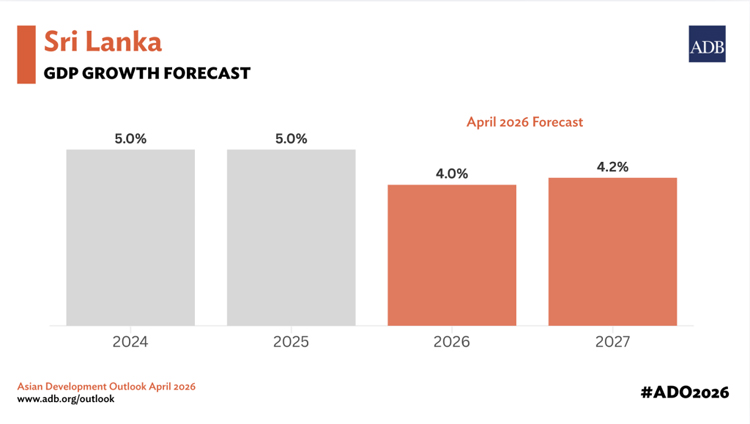

Sri Lanka is anticipated to see its economic growth slow to 4.0% in 2026, with a slight increase to 4.2% in 2027, following two robust years of 5.0% growth.
This projection is predicated on a scenario in which the ongoing conflict in the Middle East stabilizes, as outlined in the Asian Development Outlook (ADO) report from April 2026, a key publication from the Asian Development Bank (ADB). Despite facing some challenges from Cyclone Ditwah late in the year, Sri Lanka’s economy demonstrated resilience in 2025. There was a notable rise in private consumption, supported by low inflation and declining interest rates, while remittances reached an all-time high, accompanied by a significant primary budget surplus. Additionally, the current account achieved its third consecutive surplus, and official reserves grew to their highest levels in years.
The economic outlook for 2026 will be significantly influenced by the conflict in the Middle East, even as rebuilding efforts following Cyclone Ditwah provide a degree of growth support. Private consumption is expected to continue as the primary engine of growth; however, increased inflation may dampen household purchasing power. Moreover, private investment is anticipated to recover slowly due to ongoing uncertainties.
Rising energy prices, potential declines in remittance flows, and interruptions in trade and tourism could negatively impact household incomes and external financial reserves, ultimately hindering economic growth. Inflation is forecasted to rise sharply to 5.2% in 2026, primarily driven by factors associated with the Middle Eastern conflict.
Shannon Cowlin, ADB Country Director for Sri Lanka, stated, “Sri Lanka has made significant strides since the recent economic crisis, and its economic achievements over the past two years are commendable. However, the risks that lie ahead are significant and tangible. This is not the time to relax on reforms; it is crucial to maintain fiscal discipline and to bolster resilience against external shocks that will continue to test the economy. Additionally, enhancing and implementing public investment will be vital for sustaining the ongoing recovery.”
The Asian Development Bank is a premier multilateral development institution dedicated to promoting sustainable, inclusive, and resilient growth throughout Asia and the Pacific. By collaborating with its members and partners, ADB addresses complex challenges through innovative financial solutions and strategic alliances, aiming to improve lives, create quality infrastructure, and protect the environment. Established in 1966, ADB is owned by 69 member countries, with 50 of those located within the region.
Source: Financial Chronicle Biz English | Sri Lanka Business News.