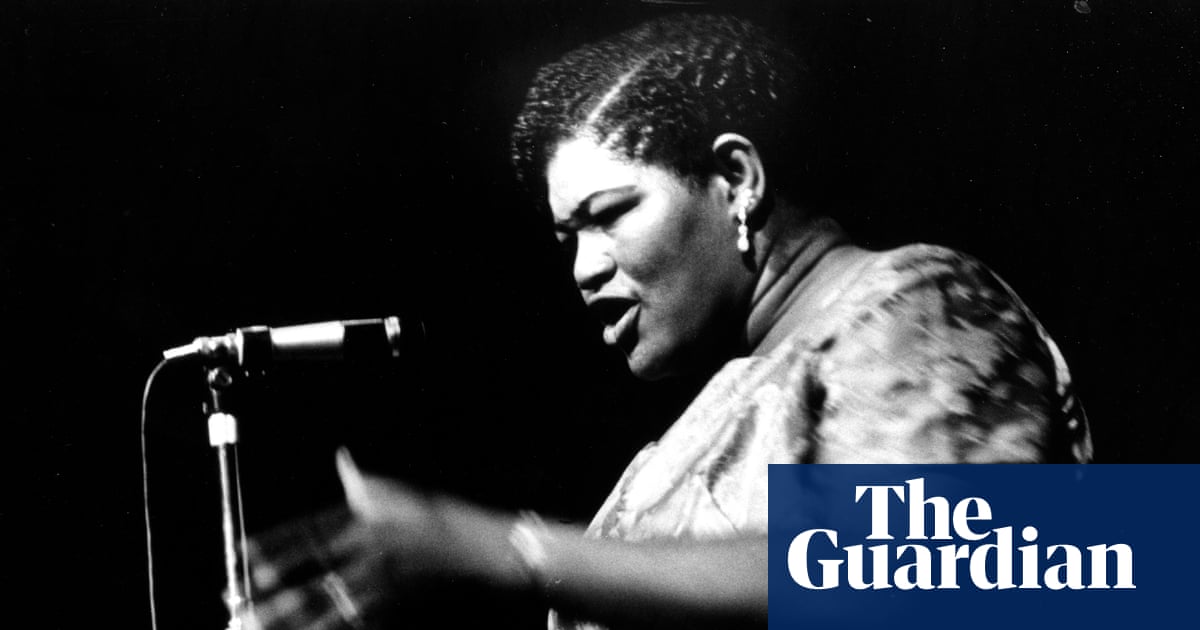

Willie Mae “Big Mama” Thornton was a powerhouse of raw emotion and resilience. Her vocal style expressed a deep sense of struggle and defiance, conveying anger and sorrow in a way that few could match. Standing at an impressive 6 feet 2 inches, with a strong build and a face marked by scars, she was a Black, gay multi-instrumentalist who refused to let a prejudiced society or a greedy music industry limit her potential.
While Thornton deserves to be celebrated alongside iconic figures like Billie Holiday and Nina Simone, she is often relegated to a mere footnote in the narratives surrounding artists like Elvis Presley and Janis Joplin, who gained fame for songs originally performed by her. A new documentary titled Big Mama Thornton: I Can’t Be Anyone But Me seeks to rectify this oversight.
Robert Clem, the documentary’s director, remarked on her uniqueness, stating, “She was a female artist who lived by her own rules during a very conservative time. She was fearless; she confronted men who tried to exploit her, performed in maximum-security prisons, and even learned the drums out of frustration with unreliable drummers. There’s so much to admire about Big Mama.”
Thornton passed away in 1984 at the age of 57, her death barely acknowledged in the music industry, which viewed her as a one-hit wonder. Although she found success with “Hound Dog,” reaching the top of the R&B charts in 1953, her subsequent career did not yield similar commercial success. As this year marks the centenary of her birth, Clem believes it is time to revive her legacy. He admits that despite growing up in Alabama, he was not familiar with her music until he researched the era for his 2018 gospel documentary, How They Got Over. “Willie Mae died too soon,” he reflects. “If she had lived longer, she would have gained a new audience.”
Born in Alabama in 1926, Thornton faced significant challenges from an early age, losing her mother when she was just three years old. Her preacher father transported his children to various congregations using a horse and cart. Thornton’s formal education ended at age 12 when she had to start working, initially cleaning bars and later collecting garbage. At 14, she was discovered by blues singer “Diamond Teeth” Mary McClain while singing on the job, leading to performances in the touring Hot Harlem Revue, featuring mainly LGBTQ+ artists. This environment suited Thornton, who favored menswear and openly embraced her sexuality, although the revue often paid poorly, forcing her to shine shoes to make ends meet.
In 1948, Thornton moved to Houston, Texas, where she caught the attention of Don Robey, a groundbreaking African American entrepreneur and record label owner. He signed her in 1950, and upon the arrival of the Johnny Otis Orchestra, Robey encouraged Otis to recruit her. Otis, a Greek American musician dedicated to promoting Black talent, gave her the nickname “Big Mama” and tasked songwriters Mike Stoller and Jerry Leiber with creating a song for her. Stoller described her as “the biggest, baddest, saltiest chick you would ever see.”
Their collaboration resulted in “Hound Dog,” which dominated the Billboard R&B chart for nearly two months. However, Robey continued to exploit Thornton by keeping her singing comedic songs that failed to achieve success. She later claimed that the only compensation she received for “Hound Dog” was $500, while Leiber and Stoller also went unpaid, as Robey was notorious for cheating songwriters. Thornton recounted a time when she asked Robey for $50 to prevent her car from being repossessed, but he refused to assist her, leading to her car being taken and forcing her to shine shoes outside the clubs where she performed.
Black British blues singer Dawnette Fessey remarked that Thornton’s struggles are evident in her music: “She has a punch – the rawness in her voice. There’s real nuance and real pain. She’s fearless, a survivor. She lost her mother at a young age, similar to my experience, which can be a tough challenge.”
Thornton had to witness Elvis’s meteoric rise with “Hound Dog,” as his sanitized 1956 version spent 11 weeks at number one, fostering a lifelong resentment towards him. “I never got a dime,” she stated in 1968 when asked about any financial generosity from Presley. “He refused to perform with me when he first became famous.”
As Presley’s career flourished, Thornton’s diminished. By 1960, she was performing solo in bars in Oakland, California, where she played drums and harmonica while singing. However, her talent eventually reached white jazz and blues enthusiasts in the Bay Area. Music journalist Ralph Gleason facilitated her performance at the 1964 Monterey Jazz Festival, and Chris Strachwitz, founder of Arhoolie Records, discovered her playing poker in a park—where she was known to keep a loaded gun on the table for protection—and convinced her to join the American Folk Blues Festival’s European tour in 1965.
On this tour, she shared stages with renowned artists like Buddy Guy and John Lee Hooker, captivating audiences. “We made a bigger impact there in Europe,” Thornton told historian Studs Terkel in a 1970 interview. Her then-manager Jim Moore recalled the overwhelming reception she received, noting that Thornton was moved to tears. Strachwitz recorded her performances in London, resulting in her first album, In Europe, released in 1966, followed by Big Mama Thornton With the Muddy Waters Blues Band in 1967, both of which showcased her remarkable talent.
“She didn’t suffer fools,” stated Memphis blues musician Charlie Musselwhite, who often toured with Thornton. He shared that once she trusted you, she could be warm and generous. “She would invite me to her room, and we’d drink and talk – she was intelligent and kind. She was comfortable being a loner; I only remember her being with a girlfriend once.”
Like many blues artists, Thornton turned to alcohol. Musselwhite recalled, “Mama always had a bottle of Old Grand-Dad, and we would take sips along the way.”