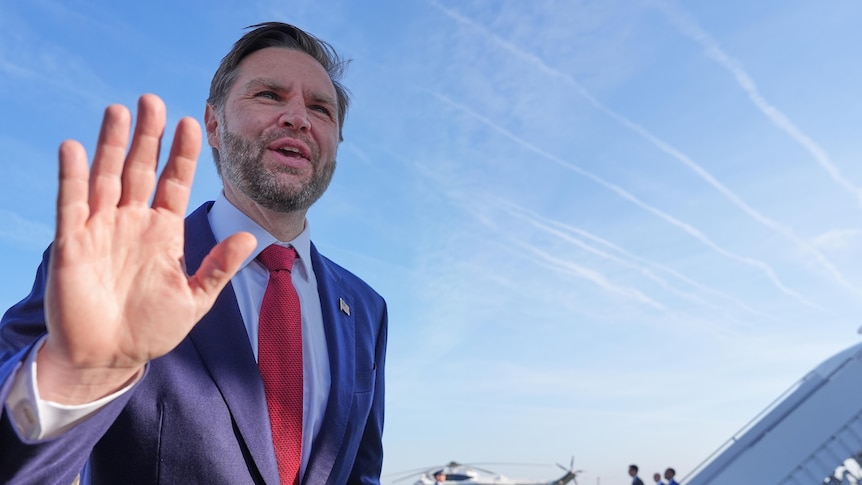

The United States delegation, under the leadership of JD Vance, has commenced its journey to Pakistan to engage in peace negotiations regarding Iran. In remarks to the media, the US Vice President expressed America’s readiness to extend a hand of cooperation but cautioned Iran against attempting to manipulate the situation.
As the temporary ceasefire teeters on the edge of collapse, both parties have leveled accusations against each other for violating the terms of the agreement. Vice President Vance has emphasized that Iran should not “play” with the United States as the two sides prepare for discussions aimed at resolving ongoing conflicts.
In Islamabad, security measures have been heightened, with a three-kilometer perimeter established around the venue where the negotiations will occur. The precise arrival time of the Iranian delegation, headed by Parliament Speaker Mohammad Baqer Qalibaf, has yet to be disclosed by Pakistani officials.
Upon boarding Air Force Two for his trip to Pakistan, Mr. Vance expressed optimism about the negotiations, stating, “I think it’s gonna be positive. We’ll of course see.” Although the White House has not released detailed information regarding the structure of the talks, Mr. Vance indicated that President Donald Trump had provided “clear guidelines” for their conduct.
According to Vance, the US is open to negotiations if Iran approaches the discussions in good faith. “If they’re gonna try and play us, then they’re gonna find that the negotiating team is not that receptive,” he warned. Joining Vance on this mission are US Special Envoy Steve Witkoff and Jared Kushner, the President’s son-in-law, who has previously participated in indirect negotiations with Iranian representatives.
Both the United States and Iran have reported breaches of the ceasefire agreement. The Strait of Hormuz remained closed on Friday, coinciding with exchanges of fire between Israel and Hezbollah in Lebanon. Each side has attributed these incidents to violations of the ceasefire terms.
On social media, President Trump criticized Iran for its handling of oil passage through the Strait of Hormuz, claiming it did not adhere to the agreed-upon terms. He also cautioned Iran against imposing charges on vessels using the strait.
Iran’s Supreme Leader, Mojtaba Khamenei, recently stated that while Iran does not seek conflict with the United States or Israel, it will steadfastly defend its national rights. “We will not renounce our legitimate rights under any circumstances,” he affirmed, emphasizing solidarity with the entire resistance front.
In parallel developments, Naim Qassem, the leader of Hezbollah, has urged the Lebanese government to refrain from making “free concessions” to Israel, as the two nations prepare for their own negotiations in Washington next week. He condemned Israel’s recent strikes in Beirut, which resulted in over 300 fatalities, labeling them as acts of “bloody criminality.”
Earlier in the day, Hezbollah announced that it had targeted Israel’s Ashdod naval base with missiles, citing violations of the ceasefire by Israel, which it claimed had persisted in attacks on Beirut. The Israeli Defense Forces reported the destruction of more than 200 rocket launchers and 1,300 launch tubes, while Lebanese media indicated that Israeli airstrikes in the southern city of Nabatiyeh had killed eight members of the State Security agency.