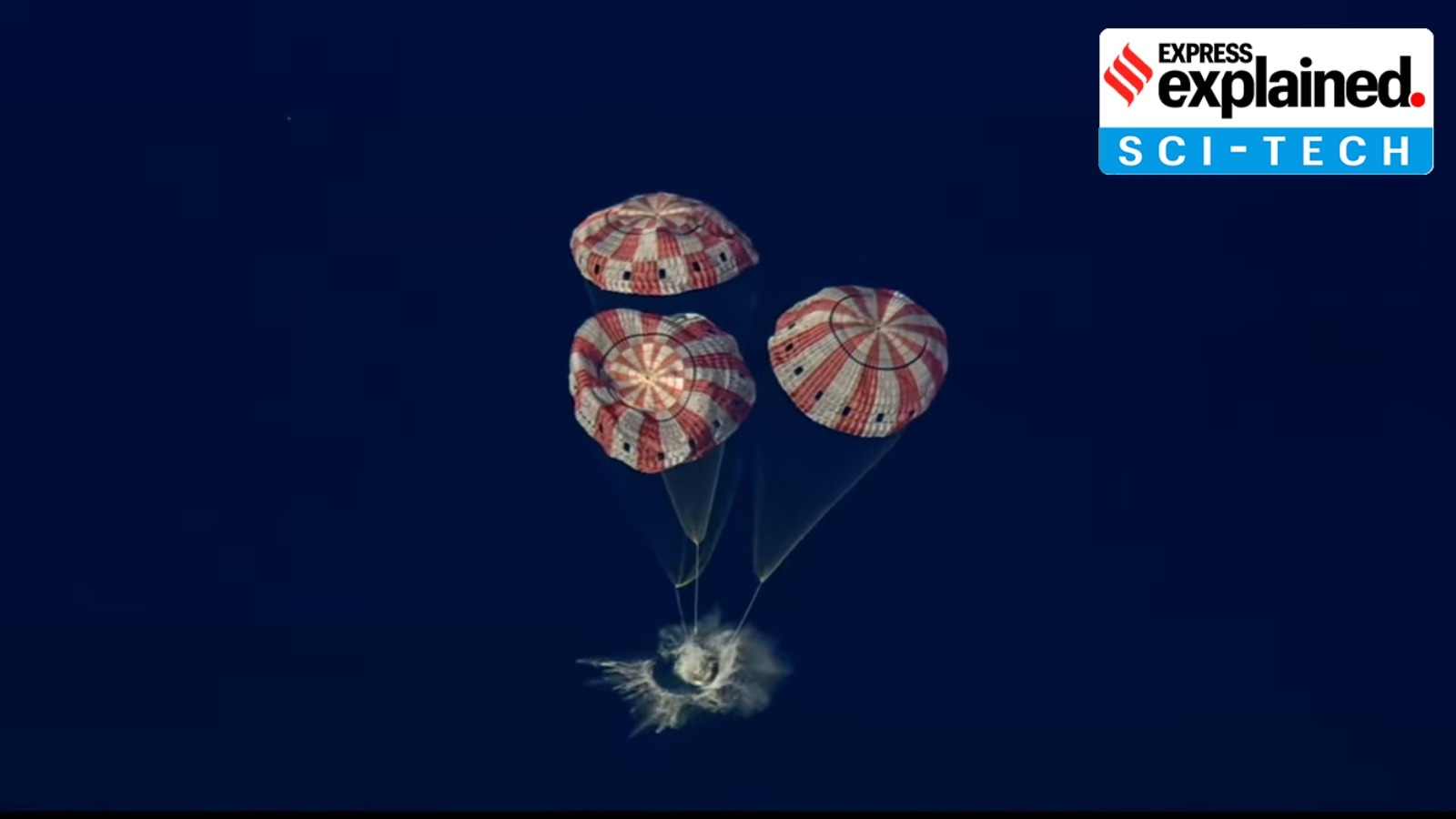

Following a groundbreaking journey around the Moon, the four astronauts aboard NASA’s Artemis II mission made their return to Earth earlier today, April 11.
The Orion spacecraft, which housed astronauts Reid Wiseman, Victor Glover, and Christina Koch from the United States, along with Jeremy Hansen from Canada, successfully splashed down in the Pacific Ocean near southern California at 5:37 AM IST on Saturday.
This mission marked the first time in over fifty years that astronauts have approached the Moon. Although they did not land on the lunar surface, their trajectory allowed them to travel farther into space than any Apollo mission, surpassing the distance achieved during the Apollo landings in the 1960s and 1970s. The Orion spacecraft reached a maximum distance of 406,778 kilometers from Earth, exceeding the Apollo 13 mission’s distance by approximately 6,606 kilometers.
Over the course of their ten-day mission, the Artemis II crew traversed about 1.12 million kilometers, although this is not the highest distance covered by a crewed mission. For comparison, Apollo 17, the final Apollo mission, covered roughly 2.38 million kilometers. The average distance from Earth to the Moon is approximately 384,400 kilometers, meaning a round trip would typically require at least 768,800 kilometers. However, the actual paths taken by spacecraft are often complex and can vary due to the elliptical orbits of both the Earth and the Moon, along with mission-specific designs affecting travel distances.
During re-entry, the Orion spacecraft was traveling at speeds between 11 and 12 kilometers per second (around 40,000 to 42,000 kilometers per hour). This velocity is significantly higher than the 26,000 to 28,000 kilometers per hour seen during re-entries from the International Space Station (ISS) and similar low-Earth orbits. The increased speed is a result of lunar missions originating from greater distances, allowing them to accelerate more before re-entering Earth’s atmosphere. In contrast, the ISS is situated about 400 kilometers above Earth.
The higher speeds also result in greater energy levels, necessitating that spacecraft returning from lunar orbits be sturdier to endure the heightened physical stresses experienced during atmospheric re-entry.
Once the Orion spacecraft entered the atmosphere, it, like other spacecraft, underwent rapid deceleration. The initial set of parachutes deployed at an altitude of approximately 6 kilometers, followed by another deployment when the spacecraft was about 2 kilometers above the surface. At this point, its speed had reduced to around 200 kilometers per hour, and it was traveling at just 30 kilometers per hour at the moment of splashdown. NASA and military teams were positioned at various sites close to the landing location in the Pacific Ocean to assist with crew extraction and transport them to a nearby ship.
The successful conclusion of the Artemis II mission paves the way for the first human landing on the Moon in over fifty years, currently planned for 2028.
As the inaugural crewed mission of NASA’s Artemis program, Artemis II aims to return humans to the Moon more than five decades after the Apollo program successfully delivered twelve astronauts through six historic missions. The Apollo missions took place just twelve years after the dawn of the space age, marking significant technological advancements. However, the early space technology landscape was too immature to leverage these achievements for ongoing exploration, resulting in the Moon landings being isolated triumphs.
When lunar exploration resumed in the early 2000s, efforts began anew, starting with orbiters rather than picking up from the 1972 endpoint. This phase of exploration has progressed gradually, and upcoming human landings are expected to serve as critical steps toward deeper engagement with the Moon, potentially using it as a launchpad for further space exploration.
The Artemis program’s first mission in 2022 involved an uncrewed spacecraft that orbited the Moon and returned safely. Artemis II has now successfully executed a rehearsal for the anticipated Moon landing mission set for 2028. This program heralds a new chapter in human spaceflight, with the goal of establishing a permanent lunar presence and facilitating regular human visits to the Moon.
Establishing such a presence will require significant time and numerous lunar missions, transporting humans, robots, equipment, and fuel to utilize local resources for creating a sustainable habitat capable of supporting human life over extended periods.