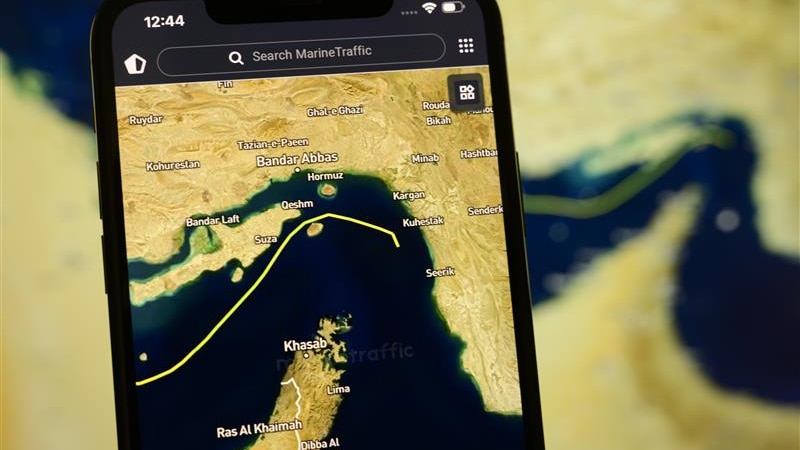

The Islamic Revolutionary Guard Corps (IRGC) of Iran has released a map that purportedly designates a “danger zone” within the Strait of Hormuz, indicating areas where sea mines may be present. This announcement coincides with the initiation of discussions aimed at reopening this vital international shipping route.
Experts suggest that Iran is leveraging the threat of sea mines to reinforce its control over the strait, which is crucial for global trade. The IRGC’s map, disseminated through semi-official news outlets ISNA and Tasnim, suggests alternative navigation routes closer to Iran’s mainland, particularly near Larak Island.
The IRGC advised that vessels must utilize this new map due to the “potential presence of various types of anti-ship mines in the main traffic zone.” This warning comes as ceasefire negotiations involving Iran, the United States, and Israel are scheduled to take place in Pakistan, where discussions will also address the reopening of the waterway.
The actual level of risk posed by Iranian sea mines remains unclear. However, analysts believe that Iran may be employing this tactic to exert pressure on global shipping firms, compelling them to adhere to its regulations.
Iran is estimated to possess over 5,000 sea mines, according to the US Defense Intelligence Agency. These mines are considered among the most straightforward and cost-effective weapons in Iran’s military arsenal, as highlighted by experts from the Stimson Center, a Washington-based think tank focused on global peace initiatives.
Iranian sea mines can take various forms, including drifting mines, seabed mines, and contact mines that attach to vessels. They are often designed to resemble floating black spheres with spikes, known as “Hertz horns,” which trigger an explosion upon contact with a ship. Andy Perry, a retired mine warfare expert from the Royal Australian Navy, explained that these horns contain a corrosive acid that activates the mine’s explosive charge when damaged.
While contact mines can inflict significant damage to a vessel, they are unlikely to sink it outright. Damage is typically localized, leading to issues such as internal flooding. Iran’s arsenal includes older contact mines as well as more advanced models that detonate in response to acoustic or magnetic fields. US officials suspect that several Iranian-manufactured Maham 3 and Maham 7 mines have been positioned in the strait. The Maham 3 is a deep-water mine anchored in depths of up to 100 meters, while the Maham 7 is designed to lie on the seabed in shallower waters and uses sensors to detect the passage of ships.
The Strait of Hormuz, measuring approximately 167 kilometers in length and narrowing to 39 kilometers at its tightest point, has been marked by Iran as an area heavily populated with mines. Since February 28, Iran has obstructed shipping through the strait amid escalating US and Israeli military activities.
This week’s ceasefire agreement includes provisions for Iran to reopen this critical trade channel. Reports suggest that Iran may seek to impose a toll of $2 million on each oil tanker transiting the strait, according to senior Iranian officials cited by The New York Times.
Malcolm Davis, a senior defense analyst at the Australian Strategic Policy Institute, indicated that Iran appears to be employing “coercive threats” to enhance its control over the strait. He emphasized that the mines are likely real but that Iran’s strategy aims to intimidate shipping operators into adhering to designated routes controlled by Iran, thus enabling the country to enforce tolls.
Iran’s Foreign Minister, Abbas Araghchi, stated that the country would ensure safe passage through the strait during the ceasefire, coordinating efforts with Iran’s Armed Forces while considering technical limitations. Davis cautioned that allowing Iran to collect tolls and oversee shipping in its territorial waters could establish a perilous precedent, potentially enabling Iran to reassert control over the strait at any time in the future.
Experts warn that if a peace agreement is reached that permits Iran to maintain its influence over the Strait of Hormuz, it would effectively validate Iran’s ability to maintain a stranglehold on global energy supplies.
Clearing mines from the strait would necessitate a painstaking and resource-heavy process, typically employing autonomous underwater vehicles equipped with sophisticated sonar technology.