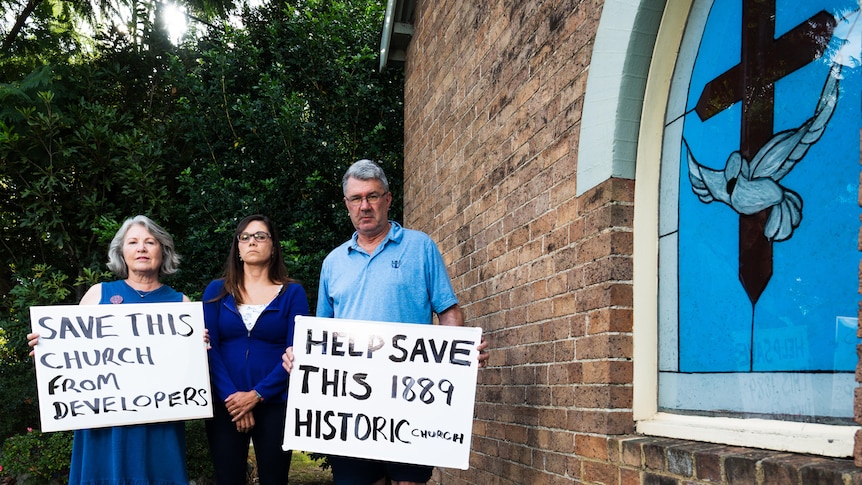

Residents of Western Sydney are rallying to prevent the demolition of the former Jamisontown Uniting Church, a historic structure that has stood for 130 years, as negotiations for its sale are underway for potential residential development.
In the inner western suburbs of Sydney, a group of five individuals has found affordable accommodation in a repurposed church constructed in the 1800s.
Proposed changes to New South Wales (NSW) planning regulations governing public worship sites could lead to the creation of over 20,000 homes in desirable metropolitan areas.
Community members in Western Sydney are expressing concern that the demolition of this 19th-century church would erase more than a century of local heritage.
As the demand for new housing intensifies, church properties are increasingly viewed as viable options for development in New South Wales.
The Jamisontown Uniting Church, which once played a central role in community events like weddings and funerals, has remained empty for over a year on a quiet suburban street.
Last month, the property was listed for auction, touted as a unique chance for medium-density housing development, with possibilities for townhouses or villas. However, the listing was removed earlier this week as discussions regarding a potential deal were initiated.
Local resident Amanda Davis expressed her apprehensions about the church’s fate, emphasizing the loss of a significant historical landmark. “There’s no heritage listing, so they’re free to demolish it,” she remarked. “There is ample land available nearby that could be utilized for new construction instead.”
In New South Wales, strict zoning regulations currently restrict housing development on lands designated as SP2 — Places of Public Worship. Religious sites such as churches, mosques, and synagogues face a lengthy application process at both state and local levels before any development can occur.
A study conducted by UrbanBio for Faith Housing Australia in June 2022 identified 747 faith-owned properties that could be leveraged for housing development. The analysis revealed that in the Sydney metropolitan area alone, underutilized church lands could potentially accommodate more than 20,000 homes if SP2 zoning restrictions were relaxed.
Amanda Bailey, the chief executive of Faith Housing Australia, stated that the organization is in discussions with the NSW government to simplify the SP2 planning process, noting that these conversations have been fruitful. “There is a profound link between the mission of local congregations and the pressing need for housing,” she explained.
Bailey added that faith-based organizations are collaborating with community members to explore ways to preserve historical significance while also addressing housing needs. “Places of worship contribute greatly to social cohesion and help combat isolation, and we aim to continue that legacy,” she noted. “We are encouraging our members to reflect on the historical narrative of their sites and how they can incorporate housing into that story.”
Paul Scully, the Minister for Planning and Public Spaces, mentioned that the Housing Delivery Authority (HDA) has identified several sites proposed by religious organizations as “state significant.” He encouraged other religious groups interested in developing housing on their land to submit proposals to the HDA, which provides an expedited process for affordable housing projects that can begin within a year.
In a different part of the city, Julian Robinson resides in a former Anglican church that has been converted into a sharehouse. The 28-year-old moved into the Dulwich Hill property last year, drawn by the initiative taken by local investors to preserve the historic building. “It’s been a blessing, to be honest,” he said, highlighting the benefits of using such spacious and sturdy structures for living arrangements.
While Robinson acknowledged some downsides, such as limited natural light and sound issues due to the architecture, he emphasized that the advantages of affordable rent and a prime location far outweigh any drawbacks. “This property has transformed the lives of five people by giving us stability and affordable housing,” he stated.
Back in Jamisontown, Amanda Davis continues to advocate for a local heritage listing as the church’s sale progresses. If developers seek to demolish the building, they will need to submit a development application (DA) to the Penrith City Council, which will then undergo a public consultation process before any decisions are made.
A spokesperson from the Penrith City Council indicated that an external heritage assessment of the building is being commissioned to aid in evaluating any future development proposals and to determine the appropriateness of a local heritage listing. Davis hopes for an outcome where the church is preserved and adapted for new uses while maintaining its historical significance.