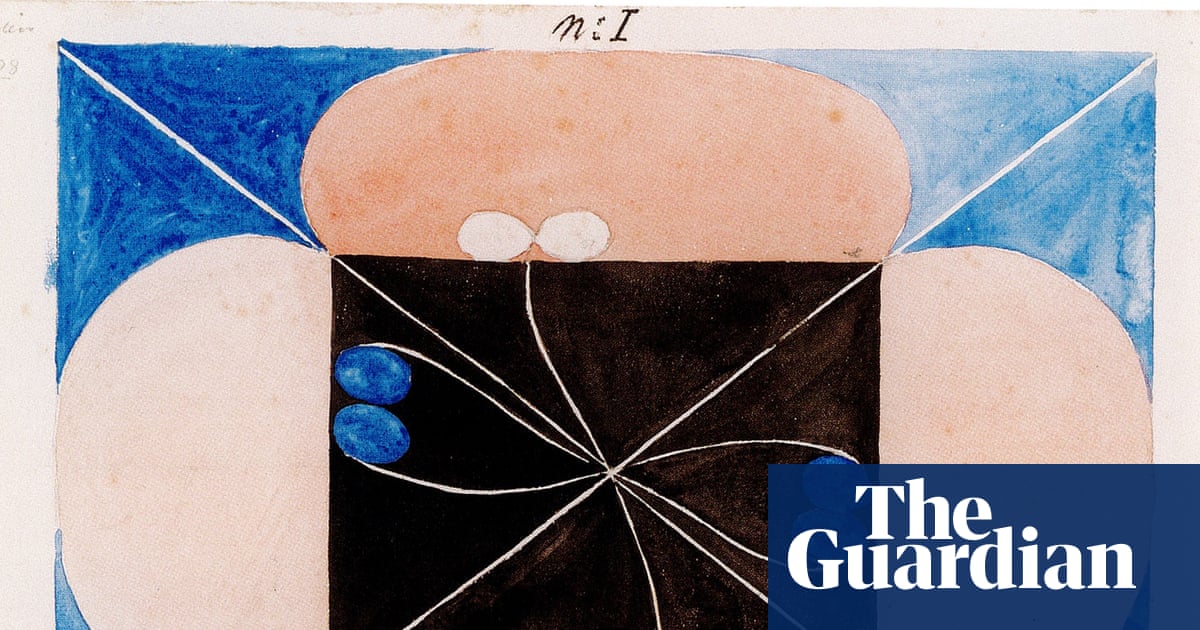

Swedish painter Hilma af Klint passed away with the belief that her visionary artworks would be too avant-garde for the world to appreciate until decades later. Recognized today as a forerunner of abstract art, she refrained from seeking acclaim after her contemporary artists dismissed her innovative pieces. Instead, she mandated that her work remain concealed for 20 years posthumously and never be sold.
More than 80 years after her passing, af Klint, a clairvoyant and mystic who felt guided by higher spiritual forces, is set to have her inaugural solo exhibition in France. This event, organized by the Grand Palais and the Pompidou Centre, will showcase what is regarded as her most significant work, “Paintings for the Temple,” created during her involvement with a spiritual women’s group that shared utopian aspirations.
Pascal Rousseau, the curator of the exhibition, noted that af Klint has been largely ignored in France and that this exhibition is part of a broader international reassessment of her contributions and the impact of women in modern art. He emphasized that the exhibition would illuminate the diverse inspirations behind her work and challenge the historical neglect of female artists and their vital roles in key artistic movements.
Despite her profound influence, af Klint’s name remains less recognizable than her male counterparts, such as Wassily Kandinsky, Piet Mondrian, and Kazimir Malevich, who claimed to be the pioneers of abstraction. When af Klint’s art was finally introduced outside Sweden in the 1980s, it became clear that she had been ahead of her time, prompting a reevaluation of art history.
Born in 1862, af Klint was among the first women to gain admission to the Royal Academy of Fine Arts in Stockholm, where she received classical training in painting. Much of her most acclaimed work emerged while she was a member of the Theosophical Society and a small spiritualist group known as “the Five.” Theosophy, which gained popularity among artists in the late 19th century, is often linked to occult practices and esoteric beliefs.
According to Rousseau, af Klint held strong beliefs in angels, reincarnation, and communication with other realms. He described her dedication to these ideas as an intense obsession lasting three decades, which ultimately fueled her creation of unique and groundbreaking artwork.
While af Klint produced and sold traditional portraits and landscapes, she kept her spiritual paintings private, convinced that the public would not comprehend the hidden symbols and enigmatic messages contained within them. Some institutions, including at least one museum in Stockholm, declined to exhibit works by female artists. In 1908, even the philosopher and artist Rudolf Steiner—another theosophist—was dismissive of her work, suggesting it lacked significance.
Before her death in 1944, af Klint instructed that her extensive collection, comprising over 1,200 paintings and 126 illustrated sketchbooks, remain sealed for two decades and never be sold. Professor Caroline Levisse remarked that af Klint felt detached from worldly concerns and intentionally chose not to engage with her contemporaries, contributing to her obscurity. She noted that af Klint did not wish for her art to be displayed in a museum, but rather in a spiritual setting, believing that her work was intended for a future audience that would ultimately understand its significance.
Aside from a few minor exhibitions in Sweden, af Klint’s paintings were not publicly showcased until 1986 in Los Angeles. It was not until a 2013 exhibition in Stockholm, which featured 230 of her works and sold out, that she garnered international recognition. A biography released in 2022 and an Oscar-nominated film in the following year further spotlighted her contributions.
Levisse pointed out that even after af Klint’s works gained visibility in the 1980s, she was frequently overlooked, citing a 2010 exhibition at the Museum of Modern Art in New York that failed to include her among abstract artists. She emphasized that af Klint is finally receiving the acknowledgment she deserves in the narrative of abstract art, suggesting that this has necessitated a reevaluation of art history. Her experimental and innovative approach established her as a pioneer in abstraction.
The upcoming Paris exhibition will feature af Klint’s “The Ten Largest,” a series of paintings on paper mounted on canvas, each approximately 3.3 by 2.4 meters (10.8 by 7.9 feet) in size. Rousseau added that these delicate pieces require restoration, indicating that this may be a rare opportunity to view them in the near future.
“Hilma af Klint: The Temple Paintings (1906-1915)” will be on display at the Grand Palais in Paris from May 6 to August 30.