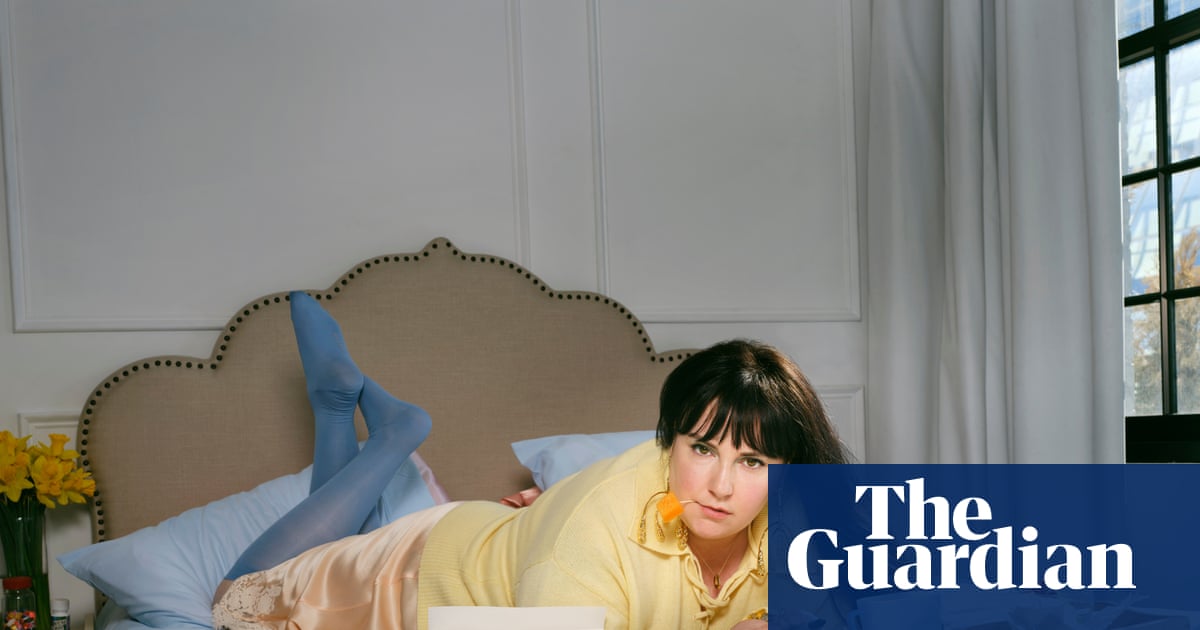

Lena Dunham’s choice of pseudonyms offers interesting insights into her self-perception as a public figure. Over the years, she has utilized various aliases to maintain her privacy during personal moments, such as checking into rehab or ordering room service. Notable among these is “Lauri Reynolds,” named after her mother Laurie, with whom she has a close relationship; “Rose O’Neill,” inspired by the American illustrator who faced significant challenges in her life; and “Renata Halpern,” an alias she reveals in her new memoir, Famesick, without providing its backstory.
During a video call from her New York apartment, Dunham, who is approaching her 40th birthday, discusses the Renata Halpern reference. She is dressed in a bright orange shirt and embraces her dark hair, reminiscent of Jane Russell in Gentlemen Prefer Blondes. Dunham, diagnosed with hypermobile Ehlers-Danlos syndrome in 2019, describes her glowing skin as the sole positive aspect of her condition. Although she has spent the last five years in London with her husband, Luis Felber, she still prefers using aliases for added security, noting that even with less attention, there are still instances of unwanted scrutiny.
The name Renata Halpern is derived from a traumatized character in Pat Conroy’s 1986 novel The Prince of Tides, which was adapted into a film featuring Barbra Streisand and Nick Nolte. Dunham expresses surprise that no one had previously recognized the reference, playfully noting the influx of mail she has received addressed to the pseudonym.
It has been nearly a decade since the series finale of Girls, and Dunham’s choice of names often reflects her affinity for complex and troubled female characters. Her memoir, Famesick, candidly explores her tumultuous life over the past two decades, detailing her rise to fame amid the chaotic landscape of early social media, the immense pressures of producing a successful television series, and her struggles with health issues, including a prolonged battle for recognition of her endometriosis. She also delves into her experiences with addiction, challenging relationships, and the loneliness that accompanied her success.
In Famesick, themes of trauma, loss, and personal struggles take center stage, with Dunham portraying herself as overly sensitive and often confined to her bed. Yet, as one converses with her, it becomes clear that there exists another side to Dunham—a determined and ambitious woman who consistently navigates demanding work at the highest levels of the industry.
This resilient side of Dunham is reflected in her writing. Famesick is not only brutally honest about the challenges of fame but is also infused with humor. She recounts a moment in the hospital before her hysterectomy, highlighting the irony of being surrounded by medical personnel instead of loved ones, all while under the influence of labor-inducing drugs. Her vivid descriptions convey both the gravity and absurdities of her experiences.
Addressing accusations of nepotism, Dunham insists that her parents were relatively unknown to viewers of HBO, and she shares a humorous anecdote about her husband’s trauma, juxtaposing it with her own feelings of being unlikable.
Reflecting on her early fame, Dunham notes that after the first season of Girls, she became the target of intense online criticism. She candidly recounts the harsh judgments she received regarding her appearance, voice, and style from anonymous critics, revealing the challenges she faced as a young woman in the spotlight. Despite the negativity, Dunham remained open and engaged with online commentary, a choice that raises questions about her motivations in the face of such scrutiny.
When asked why she continued to expose herself to public criticism, Dunham admits, “I don’t know,” acknowledging her addictive personality and the strange allure of the attention, regardless of its nature.