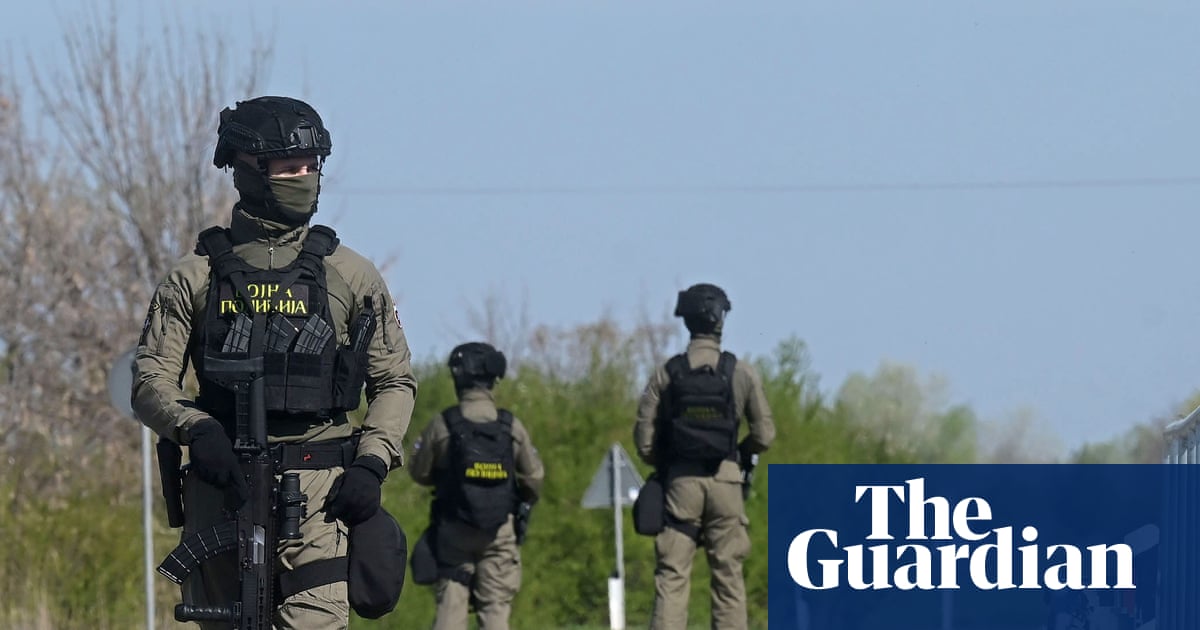

Last week, a significant amount of explosives found in Serbia was deemed insufficient to damage the Balkan Stream gas pipeline, leading experts to suspect it might be a maneuver by Russian intelligence to influence the upcoming elections in Hungary.
Mykola Zentsev, a former Ukrainian major general and munitions expert, informed the Guardian that calculations from his company indicated that the 4 kilograms of explosives seized by Serbia’s military security agency in Kanjiža would not have been capable of causing serious harm to the pipeline.
Professionals from Zentsev’s firm, Andromeda, assessed the steel and polypropylene pipeline that transports Russian gas to Hungary via Turkey, Bulgaria, and Serbia. They determined that a far larger quantity of explosives would have been necessary to inflict substantial damage. “Four kilograms is not enough to incapacitate the gas pipeline,” Zentsev asserted.
Even when optimally positioned, he noted that 4 kilograms of plastic explosive would likely result only in minor damage or shallow penetration, which could be repaired within a few days and would not significantly disrupt gas supplies. “This does not fit the typical goal of sabotage, which is to disable infrastructure for an extended period,” he concluded, supporting the notion that this incident might have been a provocation.
On Sunday, Hungarian Prime Minister Viktor Orbán mentioned that he had been briefed by Serbian President Aleksandar Vučić regarding the explosive discovery. Hungarian Foreign Minister Péter Szijjártó suggested that Ukraine might be behind the incident, labeling it “an attack on our sovereignty.”
The event received considerable media attention ahead of Hungary’s elections, where Orbán, who has pro-Russian leanings, is facing a challenging political landscape.
Péter Magyar, leader of Hungary’s opposition, accused Orbán of trying to instill fear among citizens through “false-flag operations” and suggested he was acting on the advice of Russian operatives. Ukraine has denied any involvement, a stance supported by the head of Serbia’s military security agency overseeing the investigation.
Zentsev expressed his belief that the primary beneficiaries of this situation are likely the current Hungarian government, which gains an electoral advantage, and Russia, which aims to tarnish Ukraine’s reputation globally.
Under Orbán’s leadership, Hungary has maintained close ties with Russia, continuing to purchase gas and oil from the country. Earlier in March, Budapest obstructed a €90 billion loan to Ukraine following a dispute regarding repairs to the Druzhba oil pipeline, which traverses Ukraine into Eastern Europe.
Serbian President Vučić stated on Sunday that the explosives posed a potential threat to lives and could have caused significant damage to the Balkan Stream pipeline. The explosives were discovered in two backpacks located just a few hundred meters from the gas pipeline.
However, Zentsev argued that available evidence did not suggest any attempt to position the explosives directly on the pipeline itself. A source close to Ukraine’s security services claimed the incident was likely a false-flag operation attributed to Russia’s GRU military intelligence.
“This aligns with GRU tactics,” Zentsev remarked, highlighting the military aspect of the incident. Last month, Magyar accused Orbán of soliciting assistance from GRU agents for his re-election campaign. The Russian embassy in Budapest refuted these claims, labeling them as “blatantly false information.”