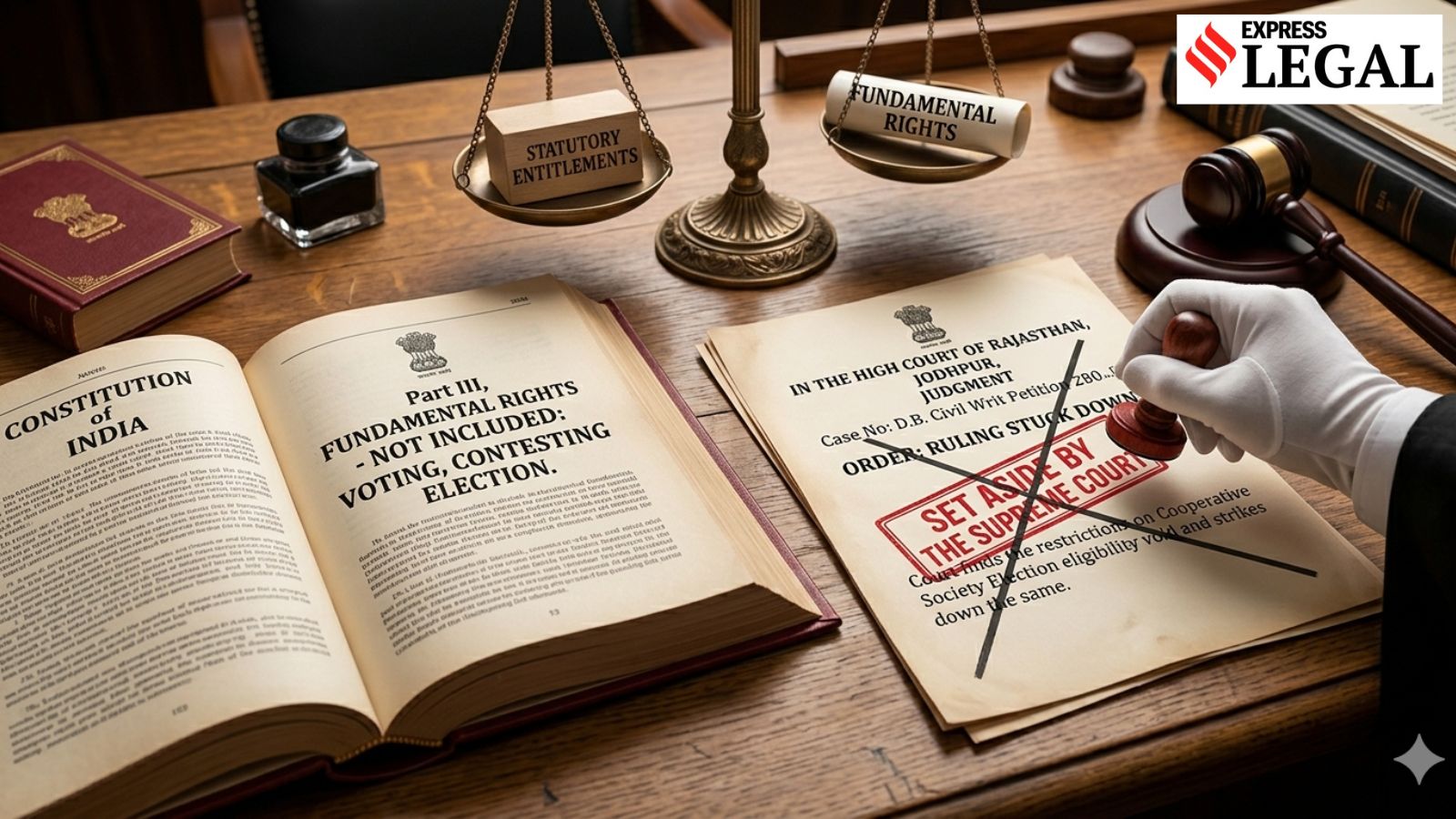

The Supreme Court of India has reaffirmed that the rights to vote and to contest elections are not inherent or fundamental rights, but rather statutory privileges that can be governed by legislation. This ruling overturned a decision made by the Rajasthan High Court, which had invalidated certain eligibility requirements for elections within cooperative societies.
A bench, comprising Justices B V Nagarathna and R Mahadevan, examined an appeal regarding the legality of specific bye-laws established by District Milk Producers’ Cooperative Unions in Rajasthan. These bye-laws set forth criteria such as minimum milk supply and operational continuity for candidates aiming to run for election to the managing committees.
In a judgment delivered on April 10, Justice Mahadevan noted, “The right to vote and the right to contest an election are not fundamental rights but purely statutory rights that can be regulated by law. These rights exist only to the extent that they are conferred by statute.” The court emphasized that the eligibility requirements do not infringe upon constitutionally guaranteed rights.
The Supreme Court evaluated the validity of the Rajasthan High Court’s decision to annul these provisions and the appropriateness of entertaining writ petitions related to the internal governance and electoral procedures of cooperative societies.
Ultimately, the Supreme Court found flaws in the reasoning of the high court, concluding that the contested bye-laws merely established eligibility criteria rather than imposing disqualifications or violating any constitutional protections.
The court clarified that while the right to vote allows a member to exercise their franchise in accordance with statutory provisions, the right to contest an election is a separate right that may be subject to specific qualifications and eligibility standards.
Moreover, the Supreme Court distinguished between eligibility criteria and disqualifications, noting that disqualifications are legal barriers arising from negative factors, whereas eligibility conditions serve as prerequisites to ensure that only active and contributing members are involved in the governance of cooperative organizations.
The bench noted that requirements such as minimum milk supply or operational continuity are reasonable and support the goal of enhancing the cooperative framework through increased accountability and efficiency.
This case originated from disputes over election regulations governing the District Milk Producers’ Cooperative Unions in Rajasthan, which operate within a three-tier dairy cooperative structure established by the Rajasthan Cooperative Societies Act of 2001. Primary village-level societies form the foundation, participating in the governance of district unions through elected representatives.
To manage elections for these unions, specific bye-laws were created, outlining eligibility conditions like minimum milk supply over a designated period, the quantity of supply, the operational status of the society, and audit classification standards.
Several primary cooperative societies contested these conditions before the Rajasthan High Court, claiming that they imposed unreasonable limitations and were beyond the authority of the primary statute.
A Single Judge of the High Court ruled in 2015 in favor of the writ petitions, declaring the bye-laws inconsistent with the Act but allowing previously conducted elections to remain unaffected. This decision was upheld by a division bench in 2022. Following these judgments, the Registrar moved to amend the bye-laws, prompting chairpersons of various district milk unions—who were not parties to the high court proceedings but claimed to be directly impacted—to appeal to the Supreme Court.
The appeal primarily addresses the legality of the contested bye-laws, the validity of the writ petitions, and the overarching issue of regulating eligibility for election contests within cooperative societies.
Reiterating established legal principles, the apex court emphasized that both the right to vote and the right to contest elections arise from statutory provisions rather than being inherent rights. It made a clear distinction, noting that while the right to vote allows for participation in elections, the right to contest is an additional right subject to more stringent regulatory requirements.
Vineet Upadhyay serves as an Assistant Editor at The Indian Express, focusing on in-depth coverage of the Indian judicial system.