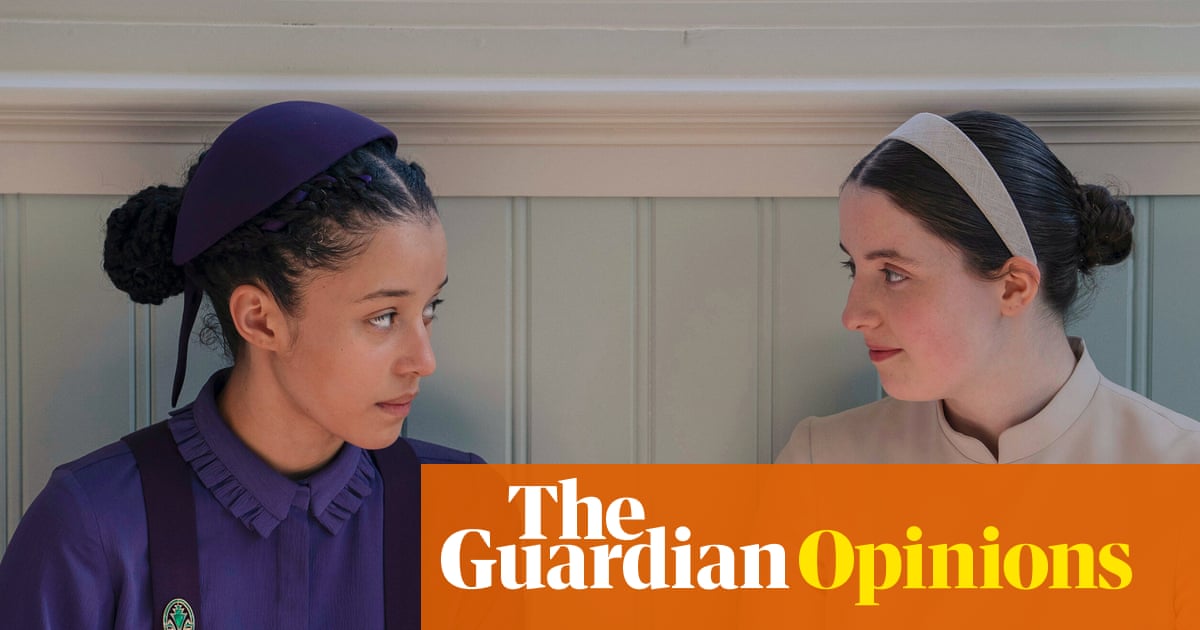

Margaret Atwood once remarked that all dystopian narratives reflect our current realities, a notion that underscores the genre’s growing popularity. Recently, Atwood’s dismal depiction of a future America governed by patriarchal theocracy made its way back to television with the adaptation of her acclaimed 2019 novel, The Testaments, a long-awaited continuation of The Handmaid’s Tale. Additionally, Paul Thomas Anderson’s film, One Battle After Another, showcasing a disturbingly familiar militarized America, garnered significant attention at the Oscars last month.
When Atwood penned The Handmaid’s Tale in 1984, she worried that the story’s core idea—transforming the U.S. from a liberal democracy into Gilead, a theocratic dictatorship following a coup—would be too far-fetched for readers to accept. However, she need not have been concerned. By the time the novel was adapted into a critically acclaimed television series in 2017, the premise felt alarmingly plausible. The series premiered shortly after Donald Trump’s election in 2016 and the subsequent erosion of women’s rights, resonating strongly with contemporary audiences. Atwood was celebrated as a visionary, with the iconic red-and-white robes of the handmaids emerging as a global symbol of female resistance. Reflecting on her decision to write a sequel over three decades later, Atwood remarked, “For a long time we were going away from Gilead and then we turned around and started going back.”
The adaptation of The Testaments continues to resonate with current events. In the narrative, young girls are groomed as “Plums” for influential men, reminiscent of the Epstein scandal. Furthermore, scenes depicting female detention centers painfully echo the real-life separations of mothers and children at the U.S.-Mexico border.
Similarly, One Battle After Another portrays a grim reality filled with migrant prisons and clandestine networks. This film, loosely inspired by Thomas Pynchon’s 1990 countercultural work, Vineland, follows a group of former revolutionaries. Like The Handmaid’s Tale, Vineland arose from concerns about a repressive government (specifically Ronald Reagan’s), and it has now been cleverly adapted to address the creeping authoritarianism of the Trump era. With themes of ICE-like crackdowns and secret Christian nationalist factions, Anderson’s portrayal of America seems less prophetic and more like an exaggerated reflection of contemporary society. Upon receiving his Oscar, the director expressed that he made the film to apologize to his children for the “housekeeping mess we left in this world.”
Interestingly, Chase Infiniti plays the role of the “lost daughter” in both One Battle After Another (as Willa) and The Testaments (as Agnes). These young characters symbolize the enduring hope for the future. Beyond their political themes, the essence of both narratives lies in the profound love between a parent and child. They represent not only resistance against oppressive regimes but also the triumph of humanity over cruelty. These stories highlight the transformative power of storytelling.
Writers and filmmakers are stepping forward to make their voices heard. This is the purpose of dystopian fiction: to reflect our current situation and project where we might be heading. It serves as both a cautionary tale and a call to action—encouraging us to lift our gaze from our screens before it’s too late, echoing the sentiments of June, the protagonist from the television adaptation of The Handmaid’s Tale. By allowing us to confront the darkest possibilities, these narratives compel us to envision brighter outcomes. In this way, they can be seen as hopeful. As George Orwell noted in 1943, “It would seem that human beings are not able to describe, nor perhaps to imagine, happiness except in terms of contrast.” The stories remind us that we must engage in ongoing battles against complacency, prejudice, and self-interest to strive for a better world.
Do you have thoughts on the topics discussed in this article? If you wish to submit a response of up to 300 words for potential publication in our letters section, please reach out via email.